Гилберт Честертон - All Things Considered
Здесь есть возможность читать онлайн «Гилберт Честертон - All Things Considered» весь текст электронной книги совершенно бесплатно (целиком полную версию без сокращений). В некоторых случаях можно слушать аудио, скачать через торрент в формате fb2 и присутствует краткое содержание. Год выпуска: 2014, Издательство: epubBooks Classics, Жанр: Публицистика, Критика, на английском языке. Описание произведения, (предисловие) а так же отзывы посетителей доступны на портале библиотеки ЛибКат.
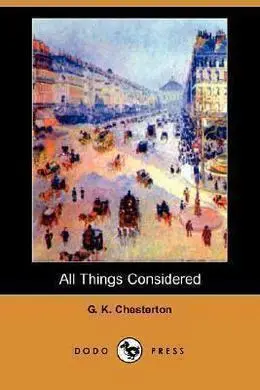
- Название:All Things Considered
- Автор:
- Издательство:epubBooks Classics
- Жанр:
- Год:2014
- ISBN:нет данных
- Рейтинг книги:3 / 5. Голосов: 1
-
Избранное:Добавить в избранное
- Отзывы:
-
Ваша оценка:
All Things Considered: краткое содержание, описание и аннотация
Предлагаем к чтению аннотацию, описание, краткое содержание или предисловие (зависит от того, что написал сам автор книги «All Things Considered»). Если вы не нашли необходимую информацию о книге — напишите в комментариях, мы постараемся отыскать её.
All Things Considered — читать онлайн бесплатно полную книгу (весь текст) целиком
Ниже представлен текст книги, разбитый по страницам. Система сохранения места последней прочитанной страницы, позволяет с удобством читать онлайн бесплатно книгу «All Things Considered», без необходимости каждый раз заново искать на чём Вы остановились. Поставьте закладку, и сможете в любой момент перейти на страницу, на которой закончили чтение.
Интервал:
Закладка:
Touching the morality of the public schools, I will take one point only, which is enough to prove the case. People have got into their heads an extraordinary idea that English public–school boys and English youth generally are taught to tell the truth. They are taught absolutely nothing of the kind. At no English public school is it even suggested, except by accident, that it is a man's duty to tell the truth. What is suggested is something entirely different: that it is a man's duty not to tell lies. So completely does this mistake soak through all civilisation that we hardly ever think even of the difference between the two things. When we say to a child, "You must tell the truth," we do merely mean that he must refrain from verbal inaccuracies. But the thing we never teach at all is the general duty of telling the truth, of giving a complete and fair picture of anything we are talking about, of not misrepresenting, not evading, not suppressing, not using plausible arguments that we know to be unfair, not selecting unscrupulously to prove an ex parte case, not telling all the nice stories about the Scotch, and all the nasty stories about the Irish, not pretending to be disinterested when you are really angry, not pretending to be angry when you are really only avaricious. The one thing that is never taught by any chance in the atmosphere of public schools is exactly that—that there is a whole truth of things, and that in knowing it and speaking it we are happy.
If any one has the smallest doubt of this neglect of truth in public schools he can kill his doubt with one plain question. Can any one on earth believe that if the seeing and telling of the whole truth were really one of the ideals of the English governing class, there could conceivably exist such a thing as the English party system? Why, the English party system is founded upon the principle that telling the whole truth does not matter. It is founded upon the principle that half a truth is better than no politics. Our system deliberately turns a crowd of men who might be impartial into irrational partisans. It teaches some of them to tell lies and all of them to believe lies. It gives every man an arbitrary brief that he has to work up as best he may and defend as best he can. It turns a room full of citizens into a room full of barristers. I know that it has many charms and virtues, fighting and good–fellowship; it has all the charms and virtues of a game. I only say that it would be a stark impossibility in a nation which believed in telling the truth.
Limericks and Counsels of Perfection
It is customary to remark that modern problems cannot easily be attacked because they are so complex. In many cases I believe it is really because they are so simple. Nobody would believe in such simplicity of scoundrelism even if it were pointed out. People would say that the truth was a charge of mere melodramatic villainy; forgetting that nearly all villains really are melodramatic. Thus, for instance, we say that some good measures are frustrated or some bad officials kept in power by the press and confusion of public business; whereas very often the reason is simple healthy human bribery. And thus especially we say that the Yellow Press is exaggerative, over–emotional, illiterate, and anarchical, and a hundred other long words; whereas the only objection to it is that it tells lies. We waste our fine intellects in finding exquisite phraseology to fit a man, when in a well–ordered society we ought to be finding handcuffs to fit him.
This criticism of the modern type of righteous indignation must have come into many people's minds, I think, in reading Dr. Horton's eloquent expressions of disgust at the "corrupt Press," especially in connection with the Limerick craze. Upon the Limerick craze itself, I fear Dr. Horton will not have much effect; such fads perish before one has had time to kill them. But Dr. Horton's protest may really do good if it enables us to come to some clear understanding about what is really wrong with the popular Press, and which means it might be useful and which permissible to use for its reform. We do not want a censorship of the Press; but we are long past talking about that. At present it is not we that silence the Press; it is the Press that silences us. It is not a case of the Commonwealth settling how much the editors shall say; it is a case of the editors settling how much the Commonwealth shall know. If we attack the Press we shall be rebelling, not repressing. But shall we attack it?
Now it is just here that the chief difficulty occurs. It arises from the very rarity and rectitude of those minds which commonly inaugurate such crusades. I have the warmest respect for Dr. Horton's thirst after righteousness; but it has always seemed to me that his righteousness would be more effective without his refinement. The curse of the Nonconformists is their universal refinement. They dimly connect being good with being delicate, and even dapper; with not being grotesque or loud or violent; with not sitting down on one's hat. Now it is always a pleasure to be loud and violent, and sometimes it is a duty. Certainly it has nothing to do with sin; a man can be loudly and violently virtuous—nay, he can be loudly and violently saintly, though that is not the type of saintliness that we recognise in Dr. Horton. And as for sitting on one's hat, if it is done for any sublime object (as, for instance, to amuse the children), it is obviously an act of very beautiful self–sacrifice, the destruction and surrender of the symbol of personal dignity upon the shrine of public festivity. Now it will not do to attack the modern editor merely for being unrefined, like the great mass of mankind. We must be able to say that he is immoral, not that he is undignified or ridiculous. I do not mind the Yellow Press editor sitting on his hat. My only objection to him begins to dawn when he attempts to sit on my hat; or, indeed (as is at present the case), when he proceeds to sit on my head.
But in reading between the lines of Dr. Horton's invective one continually feels that he is not only angry with the popular Press for being unscrupulous: he is partly angry with the popular Press for being popular. He is not only irritated with Limericks for causing a mean money–scramble; he is also partly irritated with Limericks for being Limericks. The enormous size of the levity gets on his nerves, like the glare and blare of Bank Holiday. Now this is a motive which, however human and natural, must be strictly kept out of the way. It takes all sorts to make a world; and it is not in the least necessary that everybody should have that love of subtle and unobtrusive perfections in the matter of manners or literature which does often go with the type of the ethical idealist. It is not in the least desirable that everybody should be earnest. It is highly desirable that everybody should be honest, but that is a thing that can go quite easily with a coarse and cheerful character. But the ineffectualness of most protests against the abuse of the Press has been very largely due to the instinct of democracy (and the instinct of democracy is like the instinct of one woman, wild but quite right) that the people who were trying to purify the Press were also trying to refine it; and to this the democracy very naturally and very justly objected. We are justified in enforcing good morals, for they belong to all mankind; but we are not justified in enforcing good manners, for good manners always mean our own manners. We have no right to purge the popular Press of all that we think vulgar or trivial. Dr. Horton may possibly loathe and detest Limericks just as I loathe and detest riddles; but I have no right to call them flippant and unprofitable; there are wild people in the world who like riddles. I am so afraid of this movement passing off into mere formless rhetoric and platform passion that I will even come close to the earth and lay down specifically some of the things that, in my opinion, could be, and ought to be, done to reform the Press.
Читать дальшеИнтервал:
Закладка:
Похожие книги на «All Things Considered»
Представляем Вашему вниманию похожие книги на «All Things Considered» списком для выбора. Мы отобрали схожую по названию и смыслу литературу в надежде предоставить читателям больше вариантов отыскать новые, интересные, ещё непрочитанные произведения.


Обсуждение, отзывы о книге «All Things Considered» и просто собственные мнения читателей. Оставьте ваши комментарии, напишите, что Вы думаете о произведении, его смысле или главных героях. Укажите что конкретно понравилось, а что нет, и почему Вы так считаете.