Steve LeVine - Putin's Labyrinth
Здесь есть возможность читать онлайн «Steve LeVine - Putin's Labyrinth» весь текст электронной книги совершенно бесплатно (целиком полную версию без сокращений). В некоторых случаях можно слушать аудио, скачать через торрент в формате fb2 и присутствует краткое содержание. Город: New York, Год выпуска: 2008, ISBN: 2008, Издательство: Random House, Жанр: Публицистика, на английском языке. Описание произведения, (предисловие) а так же отзывы посетителей доступны на портале библиотеки ЛибКат.
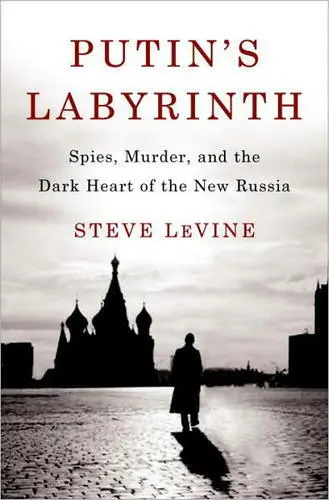
- Название:Putin's Labyrinth
- Автор:
- Издательство:Random House
- Жанр:
- Год:2008
- Город:New York
- ISBN:978-1-58836-815-7
- Рейтинг книги:3 / 5. Голосов: 1
-
Избранное:Добавить в избранное
- Отзывы:
-
Ваша оценка:
Putin's Labyrinth: краткое содержание, описание и аннотация
Предлагаем к чтению аннотацию, описание, краткое содержание или предисловие (зависит от того, что написал сам автор книги «Putin's Labyrinth»). Если вы не нашли необходимую информацию о книге — напишите в комментариях, мы постараемся отыскать её.
Drawing on new interviews with eyewitnesses and the families of victims, LeVine documents the bloodshed that has stained Putin’s two terms as president. Among the incidents chronicled in these pages: The 2002 terrorist takeover of a crowded Moscow theater—which led to the government gassing the building, and the deaths of more than a hundred terrified hostages–seen here from new angles, through the riveting words of those who survived; and the murder of courageous investigative reporter Anna Politkovskaya, shot in the elevator of her apartment building on Putin’s birthday, purportedly as a malicious “gift” for the president from supporters. Finally, a shocking story that made international headlines–the 2006 death of defector Alexander Litvinenko in London—is dramatized as never before. LeVine traces the steps of this KGB-spy-turned-dissident on his way to being poisoned with polonium-210, a radioactive isotope. And in doing so, LeVine is granted a rare series of interviews with a KGB defector who was nearly killed in strangely similar circumstances fifty years earlier. Through LeVine’s exhaustive research, we come to know the victims as real people, not just names in brief news accounts of how they died.
Putin’s Labyrinth
Putin's Labyrinth — читать онлайн бесплатно полную книгу (весь текст) целиком
Ниже представлен текст книги, разбитый по страницам. Система сохранения места последней прочитанной страницы, позволяет с удобством читать онлайн бесплатно книгу «Putin's Labyrinth», без необходимости каждый раз заново искать на чём Вы остановились. Поставьте закладку, и сможете в любой момент перейти на страницу, на которой закончили чтение.
Интервал:
Закладка:
For some, the lesson was clear: Anyone who aimed to rule effectively in a rowdy neighborhood like Russia had to demonstrate muscle. It was a limited vision, to be sure. Where Gorbachev and Yeltsin suggested that the Russian people could be more than they had perhaps imagined, controlling their own lives in a democracy, Putin told the people through his actions that the state had first claim to greatness, ahead of individuals for the most part.
But many Russians were tired of high-minded ideas anyway. They wanted to be paid their long-overdue salaries and pensions, and to have some stability in their lives. Putin by and large delivered both, and began 2008 with enviable popularity, leaving the presidency after two consecutive terms with his 70 percent approval rating intact. His chosen successor, a former law professor named Dmitri Medvedev, campaigned in a rigged election and received 70 percent of the vote. As part of the bargain, he named Putin his prime minister, with the stated intention of maintaining the policies of the previous eight years. It was no surprise: Putin had chosen Medvedev with the presumption that he, Putin, would continue to exercise his power over matters of state, then manipulated the election to make it happen.
Vyacheslav Nikonov, the Kremlin adviser who helped me understand some of Putin’s disillusionment with the West, now explained the plan for the long-term future. Nikonov was a grandson of Vyacheslav Molotov—Stalin’s foreign minister and the namesake of the Molotov cocktail—and a former assistant chief of staff to Gorbachev. He also was a chief adviser to Vladislav Surkov, Putin’s domestic policy chief, and that interested me the most. The forty-three-year-old Surkov was the mastermind behind the making of what I call The Putin—the transformation of the president’s visage into a savior-of-Russia icon, gargantuan and granite-faced, gazing from billboards, television screens, and newspapers throughout Moscow.
Although neither of us used the term during our conversation, Nikonov was a firm believer in The Putin, both the idea and the man, and seemed to expect him to rule for some time to come. He thought he would run again for president. “Putin may be back in 2012 and 2016, then 2024 and 2028,” he said, naming the years of presidential elections, with a single break to satisfy Russia’s term limits.
In other words, Putin’s circle had settled in for a good two-or three-decade run. We journalists often joked about the creative ways that this or that dictator would devise to be president for life. I remember speculating that my five-year-old daughter, who has Kazakh grandparents, would be old enough to succeed the sixty-six-year-old president of Kazakhstan by the time he agreed to step down. Yet, faced with Nikonov’s on-the-record declaration of pretty much the same ambition, I was momentarily speechless. “This is not extremely visionary,” he assured me, “but pragmatic.”
What did this exceedingly articulate Russian, dressed in a blue blazer with gold buttons and Scottish knit tie, mean by “pragmatic”? In Nikonov’s own words, Putin had created a “rich, cynical, professional” group in their late thirties and early forties who “like their jobs. They are hand-managing the government. They’ll be there another thirty years.” Maybe that was pragmatism, Russian style. In any event, Nikonov was serious. And there was no reason to doubt that Putin felt the same way.
Putin has been unfairly criticized for playing a “double game,” the multilevel chess cherished by spies everywhere. In fact, his governing strategy was transparent from the outset. He surrounded himself with people whose discipline and loyalty he trusted—other intelligence agents, military officers, and lawyers and colleagues from his old St. Petersburg days. Writers called it “Russia Inc.” or “Kremlin Inc.” A more apt label might be the “Gazprom State,” since he rode Russia’s oil and natural gas riches to global influence for himself and Russia. As the fall of the Berlin Wall marked the end of the age of the Soviet empire, Putin’s style signaled the emergence of a coolly pragmatic state (as Nikonov would put it) overseen largely by ultra-patriotic spies and former spies.
But critics warned of a downside to Putin’s approach. Boris Volodarsky, a former Russian military intelligence officer, told me of a messianic “KGB mentality” in which “everything is the state…. They will make a decision and carry it out, without limits.” By its very nature, Putin’s corps of intelligence agents will use whatever it deems necessary to achieve its goals, he said. Volodarsky was describing bespredel, anything goes.
In Soviet times, this single-mindedness among spies was suppressed by the Communist Party, according to Oleg Gordievsky, a KGB defector I met in the United Kingdom, where he lived in self-exile. He thought the dangerous thing about Putin was not that he was reverting to Soviet ways, but that he was failing to sufficiently reconstitute control over the spy services. As he put it, “The KGB without the Communist Party is a gang of gangsters.” It was a rich assertion—as if the Communist Party didn’t have its own gangster-like figures. Yet the central point remained valid—that the KGB’s successor, the FSB, now answered to no one.
Coincidentally, my contacts included another man who possessed intimate knowledge of the spy services in Soviet times. And so I headed to California for a visit with Nikolai Khokhlov, a former captain of the KGB, a defector to the West, and an intended victim of murder by radioactive poison. He knew something about bespredel.
CHAPTER 4

Nikolai
The First Victim of Deliberate Nuclear Poisoning
DEATH IS ALWAYS A SAD EVENT, BUT ON THE DAY OF NIKOLAI Khokhlov’s funeral the mourning was tempered by a sense of triumph. In his lifetime, the old Russian spy had not only outlived the KGB agents who relentlessly pursued him, but had reinvented himself in America as a man of accomplishment.
A half century earlier, on a garden terrace in West Germany, a Soviet operative had slipped a nuclear isotope into his coffee. The deadly substance—a derivative of the heavy metal thallium—was intended to kill Nikolai, a KGB officer who had unforgivably gone over to the West. It turned his face into a mask of dark spots and brown stripes that oozed blood and a sticky secretion, and caused his hair to fall out in tufts. Below his neck, his “copper-colored skin was tattooed with blood swellings.” The attending physician said death was certain.
Instead, Nikolai survived. No one knew precisely why, except that perhaps his intended killers failed to dispense a sufficiently strong dose of the poison. Whatever the case, the KGB’s failed attempt on his life only burnished his already considerable celebrity as a Cold War refugee in America. He settled in the small California community of San Bernardino, where he taught college psychology classes for two decades. In retirement, he tended his fruit trees and maintained his scholarly interests.
“He had the last laugh,” observed his widow, Tatjana, as their four grandchildren scampered about and funeral guests mingled in a tree-filled backyard on the day of the September 2007 funeral.
Inside the house, photographs from a lifetime festooned walls, a piano, and a table—images of Nikolai’s daughters, his son, who died from kidney failure, the German-born Tatjana. But there were no images from the long-ago years when he was trained as an assassin for Stalin’s Kremlin, then defected to the West, and finally survived the first-known attempted murder by radioactive poison.
Читать дальшеИнтервал:
Закладка:
Похожие книги на «Putin's Labyrinth»
Представляем Вашему вниманию похожие книги на «Putin's Labyrinth» списком для выбора. Мы отобрали схожую по названию и смыслу литературу в надежде предоставить читателям больше вариантов отыскать новые, интересные, ещё непрочитанные произведения.








Обсуждение, отзывы о книге «Putin's Labyrinth» и просто собственные мнения читателей. Оставьте ваши комментарии, напишите, что Вы думаете о произведении, его смысле или главных героях. Укажите что конкретно понравилось, а что нет, и почему Вы так считаете.