George Friedman - The Next Decade
Здесь есть возможность читать онлайн «George Friedman - The Next Decade» весь текст электронной книги совершенно бесплатно (целиком полную версию без сокращений). В некоторых случаях можно слушать аудио, скачать через торрент в формате fb2 и присутствует краткое содержание. Город: New York, Год выпуска: 2011, ISBN: 2011, Издательство: Doubleday, Жанр: Публицистика, Политика, на английском языке. Описание произведения, (предисловие) а так же отзывы посетителей доступны на портале библиотеки ЛибКат.

- Название:The Next Decade
- Автор:
- Издательство:Doubleday
- Жанр:
- Год:2011
- Город:New York
- ISBN:978-0-385-53295-2
- Рейтинг книги:5 / 5. Голосов: 1
-
Избранное:Добавить в избранное
- Отзывы:
-
Ваша оценка:
The Next Decade: краткое содержание, описание и аннотация
Предлагаем к чтению аннотацию, описание, краткое содержание или предисловие (зависит от того, что написал сам автор книги «The Next Decade»). Если вы не нашли необходимую информацию о книге — напишите в комментариях, мы постараемся отыскать её.
bestseller
now focuses his geopolitical forecasting acumen on the next decade and the imminent events and challenges that will test America and the world, specifically addressing the skills that will be required by the decade’s leaders. The next ten years will be a time of massive transition. The wars in the Islamic world will be subsiding, and terrorism will become something we learn to live with. China will be encountering its crisis. We will be moving from a time when financial crises dominate the world to a time when labor shortages will begin to dominate. The new century will be taking shape in the next decade.
In
, George Friedman offers readers a provocative and endlessly fascinating prognosis for the immediate future. Using Machiavelli’s
as a model, Friedman focuses on the world’s leaders—particularly the American president—and with his trusted geopolitical insight analyzes the complex chess game they will all have to play. The book also asks how to be a good president in a decade of extraordinary challenge, and puts the world’s leaders under a microscope to explain how they will arrive at the decisions they will make—and the consequences these actions will have for us all.
The Next Decade — читать онлайн бесплатно полную книгу (весь текст) целиком
Ниже представлен текст книги, разбитый по страницам. Система сохранения места последней прочитанной страницы, позволяет с удобством читать онлайн бесплатно книгу «The Next Decade», без необходимости каждый раз заново искать на чём Вы остановились. Поставьте закладку, и сможете в любой момент перейти на страницу, на которой закончили чтение.
Интервал:
Закладка:
Nonetheless, the peace of the western Pacific will not hold together indefinitely, and the United States should work to cement strong relations with three key players: Korea, Australia, and Singapore.
These three countries would prove essential allies in the event of war with any western Pacific country, particularly Japan, and preparations cannot begin too soon. Building the Korean navy, creating facilities in Australia, and modernizing Singapore’s forces will not arouse great anxiety. These are steps that, taken in this decade, will create the framework for managing any conflict that might arise.
Chapter 11
A SECURE HEMISPHERE
Given that the United States shares a hemisphere and quite a bit of history with Latin America and Canada, some might assume that this region has a singular importance for the U.S. Indeed, many Latin Americans in particular see the United States as obsessed with dominating them, or at least obtaining their resources. But with few exceptions—primarily in the case of Mexico and Cuba—what happens in Latin America is of marginal importance to the United States, and the region has rarely held a significant place in American thinking. Part of this has to do with distance. Washington is about a thousand miles farther from Rio de Janeiro than it is from Paris. And unlike European and Asian powers, the United States has never had an extensive war with the Latin world south of Panama. This isn’t to say that there isn’t mutual distrust and occasional hostility. But in the end—and again excepting Mexico and Cuba—the fundamental interests of the United States simply don’t intersect with those of Latin America.
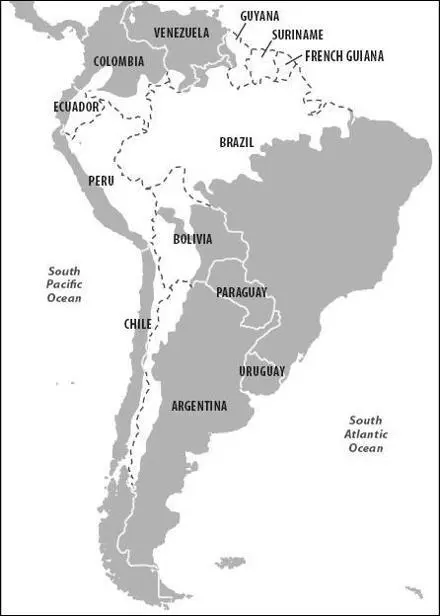
The United States has had limited concern with the region in part because of the fragmentation there, which has prevented the rise of a transcontinental power. South America looks like a single geographical entity, but in fact the continent is divided by significant topographic barriers. First, running north and south are the Andes, a chain of mountains much taller than the Rockies or the Alps and with few readily traversable passes. Then, in the center of the continent, the vast Amazonian jungle presents an equally impenetrable barrier.
There are actually three distinct regions in South America, each cut off from the others to the extent that basic overland commerce is difficult and political unity impossible. Brazil is an arc along the Atlantic Coast, with the inhospitable Amazon as its interior. A separate region lies to the south of Brazil along the Atlantic, and it consists of Argentina, Uruguay, and Paraguay, the latter not on the coast but part of this bloc of nations. To the west are the Andean nations of Chile, Bolivia, Peru, Ecuador, Colombia, and Venezuela. Off the mainland and not completely Latin are, of course, the Caribbean islands, important as platforms but without weight themselves.
The only connection between Brazil and the southern nations is a fairly narrow land bridge through Uruguay. The Andean nations are united only in the sense that they all share impenetrable geographies. The southern region along the Atlantic could become integrated, but there is really only one significant country there, Argentina. In addition, there is no passable land bridge between North and South America because of Central America’s jungle terrain, and even if there were a bridge, only Colombia and perhaps Venezuela could take advantage of it.
The key to American policy in Latin America has always been that for the United States to become concerned, two elements would have to converge: a strategically significant area (of which there are few in the region) would have to be in the hands of a power able to use it to pose a threat. The Monroe Doctrine was proclaimed in order to make it clear that just such an eventuality was the single unacceptable geopolitical development as far as the United States was concerned.
During World War II, the presence of German agents and sympathizers in South America became a serious issue among strategists in Washington, who envisioned German troops arriving in Brazil from Dakar, across the Atlantic. Similarly, during the Cold War, the United States became genuinely concerned about Soviet influence in the region and intervened on occasion to block it. But neither the Germans nor the Soviets made a serious strategic effort to dominate South America, because they understood that in most senses the continent was irrelevant to U.S. interests. Instead, their efforts were designed merely to irritate Washington and divert American resources.
The one place where outside involvement has been seen as a threat to be taken seriously is Cuba, and its singular importance is based on its singularly strategic location.
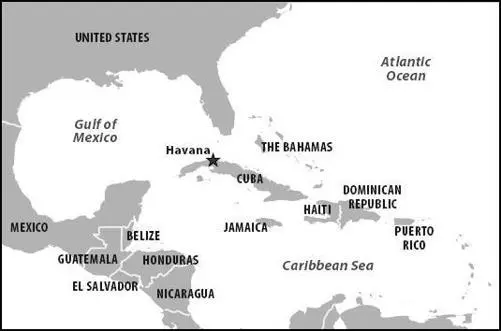
Early in the nineteenth century, American prosperity was founded on the river system that enabled farmers in the Louisiana and Ohio territories to ship their agricultural output to the East Coast and Europe. All of these goods first flowed to the city of New Orleans and were then transferred from barges to oceangoing vessels. The United States fought to keep New Orleans safe, first at the Battle of New Orleans in 1814, and then during the Texan war of independence. New Orleans and nearby ports remain the largest by tonnage in the United States, enabling midwestern grain to be shipped out and steel and other industrial goods to be shipped in.
Because a naval force in Cuba could control the sea-lanes in and out of the Gulf of Mexico and thereby could control New Orleans, the United States has always been obsessed with the island. Andrew Jackson contemplated invading it, and in 1898 the United States intervened to drive out the Spaniards. A half century later, when a pro-Soviet government emerged there under Fidel Castro, Cuba became a centerpiece of U.S. strategy. An anti-American Cuba without the Soviets was a trivial matter. An anti-American Cuba with Soviet missiles was a mortal threat.
As we look toward the decade ahead, Cuba has no great power patron, so the president can craft his Cuban policy in response to American political opinion. But he must bear in mind that if the United States faces a global competitor, Cuba will be the geographic point at which that competitor can put the greatest pressure on the United States. This makes Cuba the prize it will aim for.
In the long run, bringing Cuba back under American influence is a rational, preemptive policy, and it is highly desirable to do so before a global competitor emerges to raise the stakes and the price. Fidel and Raúl Castro will die or retire during the decade we’re considering, and the political and intelligence elites who control the island are both younger and more cynical than the founding generation of the Castro regime. Rather than gambling on whether they can survive the deaths of the founders, they will be open to accommodation, amenable to deals that allow them to retain their position while granting America increasing power over their foreign policy. The transition will be the moment for the United States to try to deal. Before the Castros leave power they might be open to a deal that preserves their legacy while conceding to American influence. If that fails, the insecurity of the transition might be the moment to approach their heirs. The American interest is simple and has nothing to do with human rights or regime change. It is to have guarantees that regardless of future challenges, Cuba will not become a base for foreign powers. Having achieved that, the United States will have achieved much.
Читать дальшеИнтервал:
Закладка:
Похожие книги на «The Next Decade»
Представляем Вашему вниманию похожие книги на «The Next Decade» списком для выбора. Мы отобрали схожую по названию и смыслу литературу в надежде предоставить читателям больше вариантов отыскать новые, интересные, ещё непрочитанные произведения.









Обсуждение, отзывы о книге «The Next Decade» и просто собственные мнения читателей. Оставьте ваши комментарии, напишите, что Вы думаете о произведении, его смысле или главных героях. Укажите что конкретно понравилось, а что нет, и почему Вы так считаете.