Eduardo Galeano - Soccer in Sun and Shadow
Здесь есть возможность читать онлайн «Eduardo Galeano - Soccer in Sun and Shadow» весь текст электронной книги совершенно бесплатно (целиком полную версию без сокращений). В некоторых случаях можно слушать аудио, скачать через торрент в формате fb2 и присутствует краткое содержание. Год выпуска: 2013, ISBN: 2013, Издательство: Byliner Inc., Жанр: Публицистика, на английском языке. Описание произведения, (предисловие) а так же отзывы посетителей доступны на портале библиотеки ЛибКат.
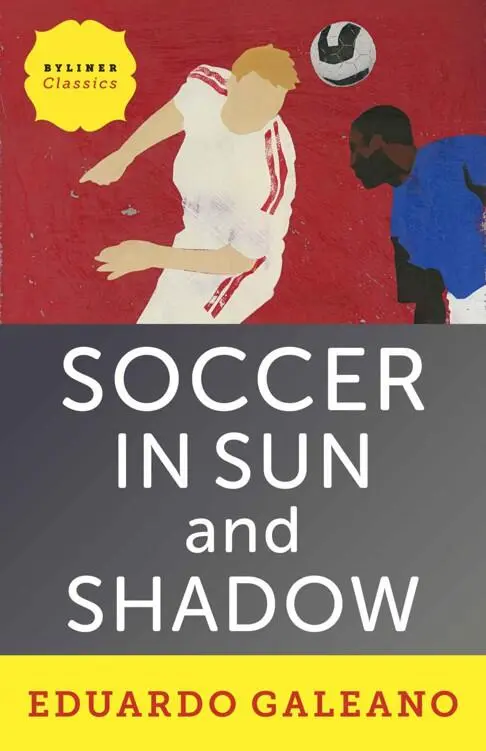
- Название:Soccer in Sun and Shadow
- Автор:
- Издательство:Byliner Inc.
- Жанр:
- Год:2013
- ISBN:9781614520771
- Рейтинг книги:4 / 5. Голосов: 1
-
Избранное:Добавить в избранное
- Отзывы:
-
Ваша оценка:
Soccer in Sun and Shadow: краткое содержание, описание и аннотация
Предлагаем к чтению аннотацию, описание, краткое содержание или предисловие (зависит от того, что написал сам автор книги «Soccer in Sun and Shadow»). Если вы не нашли необходимую информацию о книге — напишите в комментариях, мы постараемся отыскать её.
Soccer in Sun and Shadow — читать онлайн бесплатно полную книгу (весь текст) целиком
Ниже представлен текст книги, разбитый по страницам. Система сохранения места последней прочитанной страницы, позволяет с удобством читать онлайн бесплатно книгу «Soccer in Sun and Shadow», без необходимости каждый раз заново искать на чём Вы остановились. Поставьте закладку, и сможете в любой момент перейти на страницу, на которой закончили чтение.
Интервал:
Закладка:
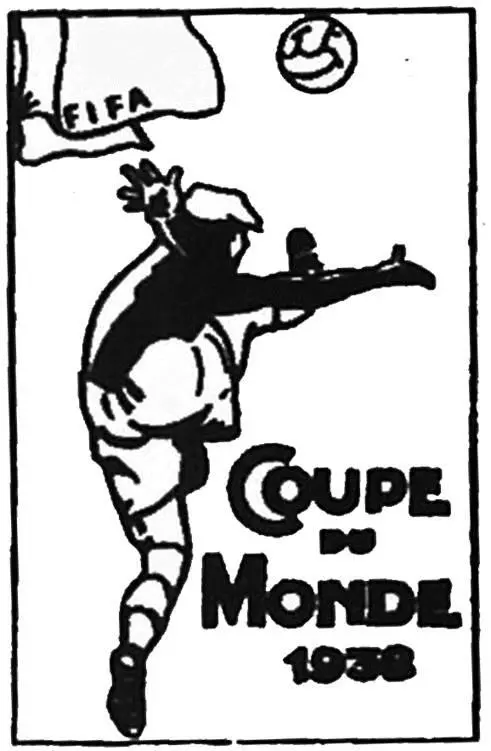
As with the previous Cup, this was a European championship. Only two South American countries joined eleven from Europe. A team from Indonesia, still called the Dutch East Indies, came to Paris as the sole representative of the rest of the planet.
Germany’s side incorporated five players from recently annexed Austria. Thus reinforced, with swastikas on their chests and all the Nazi symbols of power at hand, the German squad came on strong, claiming invincibility, only to trip and fall to modest Switzerland. The German defeat occurred a few days before Aryan supremacy suffered another rude blow in New York, when black boxer Joe Louis pulverized German champion Max Schmeling.
Italy, on the other hand, pulled off a repeat of the previous World Cup contest. In the semifinal, the Azzurri defeated Brazil. One penalty was questionable, but Brazil protested in vain. As in ’34, all the referees were European.
Then came the final: Italy against Hungary. For Mussolini, winning was a matter of state. On the eve of the match, the Italian players received a three-word telegram from Rome, signed by the Fascist leader: “Win or die.” They did not have to die, because Italy won 4–2. The following day the victors wore military uniforms to the closing ceremony, presided over by Il Duce.
The daily La Gazzetta dello Sport exalted “the apotheosis of Fascist sports symbolized by this victory of the race.” Not long before, the official press had celebrated Italy’s defeat of Brazil with these words: “We salute the triumph of Italic intelligence over the brute force of the Negroes.”
But it was the international press that chose the best players of the tournament, among them two black men, Brazilians Leônidas and Domingos da Guia. With seven goals Leônidas was the leading scorer, followed by the Hungarian Zsengellér with six. The most beautiful goal scored by Leônidas came against Poland. Playing in a torrential storm, he lost his shoe in the mud of the penalty area and made the goal barefoot.
Goal by Meazza
It was at the 1938 World Cup. In the semifinal, Italy and Brazil were risking their necks for all or nothing.
Italian striker Piola suddenly collapsed as if he’d been shot, and with the last flutter of life in his finger he pointed at Brazilian defender Domingos da Guia. The referee believed him and blew his whistle: penalty. While the Brazilians screamed to high heaven and Piola got up and dusted himself off, Giuseppe Meazza placed the ball on the firing point.
Meazza was the dandy of the picture. A short, handsome Latin lover and an elegant artilleryman of penalties, he lifted his chin to the goalkeeper like a matador before the final charge. His feet, as soft and knowing as hands, never missed. But Walter, the Brazilian keeper, was good at blocking penalty kicks and felt confident.
Meazza began his run-up and, just when he was about to execute the kick, he dropped his shorts. The crowd was stupefied and the referee nearly swallowed his whistle. But Meazza, never pausing, grabbed his pants with one hand and sent the goalkeeper, disarmed by laughter, down to defeat.
That was the goal that put Italy in the final.
Leônidas
He had the dimensions, speed, and cunning of a mosquito. At the ’38 World Cup a journalist from Paris Match counted six legs on him and suggested black magic was responsible. I don’t know if the journalist noticed, but Leônidas’s many legs had the diabolical ability to grow several yards and fold over or tie themselves in knots.
Leônidas da Silva stepped onto the field the day Brazilian great Arthur Friedenreich, already in his forties, retired. Leônidas received the scepter from the old master. It wasn’t long before they named a brand of cigarettes and a candy bar after him. He got more fan letters than a movie star; the letters asked him for a picture, an autograph, or a government job.
Leônidas scored many goals, but never counted them. A few were made from the air, his feet twirling, upside down, back to the goal. He was skilled in the acrobatics of the chilena , which Brazilians call the “bicycle.”
Leônidas’s goals were so pretty that even the goalkeeper would get up and congratulate him.
Domingos
To the east, the Great Wall of China. To the west, Domingos da Guia.
In the entire history of soccer no fullback was more solid. Domingos was champion in four cities — Rio de Janeiro, São Paulo, Montevideo, and Buenos Aires — and he was adored by all four. When he played, the stadiums were always jam-packed.
Fullbacks used to stick like stamps to the attacking strikers and peel off the ball as quickly as possible, wafting it to high heaven before it burned their feet. Domingos, in contrast, let his adversaries stampede vainly by while he stole the ball; then he would take all the time in the world to bring it out of the box. A man of imperturbable style, he was always whistling and looking the other way. He scorned speed. Master of suspense, lover of leisure, he would play in slow motion: the art of bringing the ball out slowly, calmly, was baptized domingada . When he finally let the ball go, he did so without ever running and without wanting to, because it saddened him to be left without her.
Domingos and She
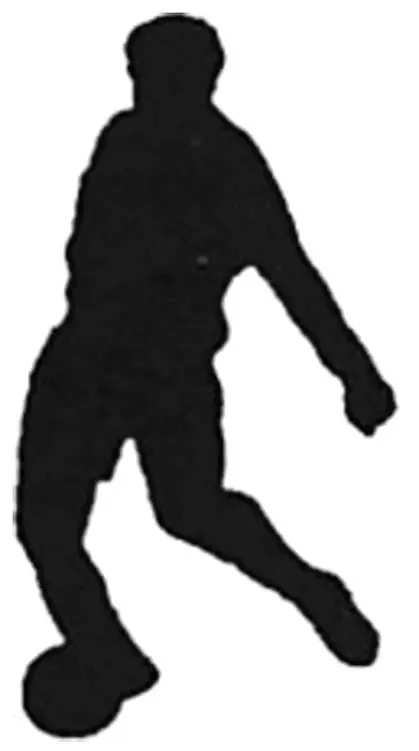
This here ball helped me a lot. She or her sisters, right? It’s a family to whom I owe a debt of gratitude. In my time on earth, she was the key. Because without her nobody plays at all. I started out in Bangu club’s factory. Working, working, until I met my friend here. And I was very happy with her.
I’ve seen the world, traveled a lot, had many women. Women are a pleasure too, right?
From an interview by Roberto Moura
Goal by Atilio
It was 1939. Nacional from Montevideo and Boca Juniors from Buenos Aires were tied at two goals apiece and time was running out. Nacional was on the attack; Boca, in retreat, was holding them off. Then Atilio García got the ball, faced the jungle of legs, and opened up a path on the right, gobbling up the field, adversary by adversary.
Atilio was used to getting kicked. They would go after him with everything they had; his legs were a map of scars. That afternoon on the way to the goal, he was tackled hard by Angeletti and Suárez and had the pleasure of eluding them both twice. Valussi tore his shirt, grabbed him by the arm, and kicked him, and hefty Ibáñez blocked his path when he was running full tilt. But Atilio was unstoppable. The ball was part of his body and his body was a tornado, knocking over players as if they were rag dolls, until at last Atilio let the ball go with a terrifying smash that nearly burst the net.
The air smelled of gunpowder. Boca players surrounded the referee, demanding he disallow the goal because of the fouls they had committed. He paid them no heed, and the players left the field, indignant.
The Perfect Kiss Would Like to Be Unique
Quite a few Argentines swear, hand over heart, that Enrique García was the one. Known as “Bandyleg,” García played left wing for the club Racing. Just as many Uruguayans swear, fingers crossed on their lips, that it was Pedro Lago, “Muleteer,” a striker for Peñarol. It was one or the other, or perhaps both.
Читать дальшеИнтервал:
Закладка:
Похожие книги на «Soccer in Sun and Shadow»
Представляем Вашему вниманию похожие книги на «Soccer in Sun and Shadow» списком для выбора. Мы отобрали схожую по названию и смыслу литературу в надежде предоставить читателям больше вариантов отыскать новые, интересные, ещё непрочитанные произведения.



Обсуждение, отзывы о книге «Soccer in Sun and Shadow» и просто собственные мнения читателей. Оставьте ваши комментарии, напишите, что Вы думаете о произведении, его смысле или главных героях. Укажите что конкретно понравилось, а что нет, и почему Вы так считаете.