Eduardo Galeano - Soccer in Sun and Shadow
Здесь есть возможность читать онлайн «Eduardo Galeano - Soccer in Sun and Shadow» весь текст электронной книги совершенно бесплатно (целиком полную версию без сокращений). В некоторых случаях можно слушать аудио, скачать через торрент в формате fb2 и присутствует краткое содержание. Год выпуска: 2013, ISBN: 2013, Издательство: Byliner Inc., Жанр: Публицистика, на английском языке. Описание произведения, (предисловие) а так же отзывы посетителей доступны на портале библиотеки ЛибКат.
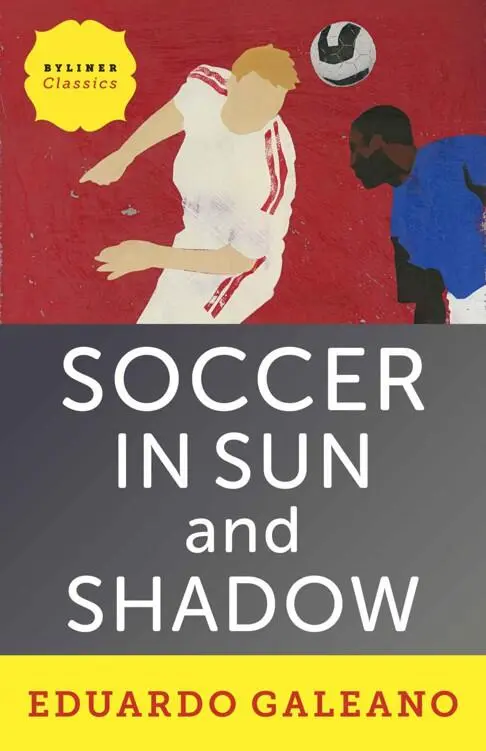
- Название:Soccer in Sun and Shadow
- Автор:
- Издательство:Byliner Inc.
- Жанр:
- Год:2013
- ISBN:9781614520771
- Рейтинг книги:4 / 5. Голосов: 1
-
Избранное:Добавить в избранное
- Отзывы:
-
Ваша оценка:
Soccer in Sun and Shadow: краткое содержание, описание и аннотация
Предлагаем к чтению аннотацию, описание, краткое содержание или предисловие (зависит от того, что написал сам автор книги «Soccer in Sun and Shadow»). Если вы не нашли необходимую информацию о книге — напишите в комментариях, мы постараемся отыскать её.
Soccer in Sun and Shadow — читать онлайн бесплатно полную книгу (весь текст) целиком
Ниже представлен текст книги, разбитый по страницам. Система сохранения места последней прочитанной страницы, позволяет с удобством читать онлайн бесплатно книгу «Soccer in Sun and Shadow», без необходимости каждый раз заново искать на чём Вы остановились. Поставьте закладку, и сможете в любой момент перейти на страницу, на которой закончили чтение.
Интервал:
Закладка:
Half a century ago, or a little more, Lago or García scored a perfect goal, one that left his adversaries paralyzed with rage and admiration. Then he plucked the ball from the back of the net and with it under his arm he retraced his path, step by step, dragging his feet. That’s right, raising lots of dust to erase his footsteps, so that no one could copy the play.
The Machine

In the early 1940s, the Argentine club River Plate had one of the best soccer teams of all time.
“Some go in, others come out, everyone moves up, everyone falls back,” explained Carlos Peucelle, one of the parents of this brood. The players traded places in a permanent rotation, defenders attacked, attackers defended: “On the blackboard and on the field,” Peucelle liked to say, “our tactical plan is not the traditional 1–2–3–5. It’s 1–10.”
Even though everyone did everything on that River team, the forward line was the best. Muñoz, Moreno, Pedernera, Labruna, and Loustau played only eighteen matches together, but they made history and they still make for conversation. These five played by ear, whistling to each other to make their way upfield and to call to the ball, which followed like a happy dog and never lost its way.
People called that legendary team “The Machine” because of its precision plays. Dubious praise: these strikers had so much fun playing they’d forget to shoot at the goal. They had nothing in common with the mechanical coldness of a machine. Fans were fairer when they called them the “Knights of Anguish,” because those bastards made their devotees sweat bullets before allowing them the relief of a goal.
Moreno

They called him “El Charro” because he looked like a Mexican movie star, but he was from the countryside upriver of Buenos Aires.
José Manuel Moreno, the most popular player on River’s “Machine,” loved to confound his opponents. His pirate legs would strike out one way but go another, his bandit head would promise a shot at one goalpost and drive it at the other.
Whenever an opponent flattened him with a kick, Moreno would get up by himself and without complaint, and no matter how badly he was hurt he would keep on playing. He was proud, a swaggerer and a scrapper who could punch out the entire enemy stands and his own as well, since his fans, though they adored him, had the nasty habit of insulting him every time River lost.
Lover of good music and good friends, man of the Buenos Aires night, Moreno used to meet the dawn tangled in someone’s tresses or propped up on his elbows on the counter of some café.
“The tango,” he liked to say, “is the best way to train: you maintain a rhythm, then change it when you stride forward, you learn the patterns, you work on your waist and your legs.”
On Sundays at midday before each match, he would devour a big bowl of chicken stew and drain several bottles of red wine. Those in charge at River ordered him to give up his rowdy ways, unbecoming of a professional athlete. He did his best. For an entire week he slept at night and drank nothing but milk. Then he played the worst match of his life. When he went back to carousing, the club suspended him. His teammates went on strike in solidarity with this incorrigible Bohemian, and River had to play nine matches with replacements.
Let’s hear it for partying: Moreno had one of the longest careers in the history of soccer. He played for twenty years in first-division clubs in Argentina, Mexico, Chile, Uruguay, and Colombia. When he returned from Mexico in 1946, River’s fans were so anxious to see his daring thrusts and feints that they overflowed the stadium. His devotees knocked down the fences and invaded the playing field. He scored three goals and they carried him off on their shoulders. In 1952 Nacional in Montevideo made him a juicy offer, but he chose instead to play for another Uruguayan side, Defensor, a small club that could pay him little or nothing, because he had friends there. That year, Moreno stopped Defensor’s decline.
In 1961 after retiring, he became coach of Medellín in Colombia. Medellín was losing a match against Boca Juniors from Argentina, and the players could not make any headway toward the goal. So Moreno, who was then forty-five, got out of his street clothes, took the field, and scored two goals. Medellín won.
Pedernera
“The penalty kick I blocked is going down in the history of Leticia,” a young Argentine wrote in a letter from Colombia. His name was Ernesto Guevara and he was not yet “Che.” In 1952 he was bumming around Latin America. On the banks of the Amazon, in Leticia, he coached a soccer team. Guevara called his traveling buddy “Pedernerita.” He had no better way of praising him.
Adolfo Pedernera had been the fulcrum of River’s “Machine.” This one-man orchestra played every position, from one end of the forward line to the other. From the back he would create plays, thread the ball through the eye of a needle, change the pace, launch surprise breakaways; up front he would blow goalkeepers away.
The urge to play tickled him all over. He never wanted matches to end. When night fell, stadium employees would try in vain to get him to stop practicing. They wanted to pull him away from soccer but they couldn’t: the game refused to him let go.

Goal by Severino

It was 1943. Boca Juniors was playing against River Plate’s “Machine” in Argentina’s soccer classic.
Boca was down by a goal when the referee whistled a foul at the edge of the River area. Sosa took the free kick. Rather than shoot on goal, he served up a center pass looking for Severino Varela’s head. The ball came down way ahead of Varela. River’s rear guard had an easy play, Severino was nowhere near it. But the veteran striker took off and flew through the air, clawing past several defenders until he connected with a devastating beret-blow that vanquished the goalkeeper.
His fans called him the “phantom beret” because he would fly uninvited into the goalmouth. Severino had quite a few years of experience and plenty of recognition with the Uruguayan club Peñarol by the time he went to Buenos Aires wearing the undefeated look of a mischievous child and a white beret perched on his skull.
With Boca he sparkled. Still, every Sunday at nightfall after the match, Severino would take the boat back to Montevideo, to his neighborhood, his friends, and his job at the factory.
Bombs
While war tormented the world, Rio de Janeiro’s dailies announced a London blitz on the playing field of the club Bangu. In the middle of 1943, a match was to be played against São Cristovão, and Bangu’s fans planned to send four thousand fireworks aloft, the largest bombardment in the history of soccer.
When the Bangu players took the field and the gunpowder thunder and lightning began, São Cristovão’s manager locked his players in the dressing room and stuck cotton in their ears. As long as the fireworks lasted, and they lasted a long time, the dressing room floor shook, the walls shook, and the players shook too, all of them huddled with their heads in their hands, teeth clenched, eyes screwed shut, convinced that the World War had come home. Those who weren’t epileptic must have had malaria, the way they were shaking when they stepped onto the field. The sky was black with smoke. Bangu creamed them.
Читать дальшеИнтервал:
Закладка:
Похожие книги на «Soccer in Sun and Shadow»
Представляем Вашему вниманию похожие книги на «Soccer in Sun and Shadow» списком для выбора. Мы отобрали схожую по названию и смыслу литературу в надежде предоставить читателям больше вариантов отыскать новые, интересные, ещё непрочитанные произведения.



Обсуждение, отзывы о книге «Soccer in Sun and Shadow» и просто собственные мнения читателей. Оставьте ваши комментарии, напишите, что Вы думаете о произведении, его смысле или главных героях. Укажите что конкретно понравилось, а что нет, и почему Вы так считаете.