Robert Leckie - Strong Men Armed
Здесь есть возможность читать онлайн «Robert Leckie - Strong Men Armed» весь текст электронной книги совершенно бесплатно (целиком полную версию без сокращений). В некоторых случаях можно слушать аудио, скачать через торрент в формате fb2 и присутствует краткое содержание. Город: Cambridge, Год выпуска: 2010, ISBN: 2010, Издательство: Da Capo Press, Жанр: nonf_military, на английском языке. Описание произведения, (предисловие) а так же отзывы посетителей доступны на портале библиотеки ЛибКат.
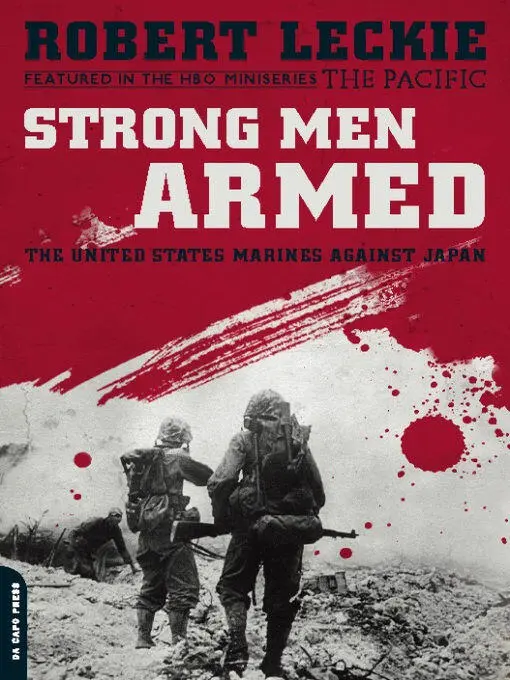
- Название:Strong Men Armed
- Автор:
- Издательство:Da Capo Press
- Жанр:
- Год:2010
- Город:Cambridge
- ISBN:978-0-786-74832-7
- Рейтинг книги:3 / 5. Голосов: 1
-
Избранное:Добавить в избранное
- Отзывы:
-
Ваша оценка:
Strong Men Armed: краткое содержание, описание и аннотация
Предлагаем к чтению аннотацию, описание, краткое содержание или предисловие (зависит от того, что написал сам автор книги «Strong Men Armed»). Если вы не нашли необходимую информацию о книге — напишите в комментариях, мы постараемся отыскать её.
Strong Men Armed — читать онлайн бесплатно полную книгу (весь текст) целиком
Ниже представлен текст книги, разбитый по страницам. Система сохранения места последней прочитанной страницы, позволяет с удобством читать онлайн бесплатно книгу «Strong Men Armed», без необходимости каждый раз заново искать на чём Вы остановились. Поставьте закладку, и сможете в любой момент перейти на страницу, на которой закончили чтение.
Интервал:
Закладка:
Captain Torgerson took command of the retreating Paramarines. He rushed among the knots of men drifting back along the ridge spine. He held roll call. He singled the men out by name, he taunted them to go forward—and they did. They drove out through a rain of Japanese hand grenades, throwing themselves on the bare slopes to fire, to set up machine guns. The Japanese singled out the Marine machine guns, dropping grenades on them from the little launchers or “knee mortars” they carried forward strapped to their legs. Sergeant Keith Perkins scurried over the ridge, hunting grenades and ammunition for his two machine guns. One by one, his gunners fell or were wounded. Perkins jumped on his last gun. He fired. He was killed.
The Paramarines were hanging on to what remained of the left flank as Red Mike Edson came forward on the ridge and tried to make telephone contact with Captain Sweeney’s Company B alone on the right. A voice came through.
“Our situation here, Colonel Edson, is excellent. Thank you, sir.”
Edson swore softly. It was a Japanese. They had cut his wire. How to reach Sweeney? Edson seized a brass-lunged corporal and spoke rapidly. The corporal darted forward on the ridge. He cupped his hands to his mouth and bellowed:
“Red Mike says it’s okay to pull back!”
Sweeney heard and gathered the remnant of his company. Slowly, taking a raking fire, grenades, they fought back to the ridge.
On top of the ridge Edson and Major Bailey were rallying their men with insults and taunts, trying to drive them forward with those irrational shouts which often halt those rational drifts to the rear. Edson was now within 10 yards of his foremost machine gun. He lay on his belly with his arm curled around his hand telephone, sometimes lifted and slammed to earth by the force of enemy mortar blasts. He saw a knot of men milling around aimlessly. He rose and rushed at them, screaming as he pointed toward the Japanese: “The only thing they have that you don’t is guts!” He led them to new positions, for he was shortening his lines, while Bailey ran among other reluctant Raiders, seizing them individually by the arm. “You,” he snarled, “do you wanna live forever?” It had been said by Dan Daly in Belleau Wood and had been mocked by a generation, but now it was being flung in American teeth once more and it could still sting.
They went forward again, to dig in, to hurl the grenades rushed to them by Bailey, to draw a shallow horseshoe on the center of the ridge and await the full fury of the Kawaguchi Brigade now massing for the final rush.
Red Mike Edson had called for artillery; with him to spot the enemy was a private named Watson. He would be Second Lieutenant Watson in the morning in reward for that hell he called down from the heavens. The shells came whistling in from the Eleventh Marines’ 105-millimeter pack howitzers a half-mile back. They fell in a curtain of steel not 200 yards from that desperate last horseshoe of defense. They shook the Marine defenders, squeezed their breath away, but they made a flashing white slaughter among the Kawaguchis.
When the Japanese commanders fired rocket signals for attack, Watson marked them and directed redoubled shelling on the enemy breaking for the ridge. They were blown apart. The night was made hideous with their screams, and those who passed that dreadful line were either cut down by Marine fire or beaten to the earth by clubbed rifles and bayonets.
It was now half-past eleven and Red Mike Edson had contacted his general and told him he would hold.
Just before midnight Admiral Mikawa’s warships reached Guadalcanal. They heard firing to the south of the airfield. They began cruising about, awaiting General Kawaguchi’s flare signaling recapture of the airfield. Then they heard firing to the east.
The Ishitari Battalion had attacked the Tenaru. They struck through a field of kunai grass against the weapons and barbed wire of the Third Battalion, First Marines. They were caught halfway across by the massed firing of Marine 75-millimeter howitzers. The Ishitaris were broken. They reformed and came again. The guns roared. Marine tanks joined the riflemen. The Ishitaris were driven off.
Admiral Mikawa was bewildered. The firing to the east had subsided. There was only a fitful crackling of gunfire in the southern hills. There was still no flare, and it was getting dangerously close to the dawn that would make him visible to American bombers. Admiral Mikawa gave up and sailed home.
It was daybreak on the ridge. A rosy sun was rising almost directly to the left of the Marine front, lighting the battle that was now over. There was only an occasional shot, the boom of a grenade on a boobytrapped body. Six hundred Japanese lay sprawled on the ridge slopes or were faintly visible in the ravines below. Souvenir-hunters were already moving warily among the bodies. Major Bailey was receiving treatment for another wound. Red Mike Edson’s men were being relieved by the Second Battalion, Fifth. Slow-flying Army Airacobras rose from the airfield to harry the retreating enemy. Mopping-up began in the jungle and far to the Marines’ rear among those Japanese who had infiltrated. Four of these infiltrators rushed into General Vandegrift’s headquarters with a cry of “Banzai!” They were shot down, but only after a Marine sergeant had died of a sword thrust.
There was also a brief flare-up to the west, where a Japanese daylight attack across the Matanikau River was hurled back.
By daybreak the main battle, that which the Marines were already calling Bloody Ridge, was over. There were 40 dead Marines and 104 wounded, against a Japanese toll which would rise far above the 600 dead at Bloody Ridge, the 250 who fell at the Tenaru, the 100-odd destroyed at the Matanikau. For General Kawaguchi had already begun a cruel march south through the jungle, a terrible red-trailed retreat of which one of his officers wrote:
“I cannot help from crying when I see the sight of these men marching without food for four or five days and carrying the wounded through the curving and sloping mountain trails. The wounds couldn’t be given adequate medical treatment. There wasn’t a one without maggots. Many died.”
And yet, Bloody Ridge marked only the end of the beginning—a fact made plain to the Marines by a Japanese prisoner who stood among his slaughtered countrymen and said:
“Make no matter about us dead. More will come. We never stop coming. Soon you all be Japanese.”
10
September 15—the day after the Battle of Bloody Ridge—gave proof that the high superiors of that Japanese prisoner were truly determined to keep coming.
On that day an American fleet was hit hard in “Torpedo Junction,” a 640-mile stretch of the Coral Sea between Guadalcanal and Espiritu Santo which abounded in Japanese submarines.
The Japanese subs attacked the carriers Wasp and Hornet, the fast new battleship North Carolina, seven cruisers and 13 destroyers—in effect the American Pacific fleet. Fortunately, a prudent decision by Vice Admiral Richmond Kelly Turner deprived the Japs of juicier prey: the six transports carrying the Seventh Marine Regiment from Espiritu to Guadalcanal. The day before, a big Kawanishi flying boat was spotted tracking the task force. Turner sent the transports back to Espiritu that night.
Next day, the fifteenth, a blue, cloudless, tropic day, the red-balled Japanese subs struck at the Americans sailing in two sections about a half-dozen miles apart.
Mighty North Carolina shuddered as a Japanese fish smashed her side. She turned and went streaking south. Little O’Brien staggered after her, only to fall apart and sink before she could reach port. Hornet and the others got away, but Wasp took three torpedoes. She burned brightly beneath the red glow of twilight on September 15, and then she went under.
Читать дальшеИнтервал:
Закладка:
Похожие книги на «Strong Men Armed»
Представляем Вашему вниманию похожие книги на «Strong Men Armed» списком для выбора. Мы отобрали схожую по названию и смыслу литературу в надежде предоставить читателям больше вариантов отыскать новые, интересные, ещё непрочитанные произведения.










Обсуждение, отзывы о книге «Strong Men Armed» и просто собственные мнения читателей. Оставьте ваши комментарии, напишите, что Вы думаете о произведении, его смысле или главных героях. Укажите что конкретно понравилось, а что нет, и почему Вы так считаете.