Robert Leckie - Strong Men Armed
Здесь есть возможность читать онлайн «Robert Leckie - Strong Men Armed» весь текст электронной книги совершенно бесплатно (целиком полную версию без сокращений). В некоторых случаях можно слушать аудио, скачать через торрент в формате fb2 и присутствует краткое содержание. Город: Cambridge, Год выпуска: 2010, ISBN: 2010, Издательство: Da Capo Press, Жанр: nonf_military, на английском языке. Описание произведения, (предисловие) а так же отзывы посетителей доступны на портале библиотеки ЛибКат.
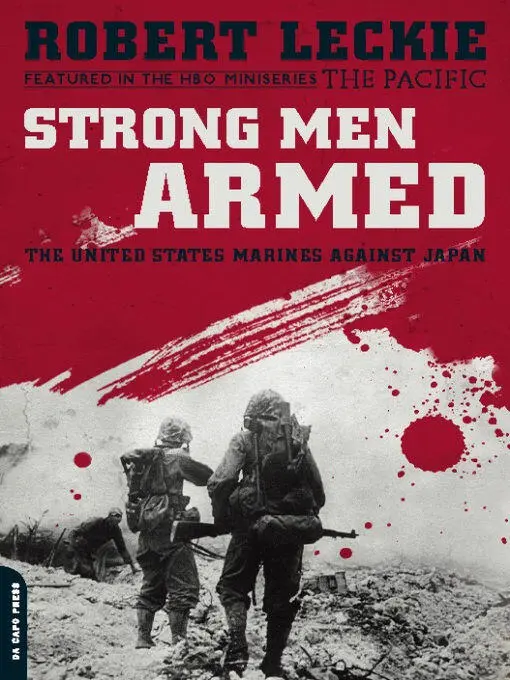
- Название:Strong Men Armed
- Автор:
- Издательство:Da Capo Press
- Жанр:
- Год:2010
- Город:Cambridge
- ISBN:978-0-786-74832-7
- Рейтинг книги:3 / 5. Голосов: 1
-
Избранное:Добавить в избранное
- Отзывы:
-
Ваша оценка:
Strong Men Armed: краткое содержание, описание и аннотация
Предлагаем к чтению аннотацию, описание, краткое содержание или предисловие (зависит от того, что написал сам автор книги «Strong Men Armed»). Если вы не нашли необходимую информацию о книге — напишите в комментариях, мы постараемся отыскать её.
Strong Men Armed — читать онлайн бесплатно полную книгу (весь текст) целиком
Ниже представлен текст книги, разбитый по страницам. Система сохранения места последней прочитанной страницы, позволяет с удобством читать онлайн бесплатно книгу «Strong Men Armed», без необходимости каждый раз заново искать на чём Вы остановились. Поставьте закладку, и сможете в любой момент перейти на страницу, на которой закончили чтение.
Интервал:
Закладка:
“Line ‘em up and squeeze ‘em off!” roared Pollock, striding among his men. “Line ‘em up and squeeze ‘em off!”
The remainder of Colonel Ichiki’s elite was being wiped out within the coconuts.
“Cease fire!” came the order, up and down the line. “Hold your fire, First Battalion coming through!”
Over the river, green-clad men were flitting through the coconuts. The First Battalion, First, had crossed the Tenaru upriver and had fanned out into a flanking skirmish line. Now they were working seaward.
Downstream, Marine tanks rolled slowly over the sandspit. They reached the coconut grove and turned right.
By nightfall more than 700 Japanese bodies had been counted. There were 34 dead Marines and 75 wounded. The surviving Japanese had sought the treacherous sanctuary of the jungle, there to endure hunger, black nights and the slow dissolution of the rain forest. They wandered leaderless, for Colonel Kiyono Ichiki had already tasted “the fruits of victory.”
He burned his colors and shot himself through the head.
7
In all the Imperial Army there was no commander who could surpass Lieutenant General Haruyoshi Hyakutate in the peculiar Japanese custom of celebrating defeat with a loud cry of victory. General Hyakutate knew all those euphemisms whereby a setback became “a valiant advance” or the report of a rout reached the ears of the Emperor as “a glorious withdrawal of unshaken discipline.”
But the affair of the Ichikis was unique. There was no euphemism at hand to describe annihilation. Undaunted, General Hyakutate sent Tokyo this message: “The attack of the Ichiki Detachment was not entirely successful.” Then he drew up a plan for another attempt at recapturing Guadalcanal.
This time he would use the surviving rear-echelons of the Ichiki Battalion—around 1,100 men—together with the 6,000-man brigade commanded by Major General Kiyotake Kawaguchi (the Japanese have no rank of brigadier general). This force would land on Guadalcanal supported by planes and ships of the Combined Fleet. The fact that it was still outnumbered by the 10,000 enemy troops to the south did not deter Hyakutate. He still refused to accept the Americans as worthy foemen. He believed the battle report that stated: “The American soldiers are extremely weak when they lack support of fire power. They easily raise their hands during battle and when wounded they give cries of pain.” So General Hyakutate ordered 5,000 Kawaguchis to join the remaining Ichikis on one of those nightly runs down The Slot which the Marines were already calling the Tokyo Express. He sent them south with the battle cry:
“Remember the Ichiki suicide!”
And they had to turn back.
On August 25, the day after the Japanese Combined Fleet met Admiral Fletcher’s carriers in the Battle of the Eastern Solomons, the Japanese convoy was sighted north of Guadalcanal by bombers from Henderson Field. A Dauntless piloted by Lieutenant Larry Baldinus dove down to plant an egg forward on the big escort cruiser, Jintsu. She went staggering home, asmoke and afire, while a Navy dive-bomber and other Marines fell on the transport Kinryu Maru. They stopped her dead in the water, and when destroyer Mutsuki went to help her, they stopped Mutsuki to—leaving both ships to await the obliterating bombs of a flight of Flying Fortresses which followed up their attack. The remaining Japanese ships turned north and sailed to the Shortland Islands, where the soldiers debarked to board barges for a less ostentatious trip south.
Henderson Field, meanwhile, had withstood the aerial assaults which had been planned to make way for these troops. On August 24, the Marine fighter pilots shot down 11 Zero fighters and 10 bombers at a loss of three of their own planes. That date marked the beginning of the long epic defense of Guadalcanal’s skies, which was to match the stand being made on the ground. From August 24 onward, Marine fliers began shooting down Zeros and twin-engined Betty bombers at a rate of from six to eight kills for every one of their own men lost. They fought, of course, with the almost invariable assistance of Navy and Army airmen—but the Guadalcanal aerial war was in the main a Marine affair, fought by the self-styled Nameless Wonders of the Bastard Air Force. These men were galled almost nightly to hear the San Francisco radio speak of “Navy fighters” or “Army bombers” while only the enemy might know who rode the cockpits of “American aircraft” or “Allied planes.” And it was a Bastard Air Force, for if aerial combat is a gentleman’s war, if it is clean, quick and sporting to fight in the clouds with hot meals and soothing drinks and laundered bedsheets awaiting the survivors, this was not so on Guadalcanal. Here the fly-boys were like the foot-sloggers.
They lived next to Henderson Field, in the very center of the Japanese bull’s-eye. They rose an hour before dawn. If they cared to eat that common gruel of wormy rice and canned spam that passed for meals on Guadalcanal, they ate it standing up, spooning the detestable slop out of borrowed mess gear. They gulped hot black coffee from canteen cups while bumping jeeps drove them through the darkness to the airstrip, where they warmed up planes that had to be towed from revetments by tractor. Then it was dawn and they were roaring aloft, climbing high, high in the skies, sucking on oxygen. They went to battle in a sort of floating world where the only sounds were the roaring of their own motors and the hammering of their guns; where all the sights were the blind white mists of engulfing clouds, the sudden pain of reappearing sunlight bursting in the eyeballs, the swift dread glimpse of the red balls streaking by.
If the Japanese patrol planes which came over at night and were called Washing-Machine Charley for the uneven beat of their motors failed to kill many of these pilots, they succeeded in keeping them awake. They circled the night sky for hours. When their gas was low and the patience of their victims nearly exhausted, they dropped their eggs and sauntered home.
To be replaced by another Charley, or far, far worse, to be supplanted by Louie the Louse. This was the name for all those scouting aircraft whose swaying flares heralded the arrival of the Tokyo Express off Guadalcanal. Louie’s droning motors and his flares were all the warning given. Then the sea-lying darkness flashed and the great naval shells wailed overhead and these pilots who were the very targets of the Japanese ships were flung gasping out of their cots while the roaring air squeezed their bodies like rubber dolls in the hand of a giant.
Only after the warships were gone, could the fliers of the Bastard Air Force sleep.
But they would rise again at dawn, greet the first light with scalding hot coffee to dissolve the rice lying in the belly like stones—greet it with the barely comprehended news of more men killed, more men wounded, and the wreckage of their tiny air force strewn up and down their mangled airstrip.
Still they flew on, taking to the skies in patched-up aircraft, flying wing-to-wing in that technique of fighting by pairs which they would bring to perfection. Within a week of their arrival, some of them were aces. By August 30, Major John Smith had five little red balls painted on his Wildcat fighter. By nightfall, there were four more.
August 30 was one of those rare days when only the Zeros came down to strike at Henderson Field. Major Smith shot one of them to earth quickly, coming in on the enemy pilot’s rear and killing him in his cockpit before he knew he was under attack. Then Smith banked toward a Zero attacking his wingman. The red ball flashed full in Smith’s sights. He pressed the button. The Zero flamed and crashed. Now a third Japanese fighter was coming up under Smith. His bullets were sewing stitches up and down his fuselage. Smith nosed over. He came at the Japanese head-on. A bullet struck Smith’s windshield and whined past his ear. He kept his thumb on the button. The Zero was coming apart in chunks. The two planes roared toward collision. They tore past each other not 15 feet apart.
Читать дальшеИнтервал:
Закладка:
Похожие книги на «Strong Men Armed»
Представляем Вашему вниманию похожие книги на «Strong Men Armed» списком для выбора. Мы отобрали схожую по названию и смыслу литературу в надежде предоставить читателям больше вариантов отыскать новые, интересные, ещё непрочитанные произведения.











Обсуждение, отзывы о книге «Strong Men Armed» и просто собственные мнения читателей. Оставьте ваши комментарии, напишите, что Вы думаете о произведении, его смысле или главных героях. Укажите что конкретно понравилось, а что нет, и почему Вы так считаете.