John Barron - MiG Pilot
Здесь есть возможность читать онлайн «John Barron - MiG Pilot» весь текст электронной книги совершенно бесплатно (целиком полную версию без сокращений). В некоторых случаях можно слушать аудио, скачать через торрент в формате fb2 и присутствует краткое содержание. Город: New York, Год выпуска: 1983, ISBN: 1983, Издательство: Avon Books, Жанр: nonf_military, на английском языке. Описание произведения, (предисловие) а так же отзывы посетителей доступны на портале библиотеки ЛибКат.
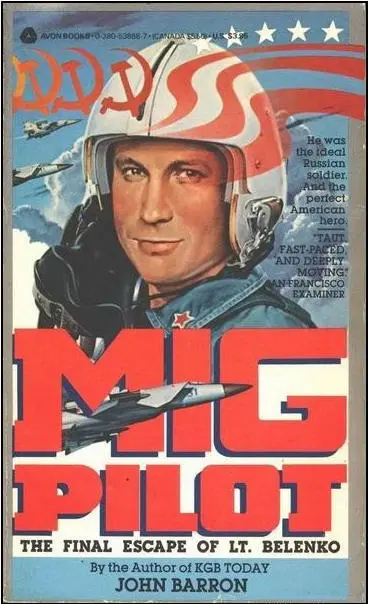
- Название:MiG Pilot
- Автор:
- Издательство:Avon Books
- Жанр:
- Год:1983
- Город:New York
- ISBN:978-0380538683
- Рейтинг книги:4 / 5. Голосов: 1
-
Избранное:Добавить в избранное
- Отзывы:
-
Ваша оценка:
MiG Pilot: краткое содержание, описание и аннотация
Предлагаем к чтению аннотацию, описание, краткое содержание или предисловие (зависит от того, что написал сам автор книги «MiG Pilot»). Если вы не нашли необходимую информацию о книге — напишите в комментариях, мы постараемся отыскать её.
MiG Pilot Viktor is not only a first class pilot, he is also a true hero.
Don’t lend this book to anyone and expect to get it back.
MiG Pilot — читать онлайн бесплатно полную книгу (весь текст) целиком
Ниже представлен текст книги, разбитый по страницам. Система сохранения места последней прочитанной страницы, позволяет с удобством читать онлайн бесплатно книгу «MiG Pilot», без необходимости каждый раз заново искать на чём Вы остановились. Поставьте закладку, и сможете в любой момент перейти на страницу, на которой закончили чтение.
Интервал:
Закладка:
But at 4:30 A.M. the NOIWON bell rang a fourth time, and the voice speaking from the Pentagon was excited. The Soviet pilot, Viktor I. Belenko, had told representatives of the Japanese Foreign Ministry that he had flown the MiG purposely to Japan and desired political asylum in the United States.
At the National Military Command Center someone shouted, “Goddamn! We’ve got a Foxbat [NATO designation of the MiG-25] and the pilot to boot. Goddamn!”
With this the situation became all the more serious and urgent, especially so because of one of the most shameful incidents of pusillanimity in American history. On November 23, 1970 Seaman Simas Kudirka jumped from a Soviet fishing ship onto a U.S. Coast Guard cutter while the two ships were tied up alongside one another in American territorial waters off Martha’s Vineyard. Ashore in Boston, a Coast Guard rear admiral, acting in what he presumed to be the spirit of detente, ordered officers on the cutter to hand the defector back to the Russians. Contrary to U.S. naval political traditions, the American officers allowed six Russians to board the cutter, beat the defector and drag him back to the Soviet ship.
As a consequence of this disgrace, the U.S. government adopted measures to ensure that no bona fide Soviet defector ever again would be turned away or that, if he were, those responsible would have their professional heads chopped off. Precise instructions were promulgated to be followed from the moment it appeared that a foreign national was seeking political asylum. These included a stringent requirement that all American officials who might be concerned be swiftly notified and that a formal, permanent record of everyone involved be maintained.
Accordingly, Steiner and his Watch team successively and rapidly telephoned at their homes and awakened an aide to State Department Counselor Helmut Sonnenfeldt, Director of Press Relations Frederick Brown, and officials in the Bureau of East Asian Affairs, the Soviet and Japanese Desks, the Humanitarian Affairs Bureau, the Visa Office, and the Immigration and Naturalization Service. A full report was cabled to Kissinger. Then Steiner on his own initiative telephoned the U.S. Embassy in Tokyo because from his service in Moscow, he recognized the gravity and potential danger involved. Please emphasize to our Japanese friends, he said, that the physical safety of the pilot is paramount. Probably they already realize that. But it cannot be stressed too much. Protect the pilot. Be sure he is free to make his own decision.
By 6:00 A.M. the Watch Center was crowded with men and women called out of their sleep to study the messages flooding in from the Embassy, the Pentagon, the CIA, the Fifth Air Force in Japan, and the wire services. On a typically active night, the Watch Officer’s log entries noting major events might fill one page; Steiner’s had filled four. Having had no time for his yogurt and cola, he drove home through calm, treelined streets, tired and pleased: pleased that he and the Watch team had done their duty, pleased that people in other agencies had done their duty, that the system had worked exactly as it was supposed to work.
In Paris, reporters accosted Kissinger and peppered him with questions about the fate of Belenko. “The United States will probably grant asylum,” he said. “If we do not, you may assume I have been overruled.”
Actually, once Belenko put his request for asylum in writing, there was no question about American willingness to accept him. The Director of Central Intelligence in consultation with the Attorney General and the Commissioner of Immigration is empowered, without reference to immigration laws or any other laws, to admit up to 100 aliens to the United States annually. But in this case the decision was made instantly by President Ford himself.
He learned of Belenko’s flight before breakfast. His national security adviser, lieutenant General Brent Scowcroft, recalls that the President at once comprehended the import of Belenko’s flight, and was extremely interested.
What did appear in question that Labor Day morning was the outcome of the ferocious Soviet pressures to browbeat and intimidate the Japanese into surrendering Belenko and the MiG-25.
Promptly after Belenko landed, the Soviet Embassy in Tokyo announced that the Soviet Union possessed “an inviolable right to protect its military secrets.” The MiG-25 was a secret military aircraft. Therefore, the Japanese must return it immediately and permit no one to look at it. The embassy further declared, as if addressing some Soviet colony, that the granting of asylum to Belenko “could not be tolerated.” The Soviet government lodged repeated protests demanding the immediate return of Belenko and the plane. One was so brazenly and harshly worded that the Japanese characterized it as unparalleled in the history of diplomatic relations with the USSR.
Soviet aircraft swarmed around Japan in a deliberate and insulting display of power. At sea, Soviet naval vessels started seizing Japanese fishing craft and hauling their crews off to Soviet prisons. These blatant piratical depredations were meant to make the Japanese cower by showing them bow the Russians could disrupt the fishing industry on which their island economy heavily depends.
Meanwhile, the Russians tried to get at the plane directly. Late in the afternoon of the sixth, a Russian using a false name showed up at the Hakodate Airport administrator’s office, identifying himself as “a crewman of a Soviet merchant ship being repaired at Hakodate harbor.” He said he had come to interview his compatriot Belenko. A Japanese official stonily turned him away.
The next afternoon three more Russians knocked at the airport administration office. Their spokesman introduced himself as the “Tass bureau chief in Tokyo” and his two companions as “Aeroflot engineers.”
“It’s our job to ship the airplane out, but we understand that its landing gear is damaged,” he said earnestly. “We must have the parts to repair them and would like to ascertain how badly the gear is smashed. So we would like to go on out to the plane, look around, and take some photographs.”
Airport administrator Masao Kageoka smiled politely. “Well, the plane is now under control of the Japanese police, and it is beyond my authority to grant you access. By the way, I don’t quite understand in which capacity you are here.”
“Oh,” said the “Tass” man, “I’m here as a civilian.”
This same indefatigable intelligence officer visited the regional headquarters of the Hokkaido police the next morning and announced that he was reporting for his “briefing” on the plane and pilot. The police said, “We can’t give you any details. Get out!”
On Tuesday, September 7, the White House announced that President Ford himself had decided to grant Belenko asylum in the United States. “If he asks for asylum here, he will be welcome,” said Press Secretary Ron Nessen. Unfortunately, some misconstrued the phrasing to mean that Belenko had not yet asked for asylum.
But, as an official statement issued at the same time by the State Department made clear, there was no doubt about Belenko’s desires: “The Japanese government notified us of the pilot’s request for asylum, and they did it yesterday. We have informed the government of Japan that we are prepared to allow the pilot to come to the United States. We understand that is his desire. I believe the same comment or a comment to that effect was made this morning at the White House.”
The announcements in Washington coupled with indications emerging from a Japanese Cabinet meeting that Belenko was about to be transferred to the Americans, incited the Russians to new fury and desperation. Soviet Ambassador Dmitri Polyansky read to the Japanese Deputy Foreign Minister a statement, the crudity of which exceeded all bounds of conventional diplomatic propriety. The Russians declared that Belenko had made an emergency landing and accused the Japanese of lying about it, or “fabricating a story” to conceal the “physical violence and other unforgivable means” employed to kidnap him.
Читать дальшеИнтервал:
Закладка:
Похожие книги на «MiG Pilot»
Представляем Вашему вниманию похожие книги на «MiG Pilot» списком для выбора. Мы отобрали схожую по названию и смыслу литературу в надежде предоставить читателям больше вариантов отыскать новые, интересные, ещё непрочитанные произведения.











Обсуждение, отзывы о книге «MiG Pilot» и просто собственные мнения читателей. Оставьте ваши комментарии, напишите, что Вы думаете о произведении, его смысле или главных героях. Укажите что конкретно понравилось, а что нет, и почему Вы так считаете.