John Barron - MiG Pilot
Здесь есть возможность читать онлайн «John Barron - MiG Pilot» весь текст электронной книги совершенно бесплатно (целиком полную версию без сокращений). В некоторых случаях можно слушать аудио, скачать через торрент в формате fb2 и присутствует краткое содержание. Город: New York, Год выпуска: 1983, ISBN: 1983, Издательство: Avon Books, Жанр: nonf_military, на английском языке. Описание произведения, (предисловие) а так же отзывы посетителей доступны на портале библиотеки ЛибКат.
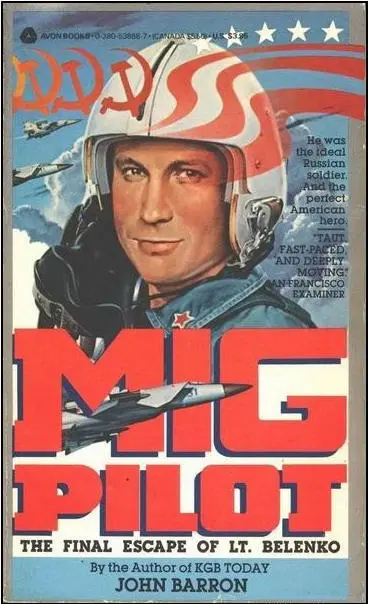
- Название:MiG Pilot
- Автор:
- Издательство:Avon Books
- Жанр:
- Год:1983
- Город:New York
- ISBN:978-0380538683
- Рейтинг книги:4 / 5. Голосов: 1
-
Избранное:Добавить в избранное
- Отзывы:
-
Ваша оценка:
MiG Pilot: краткое содержание, описание и аннотация
Предлагаем к чтению аннотацию, описание, краткое содержание или предисловие (зависит от того, что написал сам автор книги «MiG Pilot»). Если вы не нашли необходимую информацию о книге — напишите в комментариях, мы постараемся отыскать её.
MiG Pilot Viktor is not only a first class pilot, he is also a true hero.
Don’t lend this book to anyone and expect to get it back.
MiG Pilot — читать онлайн бесплатно полную книгу (весь текст) целиком
Ниже представлен текст книги, разбитый по страницам. Система сохранения места последней прочитанной страницы, позволяет с удобством читать онлайн бесплатно книгу «MiG Pilot», без необходимости каждый раз заново искать на чём Вы остановились. Поставьте закладку, и сможете в любой момент перейти на страницу, на которой закончили чтение.
Интервал:
Закладка:
Neither did he believe that the dinner — caviar, smoked salmon, smoked trout, soup, salad, filet mignon, potato balls, asparagus, fruit and cheese, strawberries and ice cream, white wine, red wine, champagne — was normal first-class fare on an international flight.
They are just putting on a show for me, no matter what Jim says.
However, he did believe and was moved by the stewardesses who after dinner came singly or in pairs to speak briefly to him.
“We are proud to have you aboard Northwest and in our country.”
“I want to congratulate you. You have done a great thing.”
“You are very brave. I am proud to meet you.”
One stewardess, a pretty, freckle-faced pixie, had no words. She only took off her stewardess’ wings, pinned them on him, and kissed him on the cheek.
Belenko kept wondering when the Dark Forces in the person of Jim would begin his interrogation, until Jim made clear there would be none. “You must be utterly exhausted, so just relax and sleep as much as you can. You have nothing to worry about. Your first problem will be to learn English. But you’ll master it quickly, and you’ll have an accent which all the girls will think is cute. You have a great future ahead of you. You’ll see.”
After the lounge lights dimmed and Jim, though not the marine, dozed off, Belenko thought not of the future but of the past. Had he done right in fleeing? Had he done right in refusing to go back? Would his relatives be better off if he returned? Who would suffer? He tried, as was his wont, to analyze and answer logically.
Even if they did not punish me, and they would punish me, but even if they did not, what could I do back there to change things? I could do nothing. Can I do anything in the West? I don’t know. Maybe. Could I help my relatives? If I could not help them, if I could not have good relations with them before, why now? Will they be hurt? Not my father, my mother, my aunt. The KGB will find I have not seen them for years. Ludmilla and Dmitri? No; her parents have enough influence to protect them. Who then? The Monster and his superiors; the political officers; the KGB. Well, they deserve it. No. No matter what happens I have done right. I do not want to live anymore unless I am free.
Despite the certitude of his conclusion, an amorphous malaise troubled him.
All right, what’s your trouble now?
Reviewing and ordering his recollections, he isolated and identified the cause. It was the echo of harshly shouted words: “One way or another we will get you back.”
CHAPTER V
“We Will Get You Back”
Viktor Ivanovich Belenko was one defector the Russians were determined to get back. Embarrassing or damaging as defections by artists, intellectuals, diplomats, or KGB officers may be, all, after a fashion, can be explained away to the world and the Soviet people. It is not too difficult for Soviet propaganda organs and the KGB disinformation department to portray an artist or intellectual as an egoistical eccentric or a spoiled degenerate leaning toward lunacy. It is not surprising if an occasional diplomat, having lived and worked in the rottenness of the West, succumbs to that rottenness and sinks into alcoholism, embezzlement, or insanity. And KGB officers? Who gives a damn about them anyway? They spend their lives selling the Soviet people, and each other, and a few are bound to wind up selling themselves.
But Belenko, symbolically and actually, was different — a son of the working class; a toiler in the fields and factories; an elite officer, whose record was strewn with commendations; a pure product of the Party; the quintessence of the New Communist Man. As a Soviet journalist said to Washington Post correspondent Peter Osnos in Moscow, “This was one of our very best people, a pilot in the air force entrusted to fly a top secret plane.” To admit that Belenko was less than the best would be to admit that the Party had been terribly, ludicrously wrong, that the very concept of the New Communist Man might be a myth. Thus, Belenko became probably the only defector in Soviet history about whom the Soviet Union had only good to say.
Were Belenko to remain alive and at liberty abroad, dangerous thoughts and precedents would arise in the minds of the people in general and other pilots in particular. If you cannot trust someone so perfect as Belenko, whom can you trust? Who is loyal? The question was reflected in a joke that spread through Moscow immediately after the British Broadcasting Corporation reported the sensational news of the escape: “Did you hear? From now on they are going to train only Politburo members to fly those planes.” And other pilots inevitably would ask themselves, “If Belenko can do it, why can’t I?” There were additional perils. Belenko was probably the most knowledgeable military man to flee since World War II, and the secrets and insights he could impart to the Americans would harm the Soviet Union. But worse, should he elect to speak out publicly, especially to the Soviet people, his words could be even more devastating than the loss of secrets.
The whole situation could be retrieved if Belenko were enticed back or if the Japanese or Americans were intimidated, duped, or cajoled into delivering him. After appropriate treatment and conditioning in a KGB psychiatric ward, he could be paraded forth as proof of the perfidies of the West, a true Soviet hero who had slipped out of the snares of the Dark Forces and come home to the Mother Country to attest to their perfidies. His staged appearances, the lines he mouthed, would dramatize to all pilots and everybody else the futility of trying to get away.
Thus, within an hour after Belenko and the MiG-25 had plowed off the runway in Hakodate, the Soviet Union initiated a massive, unprecedented campaign to recover him. In the Crisis Rooms of Washington the men who watched and participated in the intensifying international struggle that followed appreciated how great the stakes were.
Steven Steiner, thirty-six, Yale ’63, Columbia Graduate School ’66, slept from noon to eight on Sunday, September 5. He missed a balmy, sunny afternoon and upon awakening regretted anew that he could not take his wife and three children for an outing on that delightful Labor Day weekend. But he had the duty as Senior Watch Officer at the State Department Operations Center beginning at 12:01 A.M. Monday, and his family, having been with him at diplomatic posts in Yugoslavia and Moscow, had adjusted to the inconvenient hours he sometimes had to work. Just the night before he had worked the same shift.
Dressed in blue jeans, a sports shirt, and loafers, Steiner entered the Watch Center located in Room 7516 of the State Department at 11:15 P.M. and put his yogurt and diet cola in the refrigerator for later. He came early because he was required to read all the recent cables and be briefed about the world situation by the outgoing Senior Watch Officer before assuming responsibility for the Watch. Secretary of State Henry Kissinger was traveling to Europe, and the Operations Center is the Secretary’s twenty-four-hour link to Washington. So he anticipated a heavy flow of messages and a busy night.
Steiner noted in the log at 12:01 A.M. that he had taken over the Watch and made his second entry at 12:47, recording that the Watch team had obtained and cabled information concerning Africa requested by Kissinger’s entourage in Zurich.
At 1:35 A.M. the special closed-circuit telephone rang in the Watch Center — a “NOIWON” (National Operations and Intelligence Watch Officers Network) alert signaling the entire U.S. crisis-management community that something extraordinary had occurred. As Steiner picked up his phone, other Watch Officers lifted similar emergency phones at the Situation Room in the White House, the National Military Command Center at the Pentagon, the Operations Centers at the Central Intelligence Agency in Langley, Virginia, and the National Security Agency in Fort Meade, Maryland. A male voice announced over the circuit: “The Defense Intelligence Agency is convening a NOIWON alert. On the basis of a preliminary report from the U.S. Fifth Air Force, we understand that a Soviet MiG-25 has landed at Hakodate in northern Japan….” The MiG had touched down at 12:50 A.M. Washington time. The circumstances of the flight and intent of the pilot had not yet been ascertained by American representatives in Japan. Two more alerts from the DIA at 1:49 and 2:06 added a few sparse details but failed to clarify whether the pilot had landed intentionally or of necessity. Meanwhile, the news ticker in the Watch Center typed out an Agence France-Presse dispatch reporting that the pilot had jumped from the aircraft and commenced firing a pistol. To Steiner, that sounded as though the Soviet pilot probably had lost his way or been forced down by mechanical trouble and was hostile to the West.
Читать дальшеИнтервал:
Закладка:
Похожие книги на «MiG Pilot»
Представляем Вашему вниманию похожие книги на «MiG Pilot» списком для выбора. Мы отобрали схожую по названию и смыслу литературу в надежде предоставить читателям больше вариантов отыскать новые, интересные, ещё непрочитанные произведения.










Обсуждение, отзывы о книге «MiG Pilot» и просто собственные мнения читателей. Оставьте ваши комментарии, напишите, что Вы думаете о произведении, его смысле или главных героях. Укажите что конкретно понравилось, а что нет, и почему Вы так считаете.