John Barron - MiG Pilot
Здесь есть возможность читать онлайн «John Barron - MiG Pilot» весь текст электронной книги совершенно бесплатно (целиком полную версию без сокращений). В некоторых случаях можно слушать аудио, скачать через торрент в формате fb2 и присутствует краткое содержание. Город: New York, Год выпуска: 1983, ISBN: 1983, Издательство: Avon Books, Жанр: nonf_military, на английском языке. Описание произведения, (предисловие) а так же отзывы посетителей доступны на портале библиотеки ЛибКат.
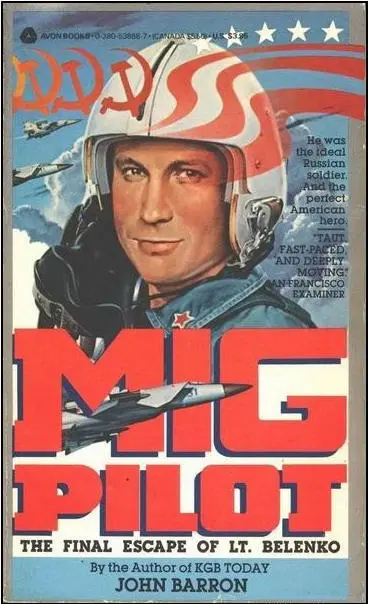
- Название:MiG Pilot
- Автор:
- Издательство:Avon Books
- Жанр:
- Год:1983
- Город:New York
- ISBN:978-0380538683
- Рейтинг книги:4 / 5. Голосов: 1
-
Избранное:Добавить в избранное
- Отзывы:
-
Ваша оценка:
MiG Pilot: краткое содержание, описание и аннотация
Предлагаем к чтению аннотацию, описание, краткое содержание или предисловие (зависит от того, что написал сам автор книги «MiG Pilot»). Если вы не нашли необходимую информацию о книге — напишите в комментариях, мы постараемся отыскать её.
MiG Pilot Viktor is not only a first class pilot, he is also a true hero.
Don’t lend this book to anyone and expect to get it back.
MiG Pilot — читать онлайн бесплатно полную книгу (весь текст) целиком
Ниже представлен текст книги, разбитый по страницам. Система сохранения места последней прочитанной страницы, позволяет с удобством читать онлайн бесплатно книгу «MiG Pilot», без необходимости каждый раз заново искать на чём Вы остановились. Поставьте закладку, и сможете в любой момент перейти на страницу, на которой закончили чтение.
Интервал:
Закладка:
However, the press conference did not produce the desired effects abroad. A succinct editorial in the Baltimore Sun typified much of the Western reaction:
Soviet officialdom is not noted for humor except, on occasion, for the crude and inadvertent kind. A classic example of the latter must be credited to one Lev V. Krylov, a Foreign Ministry official assigned to orchestrate a campaign for the repatriation of Senior Lieutenant Viktor Belenko. Lieutenant Belenko is the Soviet pilot who defected to Japan September 6 in a MiG-25 that has been fondly scrutinized by American intelligence. The Kremlin wants Lieutenant Belenko back — not to punish, heaven forbid, but to reunite him with a wife and mother who wept in front of Soviet cameras. Comrade Krylov apparently was so affected by this display of emotion that he accused Japan and the United States of acts “tantamount to splitting a family by force.”
This would almost be funny if one could put out of mind, for a moment, the tens of thousands of German families divided by the Berlin Wall and the thousands of Russian Jews in exile who wait and wait and wait for the Soviet Union to grant exit permits to their relatives.
The renewed slander of Japan disseminated at the press conference, together with another incident, infuriated the Japanese. In New York Gromyko summoned the new Japanese Foreign Minister, Zentaro Kosaka, to a Soviet UN office and, “offering not even a glass of water,” spoke to him with such condescension that Kosaka, a courtly diplomat given to understatement, described the meeting as “extremely severe.”
The Japanese government in Tokyo made public a specific rebuttal of the Soviet charges:
The Soviets claim that a bag had been thrown over Lieutenant Belenko’s head, but the fact was that he had his jacket thrown over his face by his expressed wish because he didn’t want to be exposed to cameras.
The Soviets claim that he was handcuffed because of the string seen in a picture of him, but the fact was that he held a paper bag containing his belongings, and the string of the bag appeared in the photo.
The Soviets claim that he was kept 25-30 meters away from a Soviet Embassy official who came to see him, and the Japanese police interfered with the conversation. The fact was that the distance was only eight meters, and there was no interference whatever.
The statement written and signed by Lieutenant Belenko was penned in a hotel in Hokkaido, where he landed the MiG-25 Foxbat. It was shown to Ambassador Dmitri Polyansky, but he refused to take it.
[The statement said] “I hereby state that I, Viktor Ivanovich Belenko, do not wish to return to the Soviet Union and hope to reside in the United States. This decision has been made autonomously and out of my own free will. Viktor I. Belenko.”
Privately the Japanese now said in effect to the Americans: Let’s get started. We’ll take it apart and ship it back to them in pieces.
On October 1 at four in the afternoon, President Ford received Gromyko and Soviet Ambassador Anatoly Dobrynin in the Oval Office of the White House. The subject of Belenko was not on the scheduled agenda of discussions, and Ford was surprised when Gromyko broached it — suddenly, indignantly, belligerently.
“We were after that plane like a dog in heat,” he announced — not because the Russians cared about the loss of secrets it embodied but because it was stolen. Gromyko declared that Belenko was a thief, a common criminal whom the United States was obligated to extradite in the interests of simple justice. As a criminal, who had absconded with something as valuable as an aircraft, he obviously did not qualify for political asylum. Both international law and the interests of Soviet-American relations required that he be forcibly repatriated to face the prosecution his crime deserved.
President Ford made no attempt to disguise his astonishment or anger. Having been continuously briefed all along about Belenko and attendant developments, he was aware of the press conference in Moscow three days before and the consistent Soviet portrayal of Belenko as a “good man,” a “Soviet man,” a “patriot,” “one of our best people,” a highly commended officer, who, after straying off course, had been kidnapped and dragged away from country and family against his will, an esteemed comrade, who, even if he had made some unknown mistake, would be forgiven. Now, with a straight face, the foreign minister of the Soviet Union told him that this same man was a thief who must be brought before the bar of justice.
Ford was blunt. He was thoroughly familiar with the Belenko case. If ever there was an authentic Soviet defector, if ever anyone merited political asylum, it was Belenko. He was more than welcome in the United States as long as he lived. So far as the United States government was concerned, the issue was closed and not subject to further discussion or negotiation.
Through the decades the Russians have perfected to an art the practice of wresting concessions from other nations by thrashing about, growling menacingly, and acting like a great, frightening, unruly, and unpredictable bear. The reaction of the world often has been akin to that of indulgent parents undertaking to appease a spoiled child in the midst of a temper tantrum.
The Soviet temper tantrum had failed to wrest Belenko from the Japanese or the Americans. Now the only possibility lay in reaching him personally through words or other means.
CHAPTER VI
With the Dark Forces
Flying toward what he envisioned as the very lair of the Dark Forces, Belenko knew little of the international storm he was precipitating and nothing about the intensity of continuing Soviet efforts to snare him. In his psychological approach to America, he was continuing the same intellectual quest which had driven him much of his life. He had to understand the underlying order, causes, purpose of the world he was entering. His reasoning convinced him that not all that the communists said about the United States could be true; analysis of their own words suggested the possibility that freedom of some land actually might exist. But he was so inured to lies, deceit, hypocrisy, and the devious that he was skeptical of everything. For him, not even seeing was believing. Indeed, at times, the more obvious something seemed, the greater the cause in his mind to suspect the ulterior.
As the 747 descended toward Los Angeles, Jim handed him a wig and dark glasses so that he could not be recognized subsequently from pictures photographers might snap at the airport. On the runway they jumped into one of several waiting CIA cars and, escorted by police on motorcycles, darted through night traffic to a private airport, where a small passenger jet was ready to take off.
Climbing into the plane, Belenko pulled off the wig, which was insufferably hot, and put away the glasses, drastically changing his appearance. One of the CIA men already in the plane looked around and, not seeing the man who came aboard as Belenko, panicked. “Jesus Christ! We’ve lost him already! Where in the hell did he go?”
Once Jim translated the exclamations, Belenko laughed along with the four CIA officers who were to accompany them, and all welcomed him in Russian. Belenko asked if they had any urgent questions, and the senior American replied much as Jim had over the Pacific: Relax; don’t worry. There will be plenty of time to talk later. You’re too tired now.
He was right. Days of tension, drama, anxiety, and time changes had drained him physically, intellectually, and emotionally. His impressions, sensations, and thoughts were blurred and imprecise, and he felt as if he were suspended midway in half-light between dream and reality.
The executive jet was to him a masterpiece of design, maneuvering as nimbly as a fighter while outfitted inside like an elegant hotel suite. Well, I knew they were rich and built good airplanes.
Читать дальшеИнтервал:
Закладка:
Похожие книги на «MiG Pilot»
Представляем Вашему вниманию похожие книги на «MiG Pilot» списком для выбора. Мы отобрали схожую по названию и смыслу литературу в надежде предоставить читателям больше вариантов отыскать новые, интересные, ещё непрочитанные произведения.










Обсуждение, отзывы о книге «MiG Pilot» и просто собственные мнения читателей. Оставьте ваши комментарии, напишите, что Вы думаете о произведении, его смысле или главных героях. Укажите что конкретно понравилось, а что нет, и почему Вы так считаете.