Nick Edwards - In Stitches
Здесь есть возможность читать онлайн «Nick Edwards - In Stitches» — ознакомительный отрывок электронной книги совершенно бесплатно, а после прочтения отрывка купить полную версию. В некоторых случаях можно слушать аудио, скачать через торрент в формате fb2 и присутствует краткое содержание. Год выпуска: 2013, ISBN: 2013, Жанр: Биографии и Мемуары, на английском языке. Описание произведения, (предисловие) а так же отзывы посетителей доступны на портале библиотеки ЛибКат.
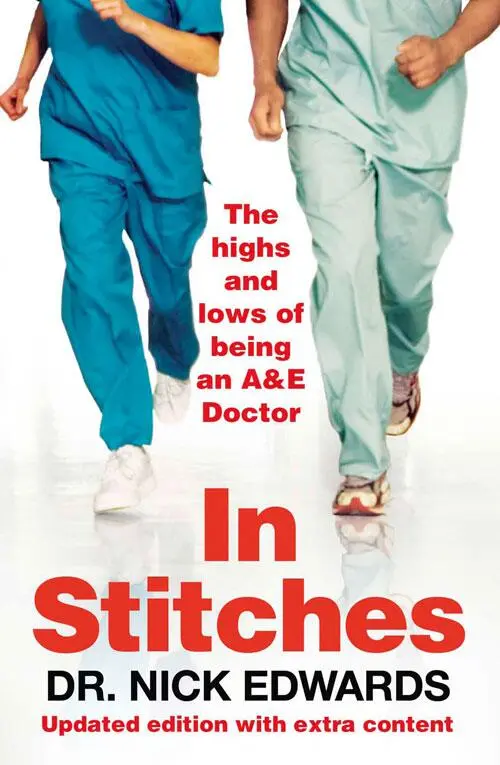
- Название:In Stitches
- Автор:
- Жанр:
- Год:2013
- ISBN:9780007332700
- Рейтинг книги:5 / 5. Голосов: 1
-
Избранное:Добавить в избранное
- Отзывы:
-
Ваша оценка:
In Stitches: краткое содержание, описание и аннотация
Предлагаем к чтению аннотацию, описание, краткое содержание или предисловие (зависит от того, что написал сам автор книги «In Stitches»). Если вы не нашли необходимую информацию о книге — напишите в комментариях, мы постараемся отыскать её.
FROM THE PUBLISHER THAT BROUGHT YOU CONFESSIONS OF A GP.
Forget what you have seen on Casualty or Holby City, this is what it is really like to be working in A&E.
Dr Nick Edwards writes with shocking honesty about life as an A&E doctor. He lifts the lid on government targets that led to poor patient care. He reveals the level of alcohol-related injuries that often bring the service to a near standstill. He shows just how bloody hard it is to look after the people who turn up at the hospital door.
But he also shares the funny side – the unusual ‘accidents’ that result in with weird objects inserted in places they really should have ended up – and also the moving, tragic and heartbreaking.
It really is an unforgettable read.
First published in 2007 when The Friday Project was a small independent, In Stitches went on to sell over 15,000 copies in the UK, the majority of which have come in the years since then. It has proved to be a real word-of-mouth hit.
This new edition includes lots of additional material bringing Nick’s story completely up to date including plenty more suprising, alarming, moving and unforgettable moments from behind the A&E curtain.
In Stitches — читать онлайн ознакомительный отрывок
Ниже представлен текст книги, разбитый по страницам. Система сохранения места последней прочитанной страницы, позволяет с удобством читать онлайн бесплатно книгу «In Stitches», без необходимости каждый раз заново искать на чём Вы остановились. Поставьте закладку, и сможете в любой момент перейти на страницу, на которой закончили чтение.
Интервал:
Закладка:
‘The current A&E target is simply not achievable without the employment of dubious management tactics. The government needs to revisit its targets and stop forcing hospitals into a position where they look for ways to creatively report back, rather than actually reducing waiting times for real people.’ (further information is available from http://news.bbc.co.uk/go/em/fr/-/1/hi/health/6332949.stm).
When the Department of Health spokesman responds by saying back to the BBC, ‘It’s absolute nonsense to suggest that the A&E waiting time standard is not being met,’ who do you believe?
It is not just the raw data that is manipulated. There are other ways in which 5 hours to you and me means 4 hours to the Department of Health. Examples I have heard from various colleagues throughout the country include:
1. Corridors are re-designated admission wards by the simple application of a curtain rail. As soon as you are admitted to the ‘admission ward’ the clock stops.
2. Patients are discharged on the computer before they have left the A&E (i.e. before they have got their discharge drugs or similar).
3. As soon as a bed on a ward is allocated to the patient, the patient is transferred to that bed on the computer, regardless of whether they have to wait an hour for the porters to take them to it.
4. Patients can be admitted by computer to an A&E ward (and not breach) but physically not move because there are a lot more beds on the computer than there are in real life.
5. The time it takes from the ambulance bringing a patient in to being logged onto the computer can take up to 30 minutes longer if there are no nurses to meet the ambulance. The clock starts ticking when we are ready and when the receptionist has had her cup of tea, NOT when you arrive.
6. If a patient has been referred by a GP, they don’t come to A&E anymore, but to an admission ward. As they are technically admitted, there is no target for how quickly they get seen and so they can often languish for hours before seeing a doctor.
7. Patients for whom A&E doctors have asked for a review by a specialist can get admitted to a ward regardless of whether the specialist has seen them or not and regardless of whether they actually need to come in or not. Once admitted to a ward they can stay there for ages without being seen by the specialist as they are no longer in A&E and so cannot breach.
8. Originally, there were specific days when the 4-hour rules were being assessed. On that day, the hospitals would cancel elective operations so that there were spare beds and employed loads of extra locum doctors and nurses to make it look as if the hospital was more efficient than it really was.
So, as you can see, hospitals feel compelled to massage their figures. The target was brought in for the right reason and initially did a very good job. But we need clinicians to make the priorities, not politicians. If the government is going to insist on targets, then let’s make some sensible ones such as all urgently triaged patients to be seen within 5 minutes of arrival. Or how about patients being able to expect a bed 30 minutes after they have been fully treated in A&E, etc? These targets may not be as glamorous to tell voters about, but they might actually improve care without distorting priorities.
The reason I moan so much about this is that what was once a tool to improve A&E is now damaging patient care and doctors’ and nurses’ sanities. I just hope a politician or two reads these words and does something about it other than claim that what we are saying is just ‘nonsense’.
At work on New Year’s Eve
I am writing this on New Years Day. Last night I was at work and it was absolute hell. The A&E looked like a war zone – police restraining aggressive drunks, teenagers vomiting and crying and overworked staff acting as bouncers. I can only assume that the managers thought that someone might fiddle figures for the night and so didn’t bother to employ any extra staff despite knowing how busy it was going to be. I was knackered by the end of the shift and was pissed off with some of the patients’ attitudes, but in all honesty, I quite enjoyed myself.
But I can hardly blame the new drinking laws. I started my shift at 9 p.m. and the drunks were already there. The first was quite a nice lad of about 17. He had fallen asleep in the street and someone had called an ambulance because he had wet himself and was vomiting.
‘So what happened?’ I asked.
‘You tell me,’ he retorted.
‘No. I asked first. What happened?’ I countered.
‘Don’t know mate. Been larging it,’ he said in his irritatingly pretend street speak accent – posh but with a touch of Estuary English.
‘It says on the notes from the nurse that you have been drinking. That can’t be true as you are under 18 and so surely can’t have been drinking. What actually happened?’ I mocked.
‘Nah mate, I gone massive. I am quality,’ he retorted in Mockney.
Luckily, I listen to Radio One, so I sort of understood what he had said.
‘So how have you gone massive mate?’ I enquired.
‘Vodka mate. Bottle of vodka – down in 1 hour. Larging it. So what I am doing here?’
I explained that an ambulance had been called for him as he was so drunk.
‘That is quality. Coming to hospital ’cos so drunk. Quality.’
I asked some questions to check that he was OK and had suffered no ill-effects from his night’s drinking. I asked him if he thought a bottle of vodka was really that sensible for a 17-year-old’s liver.
‘I can do it because I am so f**king hard. I am hard as nails me.’
‘Right … so hard you end up vomiting all night and pissing yourself so that your mummy had to collect you at 10 p.m.? Yep, hard, aren’t you? Well done mate.’
I called in his mother, and as soon as he was able to walk without falling over, he went home. Except that that wasn’t all he had to say for himself. While waiting for his mum, every couple of minutes he would call out to one of the nurses.
’Oi! Beautiful! I am quality – do you want to come home with me?’
He was harmless but irritating after a while.
The next case was a 14-year-old girl. The ambulance called ahead to say they were blue lighting her in as she was completely unconscious. The nurse and junior doctor tried to wake her up and couldn’t. I got a call on the intercom.
I walked in and initially failed as well. If she was truly unconscious then we might have to intubate her (i.e. put her to sleep and take over her breathing) so that she wouldn’t choke to death on her own vomit, which I was currently sucking out of her mouth (with a suction tube). Then I tried a ‘registrar’s trapezius squeeze’. (Basically, you squeeze as hard as possible on the bit of muscle between the neck and shoulder, then carry on squeezing until they wake up.) She did wake up – very quickly. I checked that she hadn’t hit her head or taken any drugs, asked the senior nurse to put in an intravenous cannula, watch for more vomiting, and give her some fluids.
Giving fluids to someone who is drunk is a little controversial. We spend tax-payers’ money helping them to sober up and not get as bad a hangover which may positively reinforce their A&E-seeking behaviour after drinking. This can’t be good, but I am still a believer in giving them lots of fluids when people are drunk because it helps to get rid of them more quickly. It helps them sober up, and also they soon wake up needing to go to the toilet. Sometimes it backfires and they end up losing full control of their now full bladder – but the risk is worth taking as it is so effective in aiding appropriate discharges.
I explained to the girl’s mum what was happening and why we were giving her daughter fluids. We put the girl on her side and left her where we could watch her closely. We also gave her little sister, who had to enjoy her New Year’s Eve watching her big sister vomit, a chair and a blanket to cuddle into.
Читать дальшеИнтервал:
Закладка:
Похожие книги на «In Stitches»
Представляем Вашему вниманию похожие книги на «In Stitches» списком для выбора. Мы отобрали схожую по названию и смыслу литературу в надежде предоставить читателям больше вариантов отыскать новые, интересные, ещё непрочитанные произведения.








Обсуждение, отзывы о книге «In Stitches» и просто собственные мнения читателей. Оставьте ваши комментарии, напишите, что Вы думаете о произведении, его смысле или главных героях. Укажите что конкретно понравилось, а что нет, и почему Вы так считаете.