Nick Edwards - In Stitches
Здесь есть возможность читать онлайн «Nick Edwards - In Stitches» — ознакомительный отрывок электронной книги совершенно бесплатно, а после прочтения отрывка купить полную версию. В некоторых случаях можно слушать аудио, скачать через торрент в формате fb2 и присутствует краткое содержание. Год выпуска: 2013, ISBN: 2013, Жанр: Биографии и Мемуары, на английском языке. Описание произведения, (предисловие) а так же отзывы посетителей доступны на портале библиотеки ЛибКат.
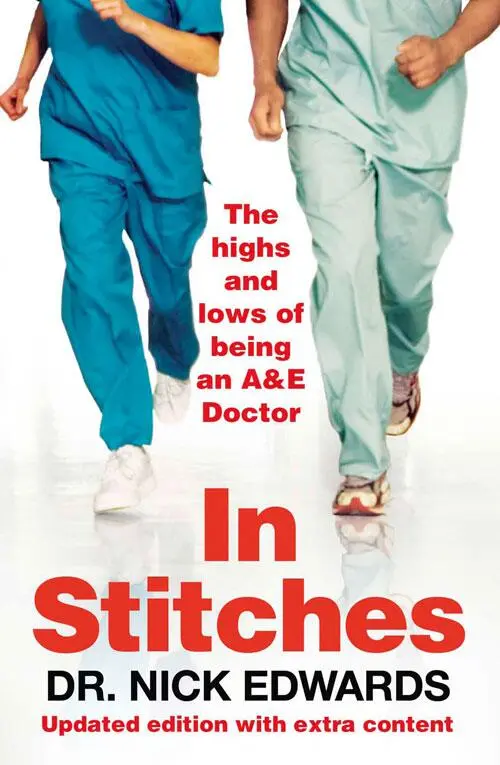
- Название:In Stitches
- Автор:
- Жанр:
- Год:2013
- ISBN:9780007332700
- Рейтинг книги:5 / 5. Голосов: 1
-
Избранное:Добавить в избранное
- Отзывы:
-
Ваша оценка:
In Stitches: краткое содержание, описание и аннотация
Предлагаем к чтению аннотацию, описание, краткое содержание или предисловие (зависит от того, что написал сам автор книги «In Stitches»). Если вы не нашли необходимую информацию о книге — напишите в комментариях, мы постараемся отыскать её.
FROM THE PUBLISHER THAT BROUGHT YOU CONFESSIONS OF A GP.
Forget what you have seen on Casualty or Holby City, this is what it is really like to be working in A&E.
Dr Nick Edwards writes with shocking honesty about life as an A&E doctor. He lifts the lid on government targets that led to poor patient care. He reveals the level of alcohol-related injuries that often bring the service to a near standstill. He shows just how bloody hard it is to look after the people who turn up at the hospital door.
But he also shares the funny side – the unusual ‘accidents’ that result in with weird objects inserted in places they really should have ended up – and also the moving, tragic and heartbreaking.
It really is an unforgettable read.
First published in 2007 when The Friday Project was a small independent, In Stitches went on to sell over 15,000 copies in the UK, the majority of which have come in the years since then. It has proved to be a real word-of-mouth hit.
This new edition includes lots of additional material bringing Nick’s story completely up to date including plenty more suprising, alarming, moving and unforgettable moments from behind the A&E curtain.
In Stitches — читать онлайн ознакомительный отрывок
Ниже представлен текст книги, разбитый по страницам. Система сохранения места последней прочитанной страницы, позволяет с удобством читать онлайн бесплатно книгу «In Stitches», без необходимости каждый раз заново искать на чём Вы остановились. Поставьте закладку, и сможете в любой момент перейти на страницу, на которой закончили чтение.
Интервал:
Закладка:
Dr. Nick Edwards
In Stitches

Copyright

William Collins
An imprint of HarperCollins Publishers Ltd.
1 London Bridge Street
London SE1 9GF
www.harpercollins.co.uk
First published in Great Britain in 2007 by Friday Books
Text © Dr Nick Edwards
A catalogue record for this book is available from the British Library
In Stitches is not authorised or endorsed by the NHS and opinions expressed within this book do not reflect those of the NHS. All situations and characters contained within the book are amalgamations of different scenarios at different hospitals and names and timings have been changed to protect anonymity. The author would like it to be known that he is writing under a pseudonym.
All rights reserved under International and Pan-American Copyright Conventions. By payment of the required fees, you have been granted the non-exclusive, non-transferable right to access and read the text of this ebook on-screen. No part of this text may be reproduced, transmitted, downloaded, decompiled, reverse engineered, or stored in or introduced into any information storage and retrieval system, in any form or by any means, whether electronic or mechanical, now known or hereinafter invented, without the express written permission of HarperCollins ebooks
HarperCollins Publishers has made every reasonable effort to ensure that any picture content and written content in this ebook has been included or removed in accordance with the contractual and technological constraints in operation at the time of publication
Source ISBN: 9781905548705
Ebook Edition © MAY 2013 ISBN: 9780007332700
Version: 2018-11-15
To Mrs Edwards: everything I do, you make possible and worthwhile. Thank you so much.
Disclaimer: this book is an attempt to take a humorous look at what it is like to work in a British Accident and Emergency Department. Much of it is tongue in cheek, so do not use it as a guide on how to manage illnesses. Call your GP or, if you can’t be bothered to wait for their receptionist to answer the phone, call an ambulance and come on down to your local A&E department for 3 hours and 59 minutes of fun.
Introduction
It was a fairly standard Saturday at work; generally busy and stressful but interrupted by episodes of upset, excitement and amusement. However, being honest, I quite enjoyed myself. I found pleasure in successfully treating someone’s heart failure and liked being able to mend a patient’s dislocated shoulder. I was amused by a drunk and injured tough-looking biker-type who had got into a fight over a game of chess. And I had a quite fascinating conversation with a man in his late 80s (who came in after a car accident), who insisted on telling me about his current sex life difficulties. Overall, if you have got to work, then working in A&E (Accident and Emergency) is one of the most interesting jobs I could think of and I am glad that it is the job I do.
Admittedly, I got mildly frustrated by the sheer number of patients who were revelling in the British culture of getting as pissed as possible, starting a fight and then coming in to A&E. And yes, I got a little weary of seeing a number of patients who had not read the big red (and quite explicit) sign as they walked in, and who had neither an accident nor an emergency and should have seen an out-of-hours GP (if one had been more readily available). However, overall, I saw a lot of patients who genuinely needed our services and whom we could help, which is the bit of my job that I love.
There was one patient that I took an instant liking to. She was in her mid-80s and had such a fast wit and spark to her personality that she felt like a breath of fresh air as I was treating her. She touched my emotional heartstrings because she reminded me of my Great Aunt.
She came in after having collapsed at home with abdominal pain, vomiting and diarrhoea. We were busy and she had had to wait 2 hours to see me. I quickly made the diagnosis of a possible gastro-enteritis (stomach bug), gave her some fluids, took some blood, organised an X-ray and arranged for admission. I wanted to wait for the results, spend more time with her and manage her care accordingly, but in a flash she was whisked away to a care of the elderly ward for me never to see her again. An hour after she arrived on the ward (and before she was seen by the ward doctors), she suddenly deteriorated and her blood pressure fell. This wasn’t noticed as quickly as it might have been had she stayed in A&E as the ward nurses were so rushed off their feet (two trained nurses having to look after 24 demanding patients).
She had been rushed out of A&E to get her to a ward so that she wouldn’t break the government’s 4-hour target (and because the A&E department has not got the resources to continue safely caring for patients for longer than a few hours in addition to seeing all the new ones constantly coming through the doors). I also had to pass responsibility over to the other doctors before her blood tests were back and before a definitive diagnosis was made. I later learned that she had been anaemic, which had put stress on her heart, and that she then ended up on the high-dependency ward, needing a blood transfusion.
For a while it was touch and go as to whether she could be stabilised. I couldn’t help wondering whether, if she had remained in A&E, under our care, all these problems could have been treated sooner and the complications avoided. However, this was not possible as, apparently, I had more pressing priorities. My next job was to go and see a bloke who had called an ambulance to get his ingrown toenail looked at and who had been waiting for 3 hours. He had, incidentally, had this problem for five weeks and wanted it (in his words) ‘sorted out now, as I’m off to Ibiza tomorrow, mate’.
I felt really frustrated. It didn’t need to be like this. Why does the ‘system’ have to impede me from caring for my sick patients and make me worry about figures and targets instead?
When you are surrounded by death and disease, aggressive and drunk patients, and nurses (male and female) trying constantly to flirt with you, it can make working in A&E an interesting and often stressful environment. However, it is the management problems and the effects of the NHS reforms, implemented without thinking about the possibilities of unintended consequences that really drive doctors and nurses mad. More importantly, they distort clinical priorities and can damage patient care. Surely this is not what the government intended? How have we drifted away from the original ideals of the NHS?
In July 1948, Nye Bevan presided over the creation of the NHS. It is a service that provides free care based on need and not ability to pay; to care for us from the cradle to the grave. It was the envy of the world and the greatest example of social policy this country has ever implemented. It is a wonderful institution that needs protecting and nurturing. Its desire to protect health and not profits means that its efficiency could outstrip that of any other health system in the world. The very thought of working for it filled me with pride.
By 1997, years of underfunding had left the NHS in a perilous state. Massive influxes of money from Blair and Brown poured in, which helped bring in some great improvements in service and much-needed reforms. This is especially true in A&E, where things have improved greatly from the days of patients spending days in corridors on trolleys waiting for a bed. The target brought in was a 4-hour rule stating that 98 percent of people have to be seen and admitted or discharged within 4 hours. Initially, it was a necessary but blunt tool, which effectively brought about urgently needed change. However, its lack of subtlety and implementation without resort to common sense is now impeding care and distorting priorities.
Читать дальшеИнтервал:
Закладка:
Похожие книги на «In Stitches»
Представляем Вашему вниманию похожие книги на «In Stitches» списком для выбора. Мы отобрали схожую по названию и смыслу литературу в надежде предоставить читателям больше вариантов отыскать новые, интересные, ещё непрочитанные произведения.






Обсуждение, отзывы о книге «In Stitches» и просто собственные мнения читателей. Оставьте ваши комментарии, напишите, что Вы думаете о произведении, его смысле или главных героях. Укажите что конкретно понравилось, а что нет, и почему Вы так считаете.