Nick Edwards - In Stitches
Здесь есть возможность читать онлайн «Nick Edwards - In Stitches» — ознакомительный отрывок электронной книги совершенно бесплатно, а после прочтения отрывка купить полную версию. В некоторых случаях можно слушать аудио, скачать через торрент в формате fb2 и присутствует краткое содержание. Год выпуска: 2013, ISBN: 2013, Жанр: Биографии и Мемуары, на английском языке. Описание произведения, (предисловие) а так же отзывы посетителей доступны на портале библиотеки ЛибКат.
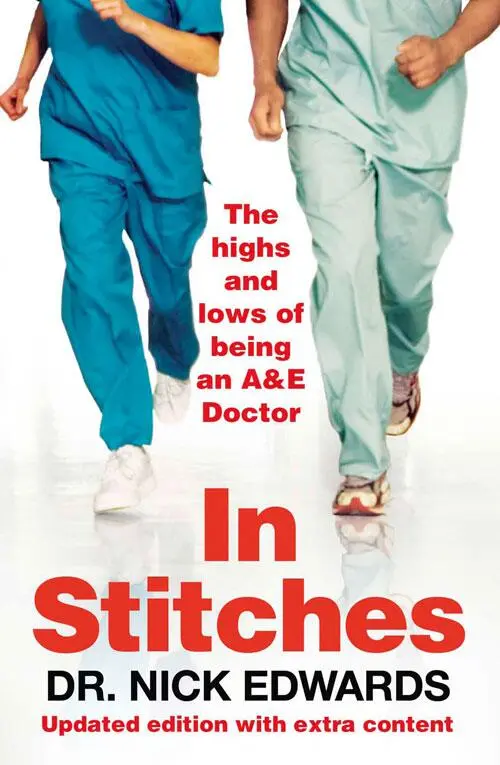
- Название:In Stitches
- Автор:
- Жанр:
- Год:2013
- ISBN:9780007332700
- Рейтинг книги:5 / 5. Голосов: 1
-
Избранное:Добавить в избранное
- Отзывы:
-
Ваша оценка:
In Stitches: краткое содержание, описание и аннотация
Предлагаем к чтению аннотацию, описание, краткое содержание или предисловие (зависит от того, что написал сам автор книги «In Stitches»). Если вы не нашли необходимую информацию о книге — напишите в комментариях, мы постараемся отыскать её.
FROM THE PUBLISHER THAT BROUGHT YOU CONFESSIONS OF A GP.
Forget what you have seen on Casualty or Holby City, this is what it is really like to be working in A&E.
Dr Nick Edwards writes with shocking honesty about life as an A&E doctor. He lifts the lid on government targets that led to poor patient care. He reveals the level of alcohol-related injuries that often bring the service to a near standstill. He shows just how bloody hard it is to look after the people who turn up at the hospital door.
But he also shares the funny side – the unusual ‘accidents’ that result in with weird objects inserted in places they really should have ended up – and also the moving, tragic and heartbreaking.
It really is an unforgettable read.
First published in 2007 when The Friday Project was a small independent, In Stitches went on to sell over 15,000 copies in the UK, the majority of which have come in the years since then. It has proved to be a real word-of-mouth hit.
This new edition includes lots of additional material bringing Nick’s story completely up to date including plenty more suprising, alarming, moving and unforgettable moments from behind the A&E curtain.
In Stitches — читать онлайн ознакомительный отрывок
Ниже представлен текст книги, разбитый по страницам. Система сохранения места последней прочитанной страницы, позволяет с удобством читать онлайн бесплатно книгу «In Stitches», без необходимости каждый раз заново искать на чём Вы остановились. Поставьте закладку, и сможете в любой момент перейти на страницу, на которой закончили чтение.
Интервал:
Закладка:
‘What a bloke’, I thought, ‘Honest and still enjoying life, and very friendly’. I smiled and in the notes wrote pain started on ‘mild exertion’. It is encounters like this that make my job pleasurable.
How targets can hurt patients and staff
In principle, a target to see and sort out patients within 4 hours is a fantastic aspiration. Unfortunately, it is like a lot of targets and reforms – they comply with the law of unintended consequences by creating an unintentional distortion in clinical priority, which impinges on the quality of care we provide.
I don’t think Labour has deliberately tried to harm patients care at all, or that it has deliberately tried to piss off NHS staff. I think that its heart is roughly in the right place, it’s just that it has implemented some ridiculously stupid NHS reforms without realising the consequences. Do you remember, during the last election, someone complaining to Blair on Question Time that they couldn’t book follow-up GP appointments? He had no idea that his policy of making all GPs guarantee that they would see people within 48 hours would mean that they would stop making follow-up appointments a week or so in advance. It was an unintended consequence. He was clearly shocked and promised to sort it out.
Well-intentioned cock-ups like this have happened throughout the NHS. Within A&E, we have the 4-hour target – we have 4 hours from when a patient arrives to either discharge them or admit them; 98 percent of patients need to meet this target. Don’t get me wrong; on the whole, the 4-hour target has banged heads together and brought about some good changes to the way we work and treat patients. Patients no longer wait 12 hours to see a doctor for a broken toe and being admitted to hospital has been streamlined. However, unintended consequences do exist and they can be harmful for patients. Let me explain with a couple of examples.
Last week, we were having a very, very busy day. There were massive delays in X-ray and an old lady who had fallen had had to wait 3 hours and 40 minutes to confirm the diagnosis of a fractured hip. She had been given some morphine while waiting for her X-ray, but was still in pain. The clock was ticking – it was 3 hours and 55 minutes since she had come in and the porters were about to be called to take her to the ward. In 5 minutes I could have given her some more morphine. However, it has side-effects such as slowing down the respiration rate (she also had a chest infection, which had caused her to fall in the first place) and nausea. What is just as effective but without the complications of a second morphine injection, is an injection of local anaesthetic into the area around the nerve going to the hip. It numbs the area within 10 minutes, and around 12 hours of pain relief is provided. However, it takes around 15 minutes to do. I told the nurse in charge that I wanted the patient to have the injection and not go to the ward just yet. I was told that she would fail her 4-hour target. This is known as a ‘breach’. In these days of targets it is so hard to argue back. If a patient breaches, then the consultants have to ‘examine’ why. If too many patients ‘breach’, then the NHS managers come down on the hospital like a ton of bricks and there are potential financial penalties.
But aren’t we in the job to provide the best possible care for the patient and not there to worry about targets? No wonder so many nurses and doctors are leaving A&E. They are doing so because they are not allowed to do their job properly – caring and managing patients.
After a 10-minute delay, we all agreed that it was in the patient’s interests to give her this injection and the figures were fiddled. (I deliberately do not get involved in this fiddling, because I think we should be producing honest figures so that something gets done rather than just massaging the ego of the Secretary of State for Health.) The department pretended she had left A&E 20 minutes earlier than she had. The figures said that she stayed 3 hours and 59 minutes. It is ridiculous that so much time and energy is spent trying desperately to meet targets, but when we fall short, someone has the job of adjusting the time. I don’t blame the A&E department for adjusting the figures. There is such pressure on us to comply with the target that adjustment is seen as acceptable. It means the hospital won’t get penalised financially or by a reduction of its ‘star performance score’ status. By fiddling the figures, it also means that we can concentrate on looking after our patients.
If there hadn’t been this target culture, then there wouldn’t have been this unnecessary stress and pressure on everyone. Perhaps if targets were used to identify where more resources were needed, rather than to punish failure, patient care might be improved. This time the potential breach was caused by a delay in X-ray (which often occurs). The solution might be to hire an extra radiographer. If this was done – if cash was invested to sort out this problem – then this delay might not occur again. But no, we fiddled the figures so we didn’t lose money and hence no one could highlight the problem. And the government could say everything is lovely-jubbly.
Another example was a 16-year-old girl who came in last Thursday. She had been drinking in the joyous surrounding of the local park. (Oh, the joys of the Anglo-Saxon drinking culture.) The ambulance was called because she was unconscious in the street. She needed fluids and a period of observation. At 3 hours and 30 minutes, my colleague reviewed her and determined that although she was now conscious, she was not well enough to go home yet. She needed another few hours to ensure that she didn’t still choke on her own vomit, etc. Before the days of targets, she would have stayed in A&E until she was well enough to go home. However, now we could only keep her for 4 hours, although she needed more time. My colleague was then told to refer her to the paediatricians to go and sober up on the kids’ ward. This was not appropriate. The paediatricians were busy enough and didn’t need to see a patient that my friend knew didn’t need their specialist skills, but then there is this bloody 4-hour target. Except in a very few clinical exceptions, we are not allowed to care for someone for longer than this time period. My colleague refused to succumb to the pressure of the nurse managers and did not refer her to the paediatricians and ended up getting a lot of grief for it.
She reviewed the girl 2 hours later. She was fit enough to go home with parental supervision. However, she was discharged about 45 minutes earlier than would have been ideal. The next day the doctor was expecting an interrogation into why she had let someone ‘breach’ but the figure had been fiddled and the patient was apparently discharged at 3 hours and 59 minutes. Again, I can understand why the figure was fiddled, but if we hadn’t fiddled the figures we might have seen the problem and a solution – a properly staffed paediatric A&E observation bed, where patients can be admitted while staying under the A&E team.
Figure fiddling happens everywhere. A recent survey by the British Medical Association and the British Association of Accident and Emergency Medicine showed that 31 percent of A&E doctors admitted to working in a department where ‘data manipulation was used as an additional measure to meet emergency access targets’. In other words, they admitted to working in an A&E where the figures were fiddled (for those of you who want to read more on this please go to http://www.bma.org.uk/ap.nsf/Content/Emergencymedsurvey07).
This is further backed by research from the City University business school that looked at the records of 170 000 A&E attendees and applied ‘queuing theory’. The conclusions were reported by lead researcher Professor Les Mayhew, who said:
Читать дальшеИнтервал:
Закладка:
Похожие книги на «In Stitches»
Представляем Вашему вниманию похожие книги на «In Stitches» списком для выбора. Мы отобрали схожую по названию и смыслу литературу в надежде предоставить читателям больше вариантов отыскать новые, интересные, ещё непрочитанные произведения.









Обсуждение, отзывы о книге «In Stitches» и просто собственные мнения читателей. Оставьте ваши комментарии, напишите, что Вы думаете о произведении, его смысле или главных героях. Укажите что конкретно понравилось, а что нет, и почему Вы так считаете.