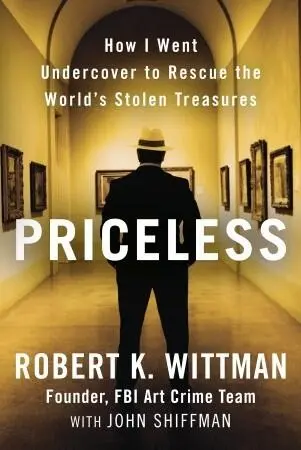
Robert Wittman - Priceless
Здесь есть возможность читать онлайн «Robert Wittman - Priceless» весь текст электронной книги совершенно бесплатно (целиком полную версию без сокращений). В некоторых случаях можно слушать аудио, скачать через торрент в формате fb2 и присутствует краткое содержание. Город: New York, Год выпуска: 2010, ISBN: 2010, Издательство: Crown Publishers, Жанр: Биографии и Мемуары, на английском языке. Описание произведения, (предисловие) а так же отзывы посетителей доступны на портале библиотеки ЛибКат.
- Название:Priceless
- Автор:
- Издательство:Crown Publishers
- Жанр:
- Год:2010
- Город:New York
- ISBN:978-0-307-46149-0
- Рейтинг книги:3 / 5. Голосов: 1
-
Избранное:Добавить в избранное
- Отзывы:
-
Ваша оценка:
Priceless: краткое содержание, описание и аннотация
Предлагаем к чтению аннотацию, описание, краткое содержание или предисловие (зависит от того, что написал сам автор книги «Priceless»). Если вы не нашли необходимую информацию о книге — напишите в комментариях, мы постараемся отыскать её.
The London Times
In
Robert K. Wittman, the founder of the FBI’s Art Crime Team, pulls back the curtain on his remarkable career for the first time, offering a real-life international thriller to rival
.
Rising from humble roots as the son of an antique dealer, Wittman built a twenty-year career that was nothing short of extraordinary. He went undercover, usually unarmed, to catch art thieves, scammers, and black market traders in Paris and Philadelphia, Rio and Santa Fe, Miami and Madrid.
In this page-turning memoir, Wittman fascinates with the stories behind his recoveries of priceless art and antiquities: The golden armor of an ancient Peruvian warrior king. The Rodin sculpture that inspired the Impressionist movement. The headdress Geronimo wore at his final Pow-Wow. The rare Civil War battle flag carried into battle by one of the nation’s first African-American regiments.
The breadth of Wittman’s exploits is unmatched: He traveled the world to rescue paintings by Rockwell and Rembrandt, Pissarro, Monet and Picasso, often working undercover overseas at the whim of foreign governments. Closer to home, he recovered an original copy of the Bill of Rights and cracked the scam that rocked the PBS series By the FBI’s accounting, Wittman saved hundreds of millions of dollars worth of art and antiquities. He says the statistic isn’t important. After all, who’s to say what is worth more—a Rembrandt self-portrait or an American flag carried into battle? They're both priceless.
The art thieves and scammers Wittman caught run the gamut from rich to poor, smart to foolish, organized criminals to desperate loners. The smuggler who brought him a looted 6th-century treasure turned out to be a high-ranking diplomat. The appraiser who stole countless heirlooms from war heroes’ descendants was a slick, aristocratic con man. The museum janitor who made off with locks of George Washington's hair just wanted to make a few extra bucks, figuring no one would miss what he’d filched.
In his final case, Wittman called on every bit of knowledge and experience in his arsenal to take on his greatest challenge: working undercover to track the vicious criminals behind what might be the most audacious art theft of all.
Priceless — читать онлайн бесплатно полную книгу (весь текст) целиком
Ниже представлен текст книги, разбитый по страницам. Система сохранения места последней прочитанной страницы, позволяет с удобством читать онлайн бесплатно книгу «Priceless», без необходимости каждый раз заново искать на чём Вы остановились. Поставьте закладку, и сможете в любой момент перейти на страницу, на которой закончили чтение.
Интервал:
Закладка:
Most museum robberies are over in a matter of minutes, simple smash-and-grab jobs. But the Gardner thieves were able to take their time. Confident that they had prevented the guards from tripping the silent alarm, and likely carrying radio scanners that picked up police frequencies, the Gardner thieves spent an astounding eighty-one minutes inside the museum. They did not even begin to try to remove paintings until 1:48 a.m., twenty-four minutes after they entered the museum. They would then spend a full forty-five minutes in the galleries, ripping masterpieces from the walls, and another twelve minutes shuttling works of art out the service door. We know these minute-by-minute details because motion detectors installed throughout the Gardner tracked the thieves’ movements. Although the robbers grabbed a printout of this record from the security chief’s office before they fled, a computer hard drive preserved a backup copy.
At 1:48 a.m., the thieves headed up the main staircase. They turned right at the second-floor landing, moving along a hallway overlooking the courtyard, and directly into the Dutch Room, through the door marked with the Neptune knocker. The paintings were secured by little more than simple hooks, and the thieves quickly removed the four Rembrandts and rudely set them on the tile floor, scattering shattered and splintered glass from one of the frames. At the easel, they grabbed the Flinck, perhaps believing it to be a Rembrandt, and, shoving the glass case aside, got to work on the Vermeer. Very neatly, probably using box cutters, one of the thieves began slicing the works from their frames.
The other thief headed back past the stairway through the Early Italian Room, turned right, moved through the Raphael Room, past a priceless Botticelli and a pair of Raphaels, arriving in the Short Gallery at 1:51 a.m. This thief easily broke into a cabinet filled with framed sketches, a collection secured only by a century-old lock. In one of the center panels, the man removed five Degas sketches, works in pencil, watercolor, and charcoal. The sketches were relatively minor pieces compared with the far more valuable artwork within arm’s reach of the Degas—a Matisse, a Whistler, and a Michelangelo. Perhaps the thief was a Degas fan; perhaps he was following orders; perhaps he was confused in the darkness and his hurry.
At 2:28 a.m., both thieves were back in the Dutch Room. They abandoned the Rembrandt self-portrait on wood, presumably because it was too heavy or could not be properly cut from its frame, and carried the five Dutch paintings and five Degas sketches downstairs. They removed the videotape from the recorder, ripped out the printout of the recordings by the motion detector, and made for the door. They opened the service entrance door twice, at 2:41 a.m. and 2:45 a.m.
The thieves stole three other works of art from the Gardner that misty morning, creating clues that have long intrigued investigators. They took two relatively valueless items—a Chinese vase from the Dutch Room and a gilded Corsican eagle finial from the top of a Napoleonic banner in the Short Gallery. Why take such minor pieces? Were these souvenirs? Or red herrings designed to trick investigators?
The third clue is most befuddling. The thieves took a three-foot-tall Manet, Chez Tortoni , from the Blue Room. This was the only work stolen from the first floor, and most curiously, the motion detectors did not pick up any movement in this gallery during the robbery. Absent a malfunction, this meant the Manet was moved before the thieves confronted the guards, raising the specter that the Gardner heist was an inside job. Additionally: Whoever took the Manet left its empty frame on the chair by the desk of the security chief, a gesture many interpreted as a final insult.
The mystery of the Manet is like most Gardner clues—intriguing but ultimately useful only to the countless armchair detectives in the bars and salons of Boston and the art community.
THE THEFT SHOCKED Boston and the art world, but it shouldn’t have.
As the value of artwork, from Impressionists to Old Masters, rose steadily at auction houses from the early sixties to the late eighties, so too did the pace of art crime, especially in New England. The thieves began slowly, targeting the region’s many colleges. Schools made prime targets because, as the thieves soon discovered, they held valuable but poorly guarded art and artifacts donated decades ago by long-dead alumni—Hudson Valley School paintings, ancient coins, rifles from the Revolutionary War. If a painting vanished from the walls of the English Department reception room, embarrassed college officials assumed it to be a prank or the work of the town delinquents, not the work of a growing cadre of Boston burglars who found it easier to steal art from a college or a mansion than to rob a bank. Emboldened by success, these thieves expanded their horizons and targeted museums. The most successful New England art thief was Myles Connor, who would become one of a number of Gardner suspects. Beginning in 1966, Connor burglarized the Forbes House Museum, the Woolworth Estate, the Mead Art Museum at Amherst College, the rotunda of the Massachusetts State House, and the Museum of Fine Arts, Boston. By the late 1980s, museums had begun to recognize the threat, but moved slowly to address it. When a new director was named to lead the Gardner in 1989, she ordered a review of her museum’s security measures. It was not completed before the 1990 crime.
Hundreds of FBI agents and police officers investigated the Gardner theft, and as the years passed, the mystique and mystery of the heist only grew. Investigators navigated a growing thicket of speculation, one fueled by a cast of characters featuring con men, private detectives, investigative journalists, and wiseguys—all chasing a reward that would climb to $5 million.
No lead went unchecked. Detectives and agents searched a trawler in the harbor, a city warehouse, a Maine farmhouse. When a pair of tourists visiting a Japanese artist’s home spotted what they believed to be The Storm on the Sea of Galilee , an FBI agent and a Gardner curator dashed to Tokyo. They found a fine copy, but no Rembrandt.
Every now and then a con man approached the media and the media bit. One got face time on 60 Minutes , the other on Primetime Live . The con artist who appeared on ABC claimed to be working with Connor, and he repeatedly teased the U.S. attorney’s office in Boston, claiming he could return one of the paintings within an hour, if paid $10,000 and granted immunity.
One newspaper reporter didn’t just investigate the story. In 1997, he became part of it. Under the blazing headline “We’ve Seen It!,” the Boston Herald reported that one of its star journalists, Tom Mashberg, was led blindfolded to a Boston warehouse in the dark of night, and shown a curled, badly damaged canvas that resembled The Storm on the Sea of Galilee . Mashberg’s source later sent him photographs of the Rembrandt and paint chips supposedly of seventeenth-century vintage. Although an initial analysis suggested the chips were authentic, further tests by the government showed they were not.
Shady mob links to the Gardner heist surfaced repeatedly, and most drew breathless press coverage across Boston. Four times in the space of a decade, the papers reported, a wiseguy with alleged ties to the Gardner case died under suspicious circumstances. When two more reputed mob associates were arrested for conspiring to rob an armored car, they alleged that FBI agents had set them up as part of a scheme to win the paintings’ return. As all of this mob-Gardner speculation swirled, alleged Boston mob boss Whitey Bulger—a man the media identified as a prime suspect in the Gardner case—fled the United States on the eve of his arrest for unrelated murders.
Читать дальшеИнтервал:
Закладка:
Похожие книги на «Priceless»
Представляем Вашему вниманию похожие книги на «Priceless» списком для выбора. Мы отобрали схожую по названию и смыслу литературу в надежде предоставить читателям больше вариантов отыскать новые, интересные, ещё непрочитанные произведения.












Обсуждение, отзывы о книге «Priceless» и просто собственные мнения читателей. Оставьте ваши комментарии, напишите, что Вы думаете о произведении, его смысле или главных героях. Укажите что конкретно понравилось, а что нет, и почему Вы так считаете.