Ed Macy - Hellfire
Здесь есть возможность читать онлайн «Ed Macy - Hellfire» — ознакомительный отрывок электронной книги совершенно бесплатно, а после прочтения отрывка купить полную версию. В некоторых случаях можно слушать аудио, скачать через торрент в формате fb2 и присутствует краткое содержание. Город: London, Год выпуска: 2009, ISBN: 2009, Издательство: HarperPress, Жанр: Биографии и Мемуары, nonf_military, на английском языке. Описание произведения, (предисловие) а так же отзывы посетителей доступны на портале библиотеки ЛибКат.
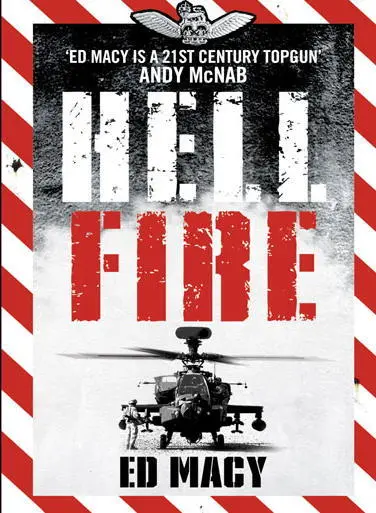
- Название:Hellfire
- Автор:
- Издательство:HarperPress
- Жанр:
- Год:2009
- Город:London
- ISBN:978-0-007-34292-1
- Рейтинг книги:3 / 5. Голосов: 1
-
Избранное:Добавить в избранное
- Отзывы:
-
Ваша оценка:
Hellfire: краткое содержание, описание и аннотация
Предлагаем к чтению аннотацию, описание, краткое содержание или предисловие (зависит от того, что написал сам автор книги «Hellfire»). Если вы не нашли необходимую информацию о книге — напишите в комментариях, мы постараемся отыскать её.
Ed Macy bent every rule in the book to get to where he wanted to be: on Ops in the stinking heat of the Afghan summer, with the world’s greatest weapons system at his fingertips. It’s 2006 and he is part of an elite group of pilots assigned to the controversial Apache AH Mk1 gunship programme. So far, though, the monstrously expensive Apache has done little to disprove its detractors. For the first month ‘in action’ Ed sees little more from his cockpit than the back end of a Chinook.
But everything changes in the skies over Now Zad. Under fire and out of options, Ed has one chance to save his own skin and those of the men on the ground. Though the Apache bristles with awesome weaponry, its fearsome Hellfire missile has never been fired in combat. Then, in the blistering heat of the firefight, the trigger is pulled.
It’s a split-second decision that forever changes the course of the Afghan war, as overnight the gunship is transformed from being an expensive liability to the British Army’s greatest asset. From that moment on, Ed and his squadron mates will face the steepest learning curve of their lives – fighting an endless series of high-octane missions against a cunning and constantly evolving enemy. Ed himself will have to risk everything to fly, fight and survive in the most hostile place on earth.
http://www.youtube.com/watch?v=LNP1lbLNKqA
Hellfire — читать онлайн ознакомительный отрывок
Ниже представлен текст книги, разбитый по страницам. Система сохранения места последней прочитанной страницы, позволяет с удобством читать онлайн бесплатно книгу «Hellfire», без необходимости каждый раз заново искать на чём Вы остановились. Поставьте закладку, и сможете в любой момент перейти на страницу, на которой закончили чтение.
Интервал:
Закладка:
‘You’ll find out soon enough. Now, just concentrate on taxiing this thing because you need to follow that line.’ He paused. ‘So unlock the tail wheel.’
Making sure I didn’t look this time, I pressed the appropriate button on the collective. Immediately, and to my enormous surprise, the tail weather-cocked rapidly to the right.
Whoa!
‘I have control.’ Scottie’s voice was reassuringly calm. ‘You’ve got too much left pedal in. There’s your first lesson.’
I cursed under my breath. Jesus. The power of this thing…
‘You’re overcontrolling. With the tail wheel released you have to use the pedals to keep the aircraft straight and the cyclic to keep it upright. Try again.’
I tried to follow the painted yellow line on the concrete that led towards the gate posts, but it was impossible. I’d never flown a helicopter with wheels before – the Gazelle had skids.
‘Where are you going?’ Scottie asked, as the Apache weaved precariously either side of the line. I was zigzagging all over the place. It was worse than my first driving lesson.
The line was now pointing straight towards the gates but I still couldn’t follow it.
‘Okay,’ he said after several more seconds of this torture. ‘I have control.’
I felt terrible. I’d never known anything like it. I was worried that I’d never get the hang of it.
Scottie plonked us bang on the line and manoeuvred the Apache between the gates and lined us up on a piece of taxiway called the ‘keyhole’ because that was how it looked from the air. It was designed to allow you to take off into wind whichever direction it was coming from.
‘I’m not teaching you this bit, Ed. Just sit back and enjoy it.’
With that, Scottie pulled up on the collective. There was a thunderous noise of downwash as the blades coned upwards, battering the air into submission. For a brief moment, as the two power plants fought to provide the torque that the Apache needed, I became aware of just how massive it was. And then suddenly we were airborne and accelerating skywards.
As I looked back over my shoulder, I saw Pat tracking us with his camera. I had no doubt my taxiing efforts would be enjoyed by all that hadn’t flown yet well before our wheels were reunited with terra firma.
Over the next two months, I learned how to tame the beast. One of the hugely innovative things about the Apache was the degree of automation built into it. Early on, I was taught about ‘holds’ – how you could punch a hold button and maintain the aircraft’s position over the ground in the hover, or its heading, or its speed, or height or a particular rate of turn. There were so many things you needed to stay ahead of in the cockpit that being relieved of the necessity to fly at certain times really helped to shoulder the load. Soon, I was climbing, descending, turning and doing climbing and descending turns.
I learned to master the MPDs – the TV screens that obviated the need for the Apache’s cockpit to be littered with the dozens upon dozens of instruments and dials of its forebears. In fact, the only ones that were common to the US AH64A were four tiny standby instruments in case all of the electrics failed; everything else was requested by the pilot as a page on an MPD. Over 5,000 different information pages could be stored on the computer and displayed on the MPD screens. Learning how to navigate our way through them was like grappling with a new Windows-type software program and we had to know it instinctively. It was the same with the knobs, switches and buttons. There were 227 of them in the cockpit, but most had at least three different modes or functionalities, giving us nearly 700 positions and over a thousand permutations to remember.
We also had to master the monocle. As well as targeting and flight information, it could also display FLIR imagery beneath the data to allow the pilot to see at night. This was all well and good. What wasn’t so good was what they called ‘monocular rivalry’ – it was by far the trickiest task I had ever had to learn.
Basically, your right eye stared at a small glass plate less than an inch from your cornea. Your left eye, meanwhile, was looking at the real world – which could stretch from your cockpit instruments to infinity. Bringing either the left or right image into focus was fairly straightforward, but trying to see both clearly at the same time seemed impossible.
Ever tried it? Which one wins?
The fact was: neither did. Each eye fought the other for supremacy in the brain, threatening to split my head apart. But then, one day, the headaches stopped; my eyes and brain had discovered how to work together. Slowly, I was becoming a part of the machine.
I learned how to do field circuits, hovering, navigation, autorotation and running takeoffs and landings. I then found out how the Apache performed on limited power – i.e. with one engine out. I practised manoeuvring in and out of confined areas – much trickier in this big machine than it had been in the Gazelle – and how to land on a slope; again, not easy in a large helicopter that had narrow wheels for an undercarriage rather than skids.
Finally, I was taught quick-stops, wingovers and high-g turns at max power and performance; how to get to height fast, how to get down fast and how to turn hard.
Then, as 2003 became 2004, it was into the part-task trainers and the simulator again to continue learning how to turn our knowledge into practice. The position and function of every switch and button was supposed to be intuitive by now; as natural as drawing breath. The instructors drilled us hard on this point. The simulator had very little light during this phase and we soon found out why. Everything we’d done had just been a prelude to flying ‘in the bag’.
Flying in the bag did not equate to anything I’d ever done before. During my early sorties in the Apache, I’d noticed Velcro strips around the interior of the cockpit. It turned out that they were to hold big black PVC panels over the clear perspex canopy for ‘bag flights’ – flights in which the student pilot was immersed in darkness. With the PVC panels in place no light entered the rear cockpit. Our only reference to the external world would be via the monocle and the feed from the instruments; the FLIR and the PNVS would be turned off. The thought of flying in the bag terrified me.
It didn’t matter what we’d achieved up till then, if we failed the bag, we’d be out.
With the PVC panels in place the rear cockpit door came down and I was plunged into total darkness for my first bag flight. Scottie flew us out to a disused military camp on Salisbury Plain – somewhere we couldn’t bump into anything, he told me reassuringly. The Pinvis was switched off and the engines were at full pelt. We were parked on a concrete square, around 100 feet by 100.
‘I can do this blindfolded!’ Reminding me of what I’d said time and time again over the past eleven years, Scottie continued to mock me. ‘Now you are. So let’s see, eh?’
I stared at the symbology on my monocle – the only help I was going to get. Scottie wanted me to lift the aircraft ten feet into the air and hold it there. It sounded simple, but I had to do so without the tail weather-cocking and without drifting forwards, backwards, left or right. If I did drift, I had to correct it and reposition the helicopter over my takeoff point.
The symbology would tell me if I was drifting. Instead of the normal crosshair, what I got now was a small circle. This represented the cyclic stick position. Sitting in the centre as it was now meant I wasn’t moving. If a line – a velocity vector – started to grow towards the top of the monocle, I was drifting forwards; to the right and I was heading to the right. All I had to do was move the cyclic between my legs in the opposite direction to the velocity line and it would return to its starting point; we would stop drifting. No rocket science there.
Читать дальшеИнтервал:
Закладка:
Похожие книги на «Hellfire»
Представляем Вашему вниманию похожие книги на «Hellfire» списком для выбора. Мы отобрали схожую по названию и смыслу литературу в надежде предоставить читателям больше вариантов отыскать новые, интересные, ещё непрочитанные произведения.


Обсуждение, отзывы о книге «Hellfire» и просто собственные мнения читателей. Оставьте ваши комментарии, напишите, что Вы думаете о произведении, его смысле или главных героях. Укажите что конкретно понравилось, а что нет, и почему Вы так считаете.