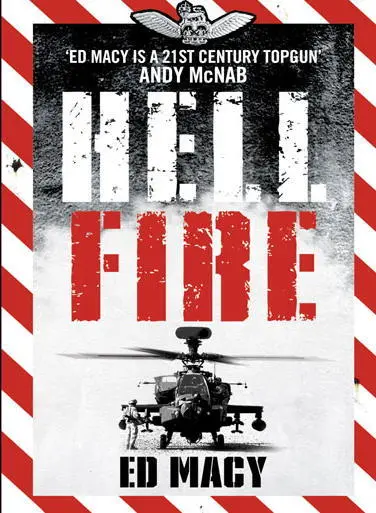
Ed Macy - Hellfire
Здесь есть возможность читать онлайн «Ed Macy - Hellfire» — ознакомительный отрывок электронной книги совершенно бесплатно, а после прочтения отрывка купить полную версию. В некоторых случаях можно слушать аудио, скачать через торрент в формате fb2 и присутствует краткое содержание. Город: London, Год выпуска: 2009, ISBN: 2009, Издательство: HarperPress, Жанр: Биографии и Мемуары, nonf_military, на английском языке. Описание произведения, (предисловие) а так же отзывы посетителей доступны на портале библиотеки ЛибКат.
- Название:Hellfire
- Автор:
- Издательство:HarperPress
- Жанр:
- Год:2009
- Город:London
- ISBN:978-0-007-34292-1
- Рейтинг книги:3 / 5. Голосов: 1
-
Избранное:Добавить в избранное
- Отзывы:
-
Ваша оценка:
Hellfire: краткое содержание, описание и аннотация
Предлагаем к чтению аннотацию, описание, краткое содержание или предисловие (зависит от того, что написал сам автор книги «Hellfire»). Если вы не нашли необходимую информацию о книге — напишите в комментариях, мы постараемся отыскать её.
Ed Macy bent every rule in the book to get to where he wanted to be: on Ops in the stinking heat of the Afghan summer, with the world’s greatest weapons system at his fingertips. It’s 2006 and he is part of an elite group of pilots assigned to the controversial Apache AH Mk1 gunship programme. So far, though, the monstrously expensive Apache has done little to disprove its detractors. For the first month ‘in action’ Ed sees little more from his cockpit than the back end of a Chinook.
But everything changes in the skies over Now Zad. Under fire and out of options, Ed has one chance to save his own skin and those of the men on the ground. Though the Apache bristles with awesome weaponry, its fearsome Hellfire missile has never been fired in combat. Then, in the blistering heat of the firefight, the trigger is pulled.
It’s a split-second decision that forever changes the course of the Afghan war, as overnight the gunship is transformed from being an expensive liability to the British Army’s greatest asset. From that moment on, Ed and his squadron mates will face the steepest learning curve of their lives – fighting an endless series of high-octane missions against a cunning and constantly evolving enemy. Ed himself will have to risk everything to fly, fight and survive in the most hostile place on earth.
http://www.youtube.com/watch?v=LNP1lbLNKqA
Hellfire — читать онлайн ознакомительный отрывок
Ниже представлен текст книги, разбитый по страницам. Система сохранения места последней прочитанной страницы, позволяет с удобством читать онлайн бесплатно книгу «Hellfire», без необходимости каждый раз заново искать на чём Вы остановились. Поставьте закладку, и сможете в любой момент перейти на страницу, на которой закончили чтение.
Интервал:
Закладка:
It was dark outside the cockpit. I glanced down at the MPD to see we were passing through 200 feet with a 4,800ft per minute rate of descent. Eighty feet per second with enough ammunition on board to win a small war. The MPDs cut out as we lost all electrics. I was now totally blind. I didn’t know which way was up. I knew we were coming up for impact so I grabbed the coaming to brace myself and prayed.
The seat crunched into my spine and the windows bloomed bright red.
Total silence…
The silence was broken by a voice in my headset: ‘Ed, Pat, that will be a re-fly. See you both in the debriefing room in ten.’
Thank fuck we’d been in a simulator.
The instructor debriefed us on our performance. We had become so engrossed in trying to kill the recce car that we had flown too close to the enemy. A guy with a shoulder-launched SAM-7 had shot us down. The missile had hit us just aft of the engines and taken out the tail rotor. The blast had pitched us forward and the loss of tail rotor authority had given us the spin. Keeping the speed on could have helped us regain control, but it was hard to want to keep flying fast when you were only a thousand feet up, and pointing straight at mother earth. Pulling up had slowed the aircraft’s speed, but then I’d lost the tail altogether.
My only saving grace was that I had managed to level the aircraft before impact.
Would I have survived?
Yes, but not without some back surgery – and I didn’t want to go there again. Had we crashed at or less than 3,660 feet per second I could have walked away unscathed. The Apache was the most survivable helicopter in the world. Pilots had crashed at multiple G levels and walked away without injury. The cockpits were guaranteed to maintain 85 per cent of their original shape in an impact.
Would my front-seater have survived?
Probably not. Pat’s face would have ploughed into the ORT, the metal tube that jutted out of the coaming in front of him.
I felt embarrassed. Both of us should have been aware of the proximity of threat. I was working so hard just flying the aircraft aggressively to keep us on target I’d had no spare mental capacity. I’d become saturated and then I’d drowned in what they called my ‘ability reservoir’ – a reservoir I was beginning to realise was more of a puddle.
Pat had been trying so hard to hit the vehicle with the cannon that he’d been unable to process any other information. We’d both had classic target fixation and the direct result had been loss of situational awareness.
So, we had failed the sortie – a sortie that had been flown in a simulator. Strike one on CTR. What was interesting about this, when I managed to get past the humiliation, was that I’d grabbed the coaming in a bid to diminish the impact of…well, nothing; it was just a simulator.
I found out later I was not alone. The Apache simulator was so good that you forgot where you were within seconds of taking off. When you were in it, you really did think it was the real thing.
A year earlier, things had kicked off in Iraq. British troops stationed in and around Al-Amarah had found themselves locked in a brutal insurgency war. Armed with AK47s and rocket propelled grenades (RPGs), the followers of Muqtada Al-Sadr had been in almost continuous contact with British Army troops since April 2004.
Things were also beginning to hot up in Afghanistan, where unrest fomented by a reconstituted Taliban – supposedly defeated in 2002 – was beginning to destabilise the nascent democracy of Afghan president Hammid Karzai. To keep the peace, Britain had recently announced that it was due to send several thousand more troops to supplement the thousand or so it already had in-theatre.
It added fresh fuel to our efforts to master the Apache in all its complexity. I was appointed as the Squadron Weapons Officer – the SWO. My workload doubled overnight.
CTR saw us learning how to conduct single-ship ops in the Apache, then two-ship ops-flight missions – then finally whole squadron operations. The squadron, led by our OC, Major Black, was split into three flights and a Headquarters Flight, with two Apaches each. We formally completed CTR on 16 September 2004 and were awarded our Initial Operating Capability (IOC).
The IOC allowed us to deploy four Apaches to a semi-permissive environment for recce and strike but warned the government that we were unable to sustain any prolonged operations. As significant a milestone as it was, we were a long way from being combat-ready. We still needed to integrate with the rest of the British Army and the wider services.
From October onwards we exercised with everybody, starting with the RAF on Combined Air Operations. During ComAOs, Apaches and RAF combat jets learned how to mount escort missions for Chinooks, the RAF’s principal transport helicopter. We practised convoy protection missions – keeping watch over the life blood of logistics support operations in Iraq and Afghanistan.
The first six months of 2005 we exercised with 16 Air Assault Brigade, the troops ready to deploy to any hot-spot at a moment’s notice. After a particularly gruelling exercise Lieutenant Colonel Felton gathered us together and announced that we had achieved TFAD. The Task Force Availability Date meant we could now deploy as a regiment to conduct operations in support of other units, but under the kind of restrictions that would take a brave government pen-pusher to sign off.
Soon afterwards we joined HMS Ocean off the coast of Northumberland for a couple of weeks of ship-borne takeoffs and deck landings. In late summer we joined it again off the south coast. We had learned how to fly to and from HMS Ocean in the North Sea; this visit was about learning how to fight from her. Over a month we flew numerous sorties from the helicopter support vessel to the Castle Martin weapons range in Wales, where we carried out attacks in representative combat conditions against targets on the ground. There wasn’t a firing range big enough in the UK to safely accommodate the range envelope of the Hellfire – but we shot off just about everything else.
We felt we’d got about as close as we could ever come, short of a real shooting war, to mastering the beast. As it turned out, this was just as well.
Lieutenant Colonel Felton had been briefed on the likelihood of our going to Afghanistan. In October, he was pretty much certain. As the weeks marched towards Christmas, it became the worst kept secret in the army.
With our short Christmas break behind us, the CO confirmed that 16 Air Assault Brigade had received orders to deploy to Afghanistan in support of the Afghan government. Along with 1310 Flight from RAF Odiham, 9 Regiment Army Air Corps was to form part of the Joint Helicopter Force (JHF) in support of the legendary 3 Para battlegroup.
The JHF would consist of eight Apaches and eight Chinooks; our brief was to provide four of each per day to whoever needed them, plus a couple of Lynx for good measure.
We were already gelling with 16 Air Assault Brigade. Our problem was that we hadn’t live-fired with them – and we hadn’t so much as seen a live Hellfire, let alone found somewhere big enough to fire it.
And we were due to deploy in May – just five months away.
DUSTY HELLFIRE
Our imminent deployment changed one very significant aspect of our operations. Up until now we had been concentrating our training in the low-level environment. At less than a hundred feet off the deck we were an extremely hard target to hit. It didn’t matter if we were two Apaches or a formation of eight Chinooks and eight Apaches – we blasted across the European landscape as fast and as low as we could.
If someone had wanted to shoot us down they would have been hard pressed. The ground clutter – villages, towns, hedges, trees, woods and forests – would mask our arrival and departure both visually and audibly. By the time we were spotted or heard, we’d be gone. That, at least, was what the manual said – and we now had no reason to doubt it.
Читать дальшеИнтервал:
Закладка:
Похожие книги на «Hellfire»
Представляем Вашему вниманию похожие книги на «Hellfire» списком для выбора. Мы отобрали схожую по названию и смыслу литературу в надежде предоставить читателям больше вариантов отыскать новые, интересные, ещё непрочитанные произведения.




Обсуждение, отзывы о книге «Hellfire» и просто собственные мнения читателей. Оставьте ваши комментарии, напишите, что Вы думаете о произведении, его смысле или главных героях. Укажите что конкретно понравилось, а что нет, и почему Вы так считаете.