Ed Macy - Hellfire
Здесь есть возможность читать онлайн «Ed Macy - Hellfire» — ознакомительный отрывок электронной книги совершенно бесплатно, а после прочтения отрывка купить полную версию. В некоторых случаях можно слушать аудио, скачать через торрент в формате fb2 и присутствует краткое содержание. Город: London, Год выпуска: 2009, ISBN: 2009, Издательство: HarperPress, Жанр: Биографии и Мемуары, nonf_military, на английском языке. Описание произведения, (предисловие) а так же отзывы посетителей доступны на портале библиотеки ЛибКат.
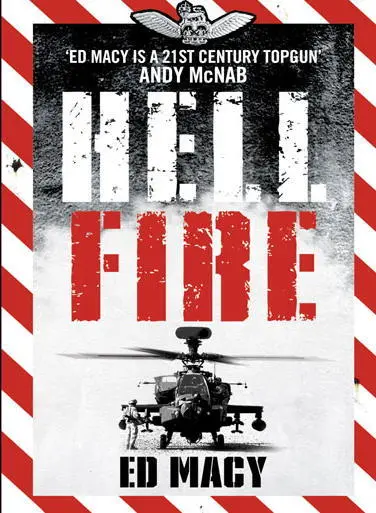
- Название:Hellfire
- Автор:
- Издательство:HarperPress
- Жанр:
- Год:2009
- Город:London
- ISBN:978-0-007-34292-1
- Рейтинг книги:3 / 5. Голосов: 1
-
Избранное:Добавить в избранное
- Отзывы:
-
Ваша оценка:
Hellfire: краткое содержание, описание и аннотация
Предлагаем к чтению аннотацию, описание, краткое содержание или предисловие (зависит от того, что написал сам автор книги «Hellfire»). Если вы не нашли необходимую информацию о книге — напишите в комментариях, мы постараемся отыскать её.
Ed Macy bent every rule in the book to get to where he wanted to be: on Ops in the stinking heat of the Afghan summer, with the world’s greatest weapons system at his fingertips. It’s 2006 and he is part of an elite group of pilots assigned to the controversial Apache AH Mk1 gunship programme. So far, though, the monstrously expensive Apache has done little to disprove its detractors. For the first month ‘in action’ Ed sees little more from his cockpit than the back end of a Chinook.
But everything changes in the skies over Now Zad. Under fire and out of options, Ed has one chance to save his own skin and those of the men on the ground. Though the Apache bristles with awesome weaponry, its fearsome Hellfire missile has never been fired in combat. Then, in the blistering heat of the firefight, the trigger is pulled.
It’s a split-second decision that forever changes the course of the Afghan war, as overnight the gunship is transformed from being an expensive liability to the British Army’s greatest asset. From that moment on, Ed and his squadron mates will face the steepest learning curve of their lives – fighting an endless series of high-octane missions against a cunning and constantly evolving enemy. Ed himself will have to risk everything to fly, fight and survive in the most hostile place on earth.
http://www.youtube.com/watch?v=LNP1lbLNKqA
Hellfire — читать онлайн ознакомительный отрывок
Ниже представлен текст книги, разбитый по страницам. Система сохранения места последней прочитанной страницы, позволяет с удобством читать онлайн бесплатно книгу «Hellfire», без необходимости каждый раз заново искать на чём Вы остановились. Поставьте закладку, и сможете в любой момент перейти на страницу, на которой закончили чтение.
Интервал:
Закладка:
We received our briefings on Afghanistan in early January and were given our Area of Responsibility (AOR): Helmand Province – the lawless badlands in the south, the last known hideout of Osama Bin Laden.
We would be operating in a barren wasteland – the Dasht-e-Margo, or Desert of Death. The vast majority of our work would be carried out in this environment, but we were also likely to operate in the mountainous north. If we operated low level out there we would be seen from miles away and have nowhere to hide.
Then we got our threat brief.
Supporting 3 Para’s battlegroup would entail escorting Chinooks into and out of austere locations laden with men and materiel. We would also be responsible for protecting the Paras should they get into any trouble. John Reid, the UK Secretary of State for Defence, had just visited Afghanistan and announced to the world that everything was going swimmingly; that 16 Brigade would probably be in and out of the country without firing a shot. Needless to say, anyone with a modicum of military experience ridiculed this statement. We hoped for the best but trained for the worst.
The Taliban, Al-Qaeda (AQ) and the HIG – the Hezb-I Islami Gulbuddin – were not known for their willingness to cooperate. We were briefed that there was a distinct possibility they would stand their ground and fight. Their easiest target – one that would cause the greatest amount of casualties for least effort – would be to shoot down a Chinook stuffed full of Paras. The unholy triumvirate knew that sending body bags home would sway UK public opinion against the war and hoped, in turn, that this might persuade Blair’s government to withdraw from Afghanistan.
We expected to have the following weapons fired at us: small arms (SA), machine guns (MGs), heavy machine guns (HMGs), rocket propelled grenades (RPGs), anti-aircraft guns (AA), and Man Portable Air Defence Systems (ManPADS)-shoulder-launched SAMs. Any one of these was more than capable of shooting us down if we stuck to the low-level environment.
If we operated above what was called the ‘small arms band’ – the expanse of sky where SAs, MGs, HMGs and RPGs were deemed effective – we would go a long way to reduce that risk. The Apache’s HIDAS would take care of any SAMs. AA guns were the only remaining threat, but they were extremely difficult to operate, used up lots of ammunition quickly and were hard to maintain. Lack of training and practice since the Russian invasion also meant they were unlikely to be used effectively. It didn’t take a genius to decide that flying at altitude would be the safest option – but the big questions still stood: could we fulfil the mission? Would we be able to get through the small arms band safely and do our job at altitude?
As a young Para I learned the art of shooting down helicopters and slow aircraft on Salisbury Plain by practising on target drones. We were shown how difficult it was to hit one if it varied its velocity, azimuth and elevation without warning. And while instructing Air Comat Tactics from 1998 to 2003, I demonstrated how to change direction, altitude and speed to throw off the hostile gunner. The trick was to swiftly recognise the threat.
We flew to Thumrait Airfield in Oman – where it was suitably hot, desiccated and mountainous – for the month-long Exercise Desert Eagle.
Billy was my instructor for dust-landings. We had bumped into each other on a number of occasions since my Basic Rotary Wing Course at Wallop. He’d been to the Apache academy in America before instructing on CTT1, and we were privileged to have him as our Squadron Qualified Helicopter Instructor (SQHI). He was very open and had the knack of getting the best out of people. ‘If you’ve done something wrong, if you’ve made a mistake, don’t hide it,’ he used to say. ‘Chances are, if you’re doing it, others might be too. You’ll be dealt with, but you won’t be punished; and you might just save someone’s life.’
When he wasn’t flying helicopters, Billy drove his Lambretta come rain or shine. If his life had been a movie, it would have been a cross between Blue Thunder and Quadrophenia , with a soundtrack by The Jam.
To perfect a dust-landing, Billy explained, we would need to employ what he called a ‘zero-zero’ technique: to reduce speed and height simultaneously in a steep approach, and to avoid rolling forward by reaching zero speed and zero height at exactly the same time. We had to trust our symbology because we would lose all external references in the final stage. Dust-landings would be like ‘the bag’ on speed.
We gave it a spin the following morning. Billy warned me it was going to be alien and uncomfortable, quite unlike anything I’d done before. The dust and sand would disorientate me; if I didn’t focus 100 per cent on the symbology, I would crash. If I got distracted, I would lose all sense of my position relative to the landing zone. Any drift would end up, at best, with the Apache rolling onto its side, and thrashing itself to pieces. At worst, we might end upside down.
No pressure then.
Billy took the reins and selected a solitary rock in the otherwise featureless landscape to land beside. It scared the shit out of me. Forty feet up, I couldn’t see a thing outside the window and my PNVS had gone as blind as I had. I only knew we were down when there was a thump as we hit the ground firmly on all three wheels. When the dust cleared I could see he’d parked the Apache right next door to it.
‘Happy with that, Ed?’
‘You must be having a laugh. I want to see you do that again to make sure you weren’t using the Force…’
Billy fancied himself as a bit of a Han Solo, but he shook his head. ‘Stop being a wuss.’ He grinned. ‘Your go.’
Second time around he talked me through the final 100 feet.
‘Concentrate on the symbology and digital readouts, Ed. Watch your speed and height readouts and keep them coming down in tandem. You need to make constant cyclic, collective and pedal adjustments to maintain an accurate countdown. We can’t afford to come into the hover or have any speed on when we hit the ground.’
Righty-fucking-ho …
Then, suddenly, it was like a bad day out with Lawrence of Arabia.
‘I’m losing all references, Billy.’
‘Me too, mate. Not a drama. Just hang in there and concentrate on the symbology. Passing forty-six feet, keep driving her forward…keep driving her down…I’m totally blind now…’
It was a fucking nightmare out there. I forced myself to focus on the velocity vector, heading and height in my monocle rather than the dust cloud billowing around us.
Billy’s calm voice helped me to stay in the zone.
‘While maintaining your scan on the heading and height and using control inputs, watch the symbology. Look at the velocity vector, Ed.’
The velocity vector – the line that told me my speed and direction of drift – edged back towards the centre circle in my monocle.
‘Keep it coming back towards the middle, but do not let it move out to the side. If you do, we’ll roll over. Keep bringing the velocity vector back using the cyclic and the height down with the collective. At the same time, keep an eye on the heading tape and adjust the pedals to make sure she doesn’t turn off heading. We’re getting into the ground cushion now, so force it down with the collective and keep her moving forward with the cyclic, constantly reducing the rate on both. You okay?’
I couldn’t see a fucking thing outside. ‘Five feet to go…’
‘Critical time, Ed… Any drift and we’re crashing this thing.’
Bloody marvellous.
I felt a bump as the Apache’s struts absorbed the impact.
‘And we’re down,’ Billy said as if we’d done nothing more arduous than reach the ground floor in a lift.
Читать дальшеИнтервал:
Закладка:
Похожие книги на «Hellfire»
Представляем Вашему вниманию похожие книги на «Hellfire» списком для выбора. Мы отобрали схожую по названию и смыслу литературу в надежде предоставить читателям больше вариантов отыскать новые, интересные, ещё непрочитанные произведения.



Обсуждение, отзывы о книге «Hellfire» и просто собственные мнения читателей. Оставьте ваши комментарии, напишите, что Вы думаете о произведении, его смысле или главных героях. Укажите что конкретно понравилось, а что нет, и почему Вы так считаете.