Robert Mason - Chickenhawk
Здесь есть возможность читать онлайн «Robert Mason - Chickenhawk» весь текст электронной книги совершенно бесплатно (целиком полную версию без сокращений). В некоторых случаях можно слушать аудио, скачать через торрент в формате fb2 и присутствует краткое содержание. Город: New York, Год выпуска: 2005, ISBN: 2005, Издательство: Penguin Books, Жанр: Биографии и Мемуары, nonf_military, на английском языке. Описание произведения, (предисловие) а так же отзывы посетителей доступны на портале библиотеки ЛибКат.
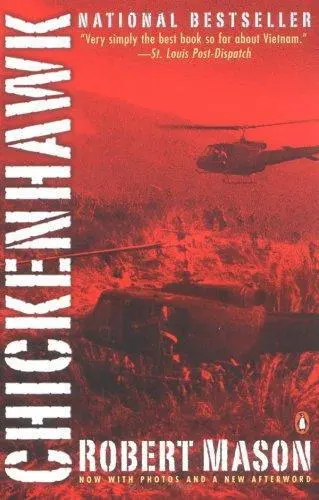
- Название:Chickenhawk
- Автор:
- Издательство:Penguin Books
- Жанр:
- Год:2005
- Город:New York
- ISBN:9780143035718
- Рейтинг книги:4 / 5. Голосов: 1
-
Избранное:Добавить в избранное
- Отзывы:
-
Ваша оценка:
Chickenhawk: краткое содержание, описание и аннотация
Предлагаем к чтению аннотацию, описание, краткое содержание или предисловие (зависит от того, что написал сам автор книги «Chickenhawk»). Если вы не нашли необходимую информацию о книге — напишите в комментариях, мы постараемся отыскать её.
have been sold since it was first published in 1983. Now with a new afterword by the author and photographs taken by him during the conflict, this straight-from-the-shoulder account tells the electrifying truth about the helicopter war in Vietnam. This is Robert Mason’s astounding personal story of men at war. A veteran of more than one thousand combat missions, Mason gives staggering descriptions that cut to the heart of the combat experience: the fear and belligerence, the quiet insights and raging madness, the lasting friendships and sudden death—the extreme emotions of a “chickenhawk” in constant danger.
Robert Mason enlisted in the army in 1964 and flew more than 1,000 helicopter combat missions before being discharged in 1968. [
]’s vertical plunge into the thickets of madness will stun readers.
(
) Mason’s gripping memoir… proves again that reality is more interesting, and often more terrifying, than fiction.
(
) Very simply the best book so far out of Vietnam.
(
)
Chickenhawk — читать онлайн бесплатно полную книгу (весь текст) целиком
Ниже представлен текст книги, разбитый по страницам. Система сохранения места последней прочитанной страницы, позволяет с удобством читать онлайн бесплатно книгу «Chickenhawk», без необходимости каждый раз заново искать на чём Вы остановились. Поставьте закладку, и сможете в любой момент перейти на страницу, на которой закончили чтение.
Интервал:
Закладка:
I laughed. I was surprised myself.
By that evening, the scattered patrols, platoons, and companies consolidated themselves. It turned out that Carpenter had lost fewer men than he had thought. Only half his company were among the dead or wounded. The others had been separated in the tight brush. The jungle was the enemy’s ally, and as long as he forced us to fight in its strangling hold, we would lose. Carpenter’s heroic, suicidal solution left him miraculously unscathed—and had stopped the rout. But we lost the battle.
The grunts were pulled back past the artillery position to wait for the Cav and the air force. The air force was sending B-52-loads of one-thousand-pound bombs from Guam.
The bombs were supposed to kill a lot of NVA; the survivors were to race up the ridges, pursued by the 101st; and the Cav—way up north—would smash them. The scope was too big. The delay caused by waiting for the air force was too long.
Early the next day, Gary and I and the rest of the Prospectors stopped in our tracks in the company area. A monstrous storm thundered up the valley from the south. The noise grew so loud you couldn’t hear the voices around you. The storm was the monster gaggle sent by the Cav.
The Cav raced up the valley, at least eighty ships, at low level, and fast. The gaggle flew over us and continued north to their assigned objective. Minutes later, the last of their formation disappeared, and the roar silenced.
“Damn! I don’t think I’ve ever seen so many Hueys flying all at once,” someone said. I admit that I felt a sense of pride on seeing my old unit. They were—in this part of the world—the big time.
The Cav’s image lost some of its gloss that same afternoon.
The 101st fought scattered firefights among a hundred branching valleys. A Cav gunship company was borrowed to help out. It was to support a ground commander who had radioed that he wanted the Cav to pulverize a spot where he would throw smoke. Yellow smoke.
Near where the 101st wanted the Cav to strike, a radio operator walked along with his patrol. He carried several smoke grenades on his belt. One of them, of course, was yellow.
At the moment the grunt commander, a mile away from the radio operater, announced that he had thrown yellow smoke, a branch pulled the yellow-smoke grenade from the radio operator’s belt, popping the pin. The radio operator and his platoon were immediately swallowed up in the chalky yellow smoke. The Cav gunships happened to be only a few hundred meters away, looking for the yellow smoke that marked their target.
The gunship rogered that they saw the smoke, and attacked. They even saw people running around under the smoke and thought they were getting old Charlie.
When the commander noticed that his yellow smoke was not being hit—that someone else’s yellow smoke was being attacked—he screamed at the gunships to stop.
It was lucky he did. In just a few seconds they had already killed the radio operator’s platoon leader and wounded twenty-one others, including the radio operator himself.
It was a freak accident, but the Cav was labeled clumsy. And after such a dramatic entrance, too. It ruined their image. The Prospectors and the 101st felt safer, knowing that the Cav would be way up north, somewhere, as the anvil. We were the hammer.
The following day, all the 101st units were pulled back in preparation for the bombing.
The NVA were not dummies. They knew that something was up. They faded into the jungle. According to the hundreds of grease-pencil marks on the maps, the NVA were surrounded, about to be driven along the ridge, north, into the hands of the clumsy but mighty Cav. The next morning, the air force was due for its part of the squeeze.
Sky King and I were assigned to carry a television film crew up and down a dirt road that marked the western boundary of the bombing zone. Pictures of bombs, especially gigantic bombs, going off have great PR value, everyone knows.
The clouds sank into the valley, hiding the mountaintops. Sky King and I cruised nervously, at 500 feet above the road. We had been assured that the air force did not miss, that it was practically impossible to be hit by a stray bomb. Our feeling was, “Bullshit.” The air force misses, a lot.
At the exact moment the bombs were supposed to hit, they did. I had just turned back, heading up the road, when we saw the hillsides a quarter mile away begin to erupt. Intersecting concussion spheres, visible in the close air, suddenly expanded away from the ground. Circles in the heavily wooded hills became instantly nude. The thousand-pound bombs fell in rapid succession, systematically and devastatingly, traveling along the ridges, in the ravines, against the hillsides, a visual staccato of overlapping blasts, tearing the earth asunder. We heard oohs and aahs from the film crew. The pattern of destruction had started across the valley from us and moved closer. Somewhere, 30,000 feet above the cloud cover, some very good bomber crews were keeping the bombs within the designated area. Charlie must be turning into hamburger.
After a half hour of this, the bombs had reached the road. The concussion rings were not only visible; they were tangible. The ship rocked in the explosions. They were going off right on the road, so I moved off the track. One bomb exploded in front of us, past the road, and for a minute I thought we might be seeing just how well a Huey holds up to thousand-pound bombs, when the bombing stopped.
Silence. The valley swirled in stringy smoke. Leafless trees stood at bizarre angles. The ground was gray and charred between monstrous craters. No one could have survived that apocalypse.
The end of the bomb run was the cue, and scores of Hueys flew in, dropping grunts all over the torn valley floor. It was the end of our mission, so I lingered only a little while before turning back to the airstrip.
I was impressed. The film crew was impressed. The grunts were impressed. But the gooks were not impressed. They were gone. They did leave behind a few men, and these were captured, dazed but intact—something like twenty NVA.
So now it was up to the Cav.
The Cav searched the ridges and the valleys for two days. And then they closed back to the bombed valley. When the net was closed, no fish were found. The dumb little barbarians had got away, showing not the least respect for superior technology. They had used judo, and bent with the force.
But a bombing was a bombing, and fighting is fighting, and many men had been heroic indeed. The battle, though lost, had been impressive.
General Westmoreland himself flew up from Saigon to pin on medals. Captain Carpenter was given a silver star and was put on Westmoreland’s staff.
Near the end of June, I got very twitchy. Being a short-timer made life difficult. It would almost be better not to know when you were due to return. As the day drew closer—only fifty days to go—the possibility of dying seemed more imminent, like I had already used up my breaks and would be getting it any day now. Somewhere between now and the day I left was the mission, probably a typical little mission-light fire—and just one little stray bullet would go through my forehead.
Nights were hell. Even with the tranquilizers Doc DaVinci gave me, I kept snapping awake at unseen dangers. Daytime was fine when I flew. The ice business also kept me busy. But when I wasn’t flying—a few hours between missions, or a day off—I grew morose. Nothing that I saw convinced me that we were doing the right thing in Vietnam. I even harbored a sympathy for the enemy, which made me feel guilty.
The local war, the one I was in, went on every day. I was part of it. In the air, I did my job the best I knew how. I flew, as did all the pilots, into hot LZs, because in the middle of the confusion the hazy principles over which the war was fought disappeared. Everything else was excluded. Even I was excluded.
Читать дальшеИнтервал:
Закладка:
Похожие книги на «Chickenhawk»
Представляем Вашему вниманию похожие книги на «Chickenhawk» списком для выбора. Мы отобрали схожую по названию и смыслу литературу в надежде предоставить читателям больше вариантов отыскать новые, интересные, ещё непрочитанные произведения.








Обсуждение, отзывы о книге «Chickenhawk» и просто собственные мнения читателей. Оставьте ваши комментарии, напишите, что Вы думаете о произведении, его смысле или главных героях. Укажите что конкретно понравилось, а что нет, и почему Вы так считаете.