Robert Mason - Chickenhawk
Здесь есть возможность читать онлайн «Robert Mason - Chickenhawk» весь текст электронной книги совершенно бесплатно (целиком полную версию без сокращений). В некоторых случаях можно слушать аудио, скачать через торрент в формате fb2 и присутствует краткое содержание. Город: New York, Год выпуска: 2005, ISBN: 2005, Издательство: Penguin Books, Жанр: Биографии и Мемуары, nonf_military, на английском языке. Описание произведения, (предисловие) а так же отзывы посетителей доступны на портале библиотеки ЛибКат.
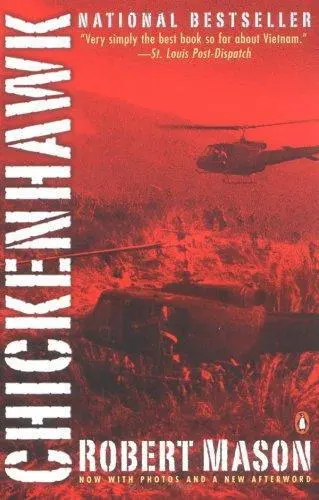
- Название:Chickenhawk
- Автор:
- Издательство:Penguin Books
- Жанр:
- Год:2005
- Город:New York
- ISBN:9780143035718
- Рейтинг книги:4 / 5. Голосов: 1
-
Избранное:Добавить в избранное
- Отзывы:
-
Ваша оценка:
Chickenhawk: краткое содержание, описание и аннотация
Предлагаем к чтению аннотацию, описание, краткое содержание или предисловие (зависит от того, что написал сам автор книги «Chickenhawk»). Если вы не нашли необходимую информацию о книге — напишите в комментариях, мы постараемся отыскать её.
have been sold since it was first published in 1983. Now with a new afterword by the author and photographs taken by him during the conflict, this straight-from-the-shoulder account tells the electrifying truth about the helicopter war in Vietnam. This is Robert Mason’s astounding personal story of men at war. A veteran of more than one thousand combat missions, Mason gives staggering descriptions that cut to the heart of the combat experience: the fear and belligerence, the quiet insights and raging madness, the lasting friendships and sudden death—the extreme emotions of a “chickenhawk” in constant danger.
Robert Mason enlisted in the army in 1964 and flew more than 1,000 helicopter combat missions before being discharged in 1968. [
]’s vertical plunge into the thickets of madness will stun readers.
(
) Mason’s gripping memoir… proves again that reality is more interesting, and often more terrifying, than fiction.
(
) Very simply the best book so far out of Vietnam.
(
)
Chickenhawk — читать онлайн бесплатно полную книгу (весь текст) целиком
Ниже представлен текст книги, разбитый по страницам. Система сохранения места последней прочитанной страницы, позволяет с удобством читать онлайн бесплатно книгу «Chickenhawk», без необходимости каждый раз заново искать на чём Вы остановились. Поставьте закладку, и сможете в любой момент перейти на страницу, на которой закончили чтение.
Интервал:
Закладка:
“Now what?” asked Niven.
“I’m going down to the end of the ravine, circle back, and try it again.” .
“We’re too heavily loaded.”
“Yeah, but I think I know where he wants it now.”
Niven called Delta Six.
“Thank you,” said the grateful voice.
As I cruised slowly toward the knoll, the muzzle flashes began. Then a tongue of tracers flitted off to our left. Apparently we were hard to see, because we hadn’t been hit yet. From the conversation during the first attempt, I had a feeling where Delta Six was and where he wanted us to drop the ammo.
“That’s it!” he yelled. “Hold it right there.”
I stopped the ship. As she sank toward the trees, Delta Six called, “Okay, dump ‘em.”
With much scraping and bumping, the boxes were shoved from the ship. They dropped seventy-five feet through the branches and leaves. The ship gained power as it lightened.
“Great job!” yelled Delta Six. “Nobody was hit. Great job. Thank you, Prospector.”
I hit one more treetop on the way out, bounced toward the ravine, and accelerated. Ten minutes later we were back at HQ being credited with saving their lives. Delta Six and his men had fired the last of their ammo to cover us.
The next morning, Delta Six had managed to push back the NVA—or the latter pulled back—and a Chinook hovered over the spot and hoisted out the wounded. Another Chinook pulled out the last of the living along with the dead.
The 101st was getting the action they had craved. Unfortunately, the territory was the enemy’s home field. In some of the LZs the grunts had cut on hilltops, the stumps were so close together that it was difficult to get the skids to fit between them. The American patrols hacked through the brush, struggling toward objectives, only to become hopelessly lost. Commanders constantly reported men missing in action who were in fact lost—you couldn’t see a man ten feet away. While they fought the jungle, the NVA harrassed them, attacked them, and sometimes overran them. When platoons and companies came under heavy attack, rescue units sent out to help them became lost, scattered, and surrounded. For days, the 101st had lost units looking for lost units looking for lost units. It was total confusion. In that confusion, many men died.
In these conditions our helicopters were the least effective in helping the grunts. We were constantly out trying to find men who cried for help on the radio but who were totally hidden in the jungle. One company we tried to save was completely wiped out as we flew above the canopy trying to find them. Their radio went dead, and they were gone.
Another company—led by a West Point football player, Bud Carpenter—became famous because Carpenter called in an airstrike on his position as he was being overrun.
Sky King and I were in the air, orbiting Carpenter’s position. Carpenter was trying to get to an old LZ to be extracted. We listened on the radio and watched the LZ, waiting for him to show up.
“We can’t make it to the LZ,” radioed Carpenter. “They’re all around us.”
“What’s your position?” implored Gunfighter Six, Carpenter’s CO.
“I’m one hundred meters east of the LZ,” said Carpenter calmly. Gunfire crackled with his voice. “I see only six men around me,” he lamented. “They’re moving closer. I want an airstrike here, now.”
“On your own position?” asked Gunfighter Six.
“Yes. Hurry.”
Two A1-E’s were already on station. They got their instructions in seconds and began to hit the coordinates. They dropped napalm, bombs, and then strafed. Carpenter’s position was covered in smoke. A long silence followed.
“That did it,” said Carpenter’s tired voice. “They stopped.”
Gunfighter Six said, “If things don’t work out to the good, I want you to know that I’m putting you in for the Medal of Honor.”
No reply.
“Also, I’m sure that when we get to you, we’ll find a lot of dead VC.”
“All I can see are my own people…” said the quiet voice.
“We’re sending help,” said Gunfighter Six.
Moments later, Gunfighter Six called us. He wanted us to land at his position, near the artillery emplacement.
“I can’t understand it,” he said. He sat on the deck of our Huey holding a plastic-covered map board. He looked gaunt and sad. He pointed to a circled spot on the green paper. “I don’t understand it. They’ve got to be here.” He was talking about a platoon he was trying to send to Carpenter’s position. But the platoon wasn’t there, because when the men fought in the direction he directed, they found nothing and became pinned down. Gunfighter Six was depressed. He had it all worked out on his game board, and the labels were all in the right place, but the men weren’t.
“I want you to fly out and find this unit.” He pointed to the map. “Find them and give them an azimuth to here.” He moved his finger across the board to Carpenter’s position.
A major and a captain got in the back of our ship with a big radio. We took off.
I flew slowly across the treetops, listening to the grunts’ radio instructions. They could hear our ship. Using our sound, they directed us right over them. During the crisscross search pattern, the enemy did not shoot. But when I found and circled a unit, they opened up from the high ground around us. I heard one tick. I flew past the unit, turned, and came back over them in the exact direction they were to go. “Go this way,” radioed the major from behind us.
The unit rogered its orders. The major had us look for another lost patrol. Again, while we cruised back and forth over the jungle, right in front of the enemy’s hillside, they did not shoot. But as soon as I circled, they opened up. The hillside was peppered with muzzle flashes. We were so close to one NVA barrage we could hear the crackling rifle fire. I felt a thump in the air frame and turned around and saw the major hitting the deck—not shot, but following his instinct to hit the deck under fire. It was kind of funny that he thought the deck was any protection—bullets went through it like tinfoil—but I didn’t laugh.
I turned and came back over the invisible men on the heading they were to follow. As we crossed them, Sky King radioed, “Two-six-zero degrees.” The lieutenant below rogered.
And we did it again. And again. In a couple of hours, we had redirected all the lost units. The ones who still talked, anyway. They were converging on one spot to join up. Gunfighter Six was not only going to secure Carpenter’s position; he was also getting his men together to pull out. He had had enough of this shit. It was time to call in the Cavalry.
We landed back at Gunfighter Six’s position and watched while he told his aides what he had in mind. The plan amounted to this: He was going to have the First Cav send out a battalion or so of troopers and position them north of the fighting, to wait on some ridge tops. He believed that if the air force bombed this area, and then the 101st went back in, they would beat the NVA up to the Cav. The crazy thing was that he believed that the NVA would travel along the ridge tops, not in the valleys. Looking at the map, I could see a thousand ways the NVA could get away, but then I wasn’t an infantry commander. I’m glad I wasn’t.
The briefing was interesting, but we were called out in the middle of it to rescue wounded men.
Sky King told me later that he didn’t believe we were going to make it. The clearing was a tight circle cut out of a stand of saplings, and the grunts had put too many wounded on board for us to hover. To top it off, we were under continuous fire.
What I did was considered reckless. The solution was automatic. The ship lost rpm at a one-foot hover, I could not leave anyone behind—because men were dying—and we were surrounded by fifteen-foot bushes and saplings. But we were on a hill. My instincts told me that if I could get through the barrier, the ship could dive down the side of the hill and we could fly. So, while Sky King advised me that we would have to drop at least one man, I shook my head and headed for the thinnest section of the vegetable wall. Luckily, the rotors are so high above the ground that they had to cut only the thinner tops of the saplings. Our nose forced through the branches and leaves, the skids tugged on clinging things, and the rotors exploded into the stuff. It sounded like we were crashing. Men screamed in the back of the ship. But even as we struggled through the trees and leaves and bushes, the ground dropped beneath us. The rotors cleared the tops, and we dragged the fuselage through the last of the foliage. We burst out of the thicket in a swirl of debris—a turbine-powered brush cutter. I sailed down the side of the hill, picked up some airspeed, and then climbed out. Sky King said, “I don’t fucking believe it!”
Читать дальшеИнтервал:
Закладка:
Похожие книги на «Chickenhawk»
Представляем Вашему вниманию похожие книги на «Chickenhawk» списком для выбора. Мы отобрали схожую по названию и смыслу литературу в надежде предоставить читателям больше вариантов отыскать новые, интересные, ещё непрочитанные произведения.









Обсуждение, отзывы о книге «Chickenhawk» и просто собственные мнения читателей. Оставьте ваши комментарии, напишите, что Вы думаете о произведении, его смысле или главных героях. Укажите что конкретно понравилось, а что нет, и почему Вы так считаете.