Robert Mason - Chickenhawk
Здесь есть возможность читать онлайн «Robert Mason - Chickenhawk» весь текст электронной книги совершенно бесплатно (целиком полную версию без сокращений). В некоторых случаях можно слушать аудио, скачать через торрент в формате fb2 и присутствует краткое содержание. Город: New York, Год выпуска: 2005, ISBN: 2005, Издательство: Penguin Books, Жанр: Биографии и Мемуары, nonf_military, на английском языке. Описание произведения, (предисловие) а так же отзывы посетителей доступны на портале библиотеки ЛибКат.
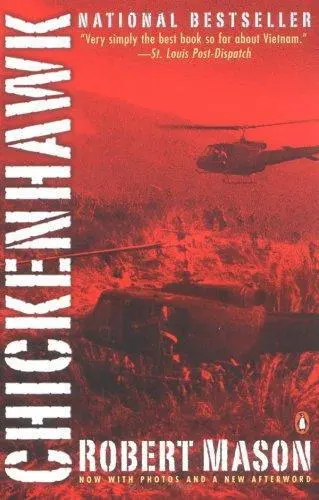
- Название:Chickenhawk
- Автор:
- Издательство:Penguin Books
- Жанр:
- Год:2005
- Город:New York
- ISBN:9780143035718
- Рейтинг книги:4 / 5. Голосов: 1
-
Избранное:Добавить в избранное
- Отзывы:
-
Ваша оценка:
Chickenhawk: краткое содержание, описание и аннотация
Предлагаем к чтению аннотацию, описание, краткое содержание или предисловие (зависит от того, что написал сам автор книги «Chickenhawk»). Если вы не нашли необходимую информацию о книге — напишите в комментариях, мы постараемся отыскать её.
have been sold since it was first published in 1983. Now with a new afterword by the author and photographs taken by him during the conflict, this straight-from-the-shoulder account tells the electrifying truth about the helicopter war in Vietnam. This is Robert Mason’s astounding personal story of men at war. A veteran of more than one thousand combat missions, Mason gives staggering descriptions that cut to the heart of the combat experience: the fear and belligerence, the quiet insights and raging madness, the lasting friendships and sudden death—the extreme emotions of a “chickenhawk” in constant danger.
Robert Mason enlisted in the army in 1964 and flew more than 1,000 helicopter combat missions before being discharged in 1968. [
]’s vertical plunge into the thickets of madness will stun readers.
(
) Mason’s gripping memoir… proves again that reality is more interesting, and often more terrifying, than fiction.
(
) Very simply the best book so far out of Vietnam.
(
)
Chickenhawk — читать онлайн бесплатно полную книгу (весь текст) целиком
Ниже представлен текст книги, разбитый по страницам. Система сохранения места последней прочитанной страницы, позволяет с удобством читать онлайн бесплатно книгу «Chickenhawk», без необходимости каждый раз заново искать на чём Вы остановились. Поставьте закладку, и сможете в любой момент перейти на страницу, на которой закончили чтение.
Интервал:
Закладка:
“They’re the proof. That razor burned.” I stopped when I understood the words that I spoke. I had never seen anything more clearly in my life, but here I stood with Gary, in the tent, holding the razor. The razor had not burned and blazed and blinded me, at least not so that anybody else could see.
I walked over to DaVinci, who stood by our bunker. I told him exactly what I had seen, in detail. He nodded as I explained.
“Here.” He handed me a small pill.
“What’s this?”
“It’ll help you sleep. I’ll give you another one tomorrow night, too. Try to relax.”
“I am relaxed—or I was.”
“Try harder.”
The next night we watched the sky over the north end of the valley fill with tracer tongues of fire from Puff. The NVA were overrunning the artillery position. Four ships from Daring’s gun platoon were in the middle of it, flying back and forth in front of the artillery piece under attack. Of the four cannon there, that one was now separated from the others as the NVA concentrated on it. Puff, the DC-3 with the Gattlings, blasted unbroken tongues of fire from the black sky. Flares popped white, dazzling and swinging over the battle. The NVA kept closing in. The tube was depressed for point-blank fire. One of the gunship pilots told us that when the NVA swarmed into the gun position the men were so mixed that they had to stop firing. The gun was taken.
We were on alert all night. By three in the morning, when we still hadn’t been called to do a night assault, I went to bed. Another little magic pill and I slept.
By dawn the next morning, the tube had been recaptured by the 101st, with the considerable help of our gunships.
Capt. John Niven came by early and said that he and I were going out. We were going to try to get some ammo to a trapped company.
Niven said in a friendly way that I was a better pilot than he. As the aircraft commander, he chose to handle the radios and let me do the flying. Our first stop was the trapped company’s HQ area at the 101st’s camp. We landed there to get the exact coordinates and to wait. The company was under fire, too heavy for us to get in. We shut down next to a small rifle range, inside the wire-strewn, mined perimeter, and waited.
At noon, we were still waiting. We could hear the company commander, Delta Six, calling on the radio in a nearby tent. He had seven fighting men left; thirty-eight more were either dead or wounded. He sounded bad, kept telling his HQ the names of the people he knew were dead, and also kept saying, “It’s still too hot for that ship. We may have to wait till dark.”
As I listened to this and waited, I wandered into the tent and got a case of .45-caliber ammunition from a sergeant. I took the five hundred rounds back out to the rifle range and proceeded to kill the rest of the afternoon by firing hundreds of rounds at beer cans. By three o‘clock, even I was impressed by my accuracy. I was regularly hitting beer cans at a hundred yards. By four o’clock, some grunts had joined me, and I borrowed an M-16 and shot a few clips with it. Another grunt let me try my luck with an M-79 grenade launcher. As I shot, I became calmer. I realized how much I needed to shoot. Shoot something, anything.
Niven came out of the tent as I blasted a beer can again. “We’re going to try for it,” he said. I slid the hot .45 into my shoulder holster and went to the ship.
“I think I’ll make a takeoff,” said Niven. “I could use the practice.”
“Sure, help yourself.”
Two grunts climbed inside with us after loading the ship full of ammo cases.
Niven cranked up, did a power check at a hover, which revealed that we were just able to hover. He nosed over, a little too much, and took off over the concertina wire. Unfortunately, the ship was too heavy for the amount of angle he had set for the takeoff, so the ship stayed low. We felt something tugging as we crossed the minefield. I looked out my window and saw barbed wire caught on the skid, trailing back, dragging in the other wire.
“We’re caught in some wire!” I yelled. He realized what was up as soon as I yelled, and reared back to level. What he did next caught me completely by surprise. Instead of staying at a hover over the minefield and backing out, he set the ship down. I lifted myself off the seat, against the straps, bracing myself for the explosion.
Niven forgot the mined perimeter. He remembered as soon as we were down. I looked at him as the ship idled. The sun shone through the Plexiglas. Sweat dripped over his face. He looked as scared as I felt. There was no explosion.
The grunts told us to stay put. Men who knew the layout of the mines came daintily stepping out to us with wire cutters and cut us free.
Niven was so shaken he had me fly.
As we drew near the trapped company, we saw gunships working the facing hill. Their efforts were frustrated by the exceedingly deep and dense foliage. In fact, the company itself was under a seventy-five-foot canopy of trees.
“Too hot, Prospector. Wait till dark,” said Delta Six.
“Roger,” replied Niven.
We turned back, frustrated. The tension was building to a high peak. I had looked the spot over, and I could not see a safe approach. The company was trapped on a low, tree-covered knoll surrounded by higher ground. If the NVA were still there when we came back, we’d be sitting ducks.
I landed back at the company’s HQ and shut down. It was two hours till dark. We had chow and waited.
There was no moon when we took off, and the sky was very dark. After a ten-minute flight up the valley, I switched off the position lights and began to descend. As we sank, the tops of the mountains, blacker than the sky, rose above us. I used the contours of the valley and the hills that I had come to know in two weeks of flying over and around them. It’s possible to see ground contour from low level even on the darkest night. Even if there’s no moon. Even if there is an overcast. There are always enough clues to construct an image. I had learned not to stare at what I wanted to see, but to see it with my peripheral vision.
So, as I moved slowly toward the knoll, I knew its treetops were lighter than the back hill behind them. Delta Six radioed that we sounded like we were on course. I had picked the right shadow.
“You’re close,” said Delta Six. “Keep coming, slowly.”
As the ship dropped out of flight and into hover, the load became evident. The dim instrument lights showed that I was using maximum power in the hover. We drifted forward, six feet above the trees, at Delta Six’s beckoning.
Delta Six said, “We hear some shooting.” I saw muzzle flashes from the hill facing us.
“I think that’s about right… wait… I can hear you right over us, but I can’t see you. We have wounded lying all around here, and I don’t want them hit by the ammo crates.”
I hovered, not looking at anything in particular, just noticing the different shades of black. Muzzle flashes began to twinkle from the hillside.
The low-rpm warning siren blared. I glanced at the dial and saw the needle dropping fast. The ship was sinking into the trees. If we didn’t drop that ammo we’d go down.
“We’ve got to drop that ammo,” said Niven.
“No! You’re right over the wounded.” Delta Six’s broadcast was filled with the crackling noise of rifle fire.
Were we or weren’t we going to drop the fucking ammo? I moved a little farther to the right. The crew chief and the grunts had the boxes poised at the edge of the deck, but it was still wrong. A treetop rose up, brushing the nose. That was it. If we didn’t go now, we’d be joining the men below us as pieces.
The shuddering Huey resisted as I tried to move forward. The warning siren blared. It was on the verge of quitting; moving forward was real effort. I heard a loud slap as the rotor hit a treetop. I couldn’t climb. If anything, I had to descend, to get the rotor speed back to normal. I turned to the right, getting a little power bonus that way, and dragged the skids across the treetops. Within a few feet I was able to drop down the side of the knoll into a black ravine. ,
Читать дальшеИнтервал:
Закладка:
Похожие книги на «Chickenhawk»
Представляем Вашему вниманию похожие книги на «Chickenhawk» списком для выбора. Мы отобрали схожую по названию и смыслу литературу в надежде предоставить читателям больше вариантов отыскать новые, интересные, ещё непрочитанные произведения.








Обсуждение, отзывы о книге «Chickenhawk» и просто собственные мнения читателей. Оставьте ваши комментарии, напишите, что Вы думаете о произведении, его смысле или главных героях. Укажите что конкретно понравилось, а что нет, и почему Вы так считаете.