Robert Mason - Chickenhawk
Здесь есть возможность читать онлайн «Robert Mason - Chickenhawk» весь текст электронной книги совершенно бесплатно (целиком полную версию без сокращений). В некоторых случаях можно слушать аудио, скачать через торрент в формате fb2 и присутствует краткое содержание. Город: New York, Год выпуска: 2005, ISBN: 2005, Издательство: Penguin Books, Жанр: Биографии и Мемуары, nonf_military, на английском языке. Описание произведения, (предисловие) а так же отзывы посетителей доступны на портале библиотеки ЛибКат.
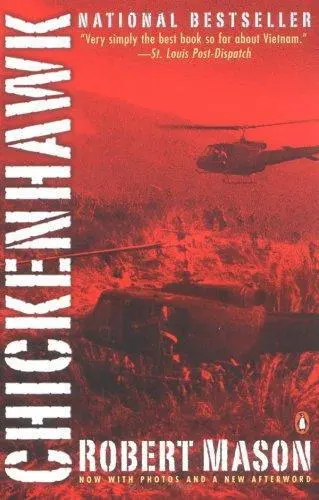
- Название:Chickenhawk
- Автор:
- Издательство:Penguin Books
- Жанр:
- Год:2005
- Город:New York
- ISBN:9780143035718
- Рейтинг книги:4 / 5. Голосов: 1
-
Избранное:Добавить в избранное
- Отзывы:
-
Ваша оценка:
Chickenhawk: краткое содержание, описание и аннотация
Предлагаем к чтению аннотацию, описание, краткое содержание или предисловие (зависит от того, что написал сам автор книги «Chickenhawk»). Если вы не нашли необходимую информацию о книге — напишите в комментариях, мы постараемся отыскать её.
have been sold since it was first published in 1983. Now with a new afterword by the author and photographs taken by him during the conflict, this straight-from-the-shoulder account tells the electrifying truth about the helicopter war in Vietnam. This is Robert Mason’s astounding personal story of men at war. A veteran of more than one thousand combat missions, Mason gives staggering descriptions that cut to the heart of the combat experience: the fear and belligerence, the quiet insights and raging madness, the lasting friendships and sudden death—the extreme emotions of a “chickenhawk” in constant danger.
Robert Mason enlisted in the army in 1964 and flew more than 1,000 helicopter combat missions before being discharged in 1968. [
]’s vertical plunge into the thickets of madness will stun readers.
(
) Mason’s gripping memoir… proves again that reality is more interesting, and often more terrifying, than fiction.
(
) Very simply the best book so far out of Vietnam.
(
)
Chickenhawk — читать онлайн бесплатно полную книгу (весь текст) целиком
Ниже представлен текст книги, разбитый по страницам. Система сохранения места последней прочитанной страницы, позволяет с удобством читать онлайн бесплатно книгу «Chickenhawk», без необходимости каждый раз заново искать на чём Вы остановились. Поставьте закладку, и сможете в любой момент перейти на страницу, на которой закончили чтение.
Интервал:
Закладка:
It could be something like ticking a tree limb with the rotor in an LZ just to see if you could pull it that close. That would be considered foolish back in the States. Here, that kind of judgment could save your life.
I experimented with the Huey tuck that day. If the Huey was nosed over too far on takeoff, the wind resistance on top of the flat roof would force the nose even lower. The ship would then try to dive into the ground as it accelerated. If this happened over level ground, you were trapped in a vicious circle. Pulling the cyclic back would not overcome the wind pressure on the roof. Pulling up on the collective to stay away from the ground only added power to the system, causing you to crash at a higher speed. If you didn’t do anything but curse, you hit the ground at a lower speed. Either way, you lost.
I almost got caught in a Huey tuck once, and I wanted to know just how far over was too far. I found out by simulating a level takeoff from a pinnacle.
I nosed over very hard and pulled enough pitch to keep the ship flying horizontal to the ground. I tested the cyclic, and the ship would not respond. I could feel it happening. Adding power only made it worse. When I could feel the trap and feel how I got into it, I knew I could never get into it by accident. I was experimenting with this over a valley, so all I had to do to recover was dive.
Near the end of the day, Charlie decided to try to wipe out a platoon or two before dark.
We were at a field command post where our ships were being loaded when the grunt commander called Astor over to his command tent.
There were six Hueys in the laager. When Astor came out minutes later, he signaled for a crank-up, then walked over to Gary and me.
“There’s a platoon coming under attack just a few klicks from here. We only need five ships to get them out.” Astor zipped up his flak vest. “I want you to stay here and monitor our frequency in case we need you.” He trotted to his ship, which was already running.
“Pretty tough assignment,” said Gary. We both climbed into the cockpit. Gary started up so that we could monitor the radios without draining the battery. Having to get a jump start in the middle of nowhere was something neither of us wanted to experiment with.
I tuned the radios.
“Charlie One-Six, Preacher Yellow One,” Astor called.
No answer.
“Roger, Charlie One-Six. We are inbound. Throw smoke.”
No answer. On the ground we could hear only Astor’s side of the radio conversation. He sounded just like he knew what he was doing.
“Yellow One, they are on the other side of the tree line.” That was John Hall’s voice.
“Negative, Yellow Four. I see the smoke,” said Astor.
I started to fasten my straps. If they were that close to pickup, we would be in the air in minutes.
“Negative, Yellow One. The target is upwind of that smoke,” said Hall.
“Yellow Four, I am in charge here,” said Astor.
“Roger.”
“Do you think we should get into the air?” asked Gary.
“Naw, not yet. Wait for Astor to give us the word.”
“Yellow Four is taking heavy fire from the tree line!” yelled Hall.
Astor, possibly already on the ground, did not answer.
“Yellow One, we are aborting. My crew chief has been hit.” We could hear the machine guns on Hall’s ship chatter while he talked.
“We’d better go,” I said.
“Right.” Gary brought the Huey up to rpm and made a quick takeoff.
“Yellow One, Charlie One-Six. I have you in sight. You’re about five hundred meters downwind of us.”
It was clear to Gary and me that Astor had really blown it. He had landed downwind of the grunts’ secure position, following the drifting smoke, even though Hall had seen the correct position. I saw the flight and called Astor to say we were joining up. He radioed a curt “Roger.” We joined up and made the landing to the grunts’ clearing without incident.
As the crews mingled after the mission, back at the Golf Course, Astor separated himself and walked away quickly.
“That guy is an accident looking for a place to happen,” I said.
“Yeah, he’s a disaster all right…. Hey. Major Disaster!” said Gary. Everybody laughed. He was christened.
Hall met us at the tent. His crew chief, Collins, was dead. The ship had taken more than twenty rounds. Hall was shaking with anger. He had been right. Disaster had ignored his warnings.
“I’m going to kill him,” said Hall.
“I know how you feel,” I said.
“No, I mean that I will actually kill him. You know, dead.” Hall unsnapped his revolver holster and walked off toward Disaster’s hooch. I thought he was just acting tough, but when I got to the mess line fifteen minutes later, I heard Disaster calling for help from inside his hooch.
Hall stood tall and silent, his pistol at the ready, a can of beer in his left hand. He had taken a position midway between Disaster’s hooch and the mess tent. About thirty men, getting their evening chow, looked on with interest.
“Hall, if you don’t put that gun away immediately, I’ll have you court-martialed.” The voice came from behind the hooch door.
“You’ll have to come out sometime, Major.”
“You’re crazy! You can’t pull a gun on a superior officer and hold him captive in his own quarters. You’re going to be in serious trouble if you don’t put that gun away. Right now!”
“You killed Collins, Major. Now it’s your turn.” Hall raised his pistol to aim.
“Help!” Disaster screamed when he saw Williams come near the mess tent. Williams looked up and saw Hall in the darkening twilight. Disaster peered hopefully out, then yelled again, “Help! Major Williams, get this madman away from me!” Williams nodded and rinsed his mess kit before he walked into the mess tent.
Nobody came to Disaster’s aid. Once in a while we heard him yell. No one paid the slightest attention. Later that night Hall gave up the vigil. I heard him singing drunkenly on the path outside my tent. The next morning he was still so drunk that he could not be allowed to fly.
That incident seemed to precipitate a series of conflicts among us as tension took its toll. Hall beat up Daisy one night, splitting his lip. He continued to harass Disaster by throwing Montagnard spears at him as he walked around the camp. Soon after Captain Fontaine was carried screaming back to his hooch; Riker told Shaker, very plainly, to shove it, when Shaker told him to go work on the club. Connors and Nate pushed each other around over where the laundry should be hung. Nate and Kaiser scuffled over a territorial dispute.
The farewell party for Williams was very quiet. The major, an excellent air leader, was being transferred to brigade staff in Saigon—a move up. The party was restrained because Williams had never been close to us, like Fields had been.
The next day, after an award ceremony to pass out air medals among us, our new CO, Major Crane, made his introduction speech.
“I think that everything around here is just fine except for personal neatness,” said Crane. “This company has an impressive list of accomplishments in the Cav. I’m sure you’ve been so busy that you just let things slide.” He wore crisp fatigues and spit-shined boots. Even Williams, Mr. Hardass himself, didn’t worry about that kind of bullshit. Williams concentrated on our missions. Crane was already talking about the busywork.
“You may not think that wearing a shirt in the company area is very important—and, by the way, the shirt must be tucked in—but I do. Sure, it’s tough here. This is combat. But if we let just one aspect of our professional demeanor fall to the wayside, our overall performance will suffer.” He paused, smiled. Just a regular guy doing his job. “So from now on, we will conform to standard army dress codes at all times. That means tucked-in shirts outside the tents, bloused boots, and clean uniforms.”
Читать дальшеИнтервал:
Закладка:
Похожие книги на «Chickenhawk»
Представляем Вашему вниманию похожие книги на «Chickenhawk» списком для выбора. Мы отобрали схожую по названию и смыслу литературу в надежде предоставить читателям больше вариантов отыскать новые, интересные, ещё непрочитанные произведения.







Обсуждение, отзывы о книге «Chickenhawk» и просто собственные мнения читателей. Оставьте ваши комментарии, напишите, что Вы думаете о произведении, его смысле или главных героях. Укажите что конкретно понравилось, а что нет, и почему Вы так считаете.