Robert Mason - Chickenhawk
Здесь есть возможность читать онлайн «Robert Mason - Chickenhawk» весь текст электронной книги совершенно бесплатно (целиком полную версию без сокращений). В некоторых случаях можно слушать аудио, скачать через торрент в формате fb2 и присутствует краткое содержание. Город: New York, Год выпуска: 2005, ISBN: 2005, Издательство: Penguin Books, Жанр: Биографии и Мемуары, nonf_military, на английском языке. Описание произведения, (предисловие) а так же отзывы посетителей доступны на портале библиотеки ЛибКат.
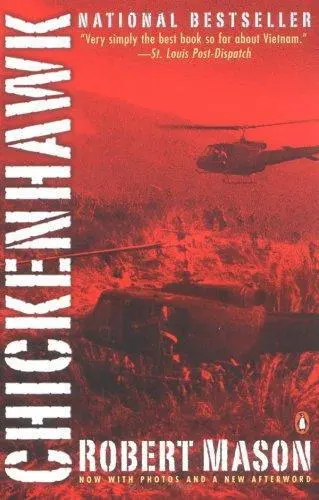
- Название:Chickenhawk
- Автор:
- Издательство:Penguin Books
- Жанр:
- Год:2005
- Город:New York
- ISBN:9780143035718
- Рейтинг книги:4 / 5. Голосов: 1
-
Избранное:Добавить в избранное
- Отзывы:
-
Ваша оценка:
Chickenhawk: краткое содержание, описание и аннотация
Предлагаем к чтению аннотацию, описание, краткое содержание или предисловие (зависит от того, что написал сам автор книги «Chickenhawk»). Если вы не нашли необходимую информацию о книге — напишите в комментариях, мы постараемся отыскать её.
have been sold since it was first published in 1983. Now with a new afterword by the author and photographs taken by him during the conflict, this straight-from-the-shoulder account tells the electrifying truth about the helicopter war in Vietnam. This is Robert Mason’s astounding personal story of men at war. A veteran of more than one thousand combat missions, Mason gives staggering descriptions that cut to the heart of the combat experience: the fear and belligerence, the quiet insights and raging madness, the lasting friendships and sudden death—the extreme emotions of a “chickenhawk” in constant danger.
Robert Mason enlisted in the army in 1964 and flew more than 1,000 helicopter combat missions before being discharged in 1968. [
]’s vertical plunge into the thickets of madness will stun readers.
(
) Mason’s gripping memoir… proves again that reality is more interesting, and often more terrifying, than fiction.
(
) Very simply the best book so far out of Vietnam.
(
)
Chickenhawk — читать онлайн бесплатно полную книгу (весь текст) целиком
Ниже представлен текст книги, разбитый по страницам. Система сохранения места последней прочитанной страницы, позволяет с удобством читать онлайн бесплатно книгу «Chickenhawk», без необходимости каждый раз заново искать на чём Вы остановились. Поставьте закладку, и сможете в любой момент перейти на страницу, на которой закончили чтение.
Интервал:
Закладка:
“When we get back, I’m reporting you for insubordination.”
“Right. Well, it’s turnaround time. Nate is going to fly on us on the flight back. You take the controls and just aim this thing back to the west. You got it.”
Hertz took the controls. We said nothing more on the flight back to the Golf Course. I did consider the possibility of a steep bank, flip off his belts, open the door, and assholes away. But that was impossible.
Hertz made the approach to our area nicely. In fact, the only thing he had done wrong was the oscillating in the formation. I could’ve helped him on that if he had just relaxed. On the ground, he opened the door and stomped off. I logged the book, entering myself as the aircraft commander, Hertz as pilot.
“How’d it go?” Gary asked as I dumped my gear on my, bunk.
“Shitty. That new guy Hertz tried to kill me and Nate, and when I had to grab the controls, he got pissed off.”
“Yeah. I heard him yelling at Farris a little while ago.”
“What’d he say?”
“I couldn’t tell, but I heard your name a couple of times.”
Nate walked in grinning. “Mason, you really pissed off that new captain.”
“I know. He said he was going to turn me in for insubordination. Maybe they’ll send me home early.”
“No such luck.” Nate sat down on my bench. “Farris ended up chewing his ass.”
“Really? What’d he say?”
“He said that regardless of rank, you were the aircraft commander. And he said, ‘If Mason said you were too close, then you were too close.’”
“Really?”
“Yep.” Nate fiddled with a plastic chess piece on the board I’d left set up. “Hertz has to apologize to you, too.” Now I felt very good.
“Wanna play a short game?” Nate held up two pawns.
“Anytime,” I said.
III. SHORT-TIMER’S BLUES
10. Grounded
And still the little men keep coming, with their awkward, sauntering gait, the mark of a lifetime of transporting heavy loads on carrying poles.
—Bernard B. Fall, in The New York Times Magazine , March 6, 1966April 1966
When a First of the Ninth platoon landed near Chu Pong, they captured NVAs who said that there were at least a thousand more men in the area. Moments later the platoon was under fire and trapped. While trying to get them out, two slick ships were shot down, and fifteen men were killed.
This was bad news to many of us. The strategy of attrition was an endless cycle of our taking and retaking the same areas.
“Why the fuck don’t they keep some troops out there?” said Connors. “This is like trying to plug fifty leaks with one finger!”
Week after week, the magazines reported kill scores that we knew were inflated with villagers. There were quotes from generals who reported we had them on the run, and quotes from the leader of the posse, LBJ, that victory was just around the corner.
The perimeter of the Golf Course was now mined, searchlighted, patrolled, and guarded. In seven months the VC had been able to get only a few mortars over it and a handful of men through it.
When the Eastern mind encounters such a hard obstacle, it is inclined to use a kind of mental judo to bridge it. The VC asked themselves how they could get the Americans to give them rides in their helicopters so that they could inspect our defenses.
“Mason, you and Resler go over to the bridge and bring back some prisoners,” said Farris.
Gary and I lifted from row three and flew to a small field near the southeast corner of the perimeter. Here a second lieutenant ran over with his M-16 held by the sights.
“Got two suspects for you,” he said. He pointed behind him to two kids, maybe twelve years old. They were smiling as the grunts gave them chocolates. One of them smoked a cigarette awkwardly.
“Those two?” I asked.
“Right. We caught them wandering too close to the perimeter.”
“Maybe they don’t know they’re not supposed to be here.”
“No, they know all right. Our orders are to arrest anyone who gets too close. You’re to take them to the cage.”
“Where’s that?” I asked.
“You know where finance is?”
“Yeah.”
“Well, there’s a barbed-wire pen in a field near there. You’ll be able to find it easy.”
“Okay.”
The lieutenant motioned the prisoners toward our ship. The two boys grinned with childish expectation and ran over.
“Do they get blindfolded or something?” Gary asked.
“Naw,” said the lieutenant. “They’re just kids.”
One of the boys sat in the web seat and the other sat on the floor with his legs dangling out—like the grunts did—and Gary and I strapped back in.
Coming back into the Golf Course, we went out of the pattern and circled around the division to reenter traffic on the downwind leg. The boys were all eyes. The one on the floor punched the other and pointed at something. They both laughed.
Gary told the tower we were going to the pen, and they cleared us to fly down row three and beyond. We crossed the northern perimeter, the troopers’ garrison, the tube emplacements, the antimortar radar installation, the sky-crane pad, and the long rows of Hueys. Beyond the heliport we flew over the tent cities to a field.
Two clerks on guard duty came over to corral the prisoners. The boys jumped off smiling and went where they were pointed. Five or six prisoners crab-walked around under the three-foot-high barbed-wire ceiling of the cage. One of them waved to the boys. They called a greeting. It did not look like a good place to spend time, but as we were told, no one stayed there very long anyway.
“After we question them, we either send them back home or turn them over to the ARVNs. These two little fucks will probably be sent back home,” said the sergeant in charge.
Back in the air, I had the feeling that we had just been tricked. They had just done an aerial survey of the entire First Cav compound, and they didn’t even have an airplane.
The perimeter of tangled concertina, land mines, antiper sonnel mines, trip wires, and observation towers was constantly infiltrated by the haphazard return of nature; that is, weeds. With the mines in place, no one could go out to trim the weeds. Weeds were not only messy; they could conceal the approach of the enemy. The solution was to have men spray defoliant chemicals out the doors of a hovering Huey. There was no way to get out of the minefield if the engine failed. To someone as nervous around explosives as myself, the chance that just the air pressure under our hovering ship might trigger a mine seemed possible. And what about the sticks and stuff that blew around in our rotor wash? The imagined dangers were endless. I never thought for one moment about the defoliant itself.
For two or three days, Resler and I drew the job. As with most noncombat chores with the Huey, it became a game.
“Whatever you do, don’t catch the concertina with the skids,” said Resler.
“What do you think? I bought my license at Sears?”
We flew slowly along the rows of concertina just missing the short iron posts that anchored it. A man used a long nozzle to spray a mist of chemicals that swirled into the wire and around the ship. At the end of a three-hundred-yard pass, we rose slightly, turned, and went back, paralleling the same route ten feet farther over. One of the men in the back of the chopper waved to the man in the observation tower. He waved back, and with his finger traced a circular path beside his head for good measure. Guard duty is shit, but at least I’m not stupid.
For three hours Gary and I painstakingly covered every square inch of our assigned section of the perimeter with weed killer. The stuff swirled into the cockpit, but was odorless and tasteless. The men of the spray crew were protected only by buttoned-up collars and pulled-down baseball caps in their never-ending job.
Читать дальшеИнтервал:
Закладка:
Похожие книги на «Chickenhawk»
Представляем Вашему вниманию похожие книги на «Chickenhawk» списком для выбора. Мы отобрали схожую по названию и смыслу литературу в надежде предоставить читателям больше вариантов отыскать новые, интересные, ещё непрочитанные произведения.





Обсуждение, отзывы о книге «Chickenhawk» и просто собственные мнения читателей. Оставьте ваши комментарии, напишите, что Вы думаете о произведении, его смысле или главных героях. Укажите что конкретно понравилось, а что нет, и почему Вы так считаете.