Robert Mason - Chickenhawk
Здесь есть возможность читать онлайн «Robert Mason - Chickenhawk» весь текст электронной книги совершенно бесплатно (целиком полную версию без сокращений). В некоторых случаях можно слушать аудио, скачать через торрент в формате fb2 и присутствует краткое содержание. Город: New York, Год выпуска: 2005, ISBN: 2005, Издательство: Penguin Books, Жанр: Биографии и Мемуары, nonf_military, на английском языке. Описание произведения, (предисловие) а так же отзывы посетителей доступны на портале библиотеки ЛибКат.
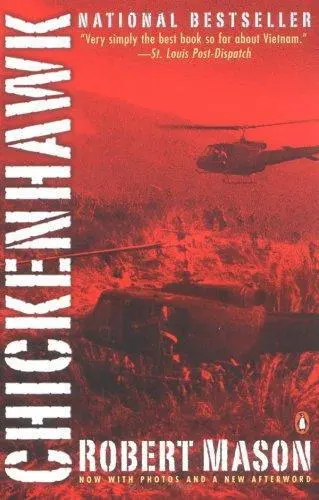
- Название:Chickenhawk
- Автор:
- Издательство:Penguin Books
- Жанр:
- Год:2005
- Город:New York
- ISBN:9780143035718
- Рейтинг книги:4 / 5. Голосов: 1
-
Избранное:Добавить в избранное
- Отзывы:
-
Ваша оценка:
Chickenhawk: краткое содержание, описание и аннотация
Предлагаем к чтению аннотацию, описание, краткое содержание или предисловие (зависит от того, что написал сам автор книги «Chickenhawk»). Если вы не нашли необходимую информацию о книге — напишите в комментариях, мы постараемся отыскать её.
have been sold since it was first published in 1983. Now with a new afterword by the author and photographs taken by him during the conflict, this straight-from-the-shoulder account tells the electrifying truth about the helicopter war in Vietnam. This is Robert Mason’s astounding personal story of men at war. A veteran of more than one thousand combat missions, Mason gives staggering descriptions that cut to the heart of the combat experience: the fear and belligerence, the quiet insights and raging madness, the lasting friendships and sudden death—the extreme emotions of a “chickenhawk” in constant danger.
Robert Mason enlisted in the army in 1964 and flew more than 1,000 helicopter combat missions before being discharged in 1968. [
]’s vertical plunge into the thickets of madness will stun readers.
(
) Mason’s gripping memoir… proves again that reality is more interesting, and often more terrifying, than fiction.
(
) Very simply the best book so far out of Vietnam.
(
)
Chickenhawk — читать онлайн бесплатно полную книгу (весь текст) целиком
Ниже представлен текст книги, разбитый по страницам. Система сохранения места последней прочитанной страницы, позволяет с удобством читать онлайн бесплатно книгу «Chickenhawk», без необходимости каждый раз заново искать на чём Вы остановились. Поставьте закладку, и сможете в любой момент перейти на страницу, на которой закончили чтение.
Интервал:
Закладка:
“You dumb shit!” he yelled. Daisy jumped back. “You almost got us killed.”
Captain attacked by chief warrant officer. He backed away.
“Look, Banjo, all you had to do was descend to the valley like I did.”
“Brilliant, Daisy. No one ever descends over mountains in weather. You dumb shit.”
“I knew where the valley was all the time,” said Daisy.
“You liar.”
I walked past them into the tent. Farris wanted to know what all the excitement was about.
“Daisy decided to have the radar at Dog vector us back and led us into a cloud bank.”
“So what’s the problem?”
“The radar lost us in the clouds and Daisy told us to descend.”
“So?”
“So, neither of us knew where we were—over a valley or a mountain.”
“So what did you do?” asked Farris.
“Banjo and I climbed until we broke through at six thousand.”
“So why are you mad?”
“I’m mad because if we had followed Daisy’s orders, we could’ve bought it. It pisses me off to have leaders like him running loose.”
“So, you found out that even leaders make mistakes.”
“Yeah, I guess that’s it—if you classify Daisy as a leader. I’m more inclined to call him a moron that happens to be a captain.”
Farris nodded and gave me an understanding smile. “Well, I’m going to finish this letter. See you in the morning.”
As I tried to sleep, I kept wondering why I felt so miserable. I kept jerking suddenly awake for no apparent reason. It seemed like I did that all night.
I kept hearing ricochets and ducked every time I did. Farris saw this and smiled. Farris did not duck.
“What the fuck is that?” I said.
“It’s nothing. Don’t worry.”
Nothing doesn’t ricochet. I wasn’t exactly worried. I was mostly irritated. We were in the middle of another long laager in another ruined garden. Twenty bored helicopter crews sprawled, hunkered, or wandered around the machines, sweating their brains out. When the whining bullets sounded overhead, faces tracked them across the sky.
Adjacent to our laager was a village. From where we were parked you could not see the huts for the trees, over a hundred feet tall. A trail led into the dark-green lush-ness. I decided to follow it.
In just a few steps I was in another world. Dark and cool under the canopy of green, the well-worn, clean path led to a kind of courtyard and stopped.
A hundred feet above me a small circle of light broke through the trees. I turned to look behind me for the inevitable bunch of people, the “Hey-GI-you” crowd. No one anywhere. I stepped up on a kind of sidewalk that connected the hooches. I looked in the door of the first hooch. Nobody was home. I leaned in cautiously—some—where in my brain a voice warned me to watch for booby traps—and saw that the cooking fire at the back of the hooch was glowing. I looked around outside again—nobody.
I walked to the next door, leaned inside, and met a face that had been hiding against the wall next to the door. The face was a woman’s. She was smiling, her forehead wrinkled in worry. From behind her black pajama pants peered a small boy.
She bowed slightly and said something to me and then called out to someone. I stepped back outside nervously, wondering why the fuck I was here alone. The woman and boy followed me out, smiling and bowing nervously. Behind me I heard another voice. I turned quickly and saw an ancient lady in black limping across the courtyard.
She smiled, showing black teeth. I didn’t remember any words in Vietnamese except numbers. I didn’t know what to say except “You Vietcong?”
Suddenly the three of them pointed outside the village. “Vietcong.” I wanted to ask them where their men were, but I didn’t know the words. Finally, I did the American thing and took their photograph.
I began to feel self-conscious with the three of them huddled fearfully on their sidewalk. I explained to them that I was just looking around and that I was going on along the trail. I waved good-bye.
The trail led to another, identical courtyard. No one was home here, either. I found some cooking fires still hot, but everybody had obviously beat a hasty retreat. Alone in one of the hooches, I touched the wattle walls and sat in a net hammock. Above me, the exposed bamboo rafters and beams looked well made. The floor was clean, even if it was made of dirt. Not a bad place, actually. Certainly it was a lot better than the tent I slept in. It was not the average American home, but I doubt that the inhabitants paid much of a mortgage.
I walked farther into the village under the trees, passing a suspicious pile of rice stalks that probably hid the entrance to underground bunkers and tunnels. I could’ve gone over and checked. I could’ve grabbed my pistol and committed suicide, too. They both would’ve amounted to the same thing.
The last hooch I examined was the home of a master carpenter. I discovered his box of tools. Inside the box—about the size of a small suitcase—scores of tools rested in neat compartments. Yellow brass gleamed; shiny steel edges glinted. Knurled hardwood knobs held planing blades tight in their handles. All manner of carving tools reposed in their own boxes. The wide selection and the quality of their tools told me that these people, or at least this person, were definitely not savages.
I had never heard of a gook or a slope-head or a slant-eye or a dink who did anything but eat rice and shit and fight unending wars. These tools and that waterwheel convinced me that there was a successful way of life going on around us, but all we saw were savages, backward savages fighting against the Communist hordes from the North. Why were all the men of this beautiful village gone just when the Americans were right outside? Wouldn’t people under attack by the Communists welcome the men who were there to save them? Or was I seeing the wrong way? Maybe the only people who wanted us around were the Saigon politicians who were getting rich by having the Americans here. This village was a long way from Saigon. And the people weren’t rich; they were just people.
The carpenter had made a bench whose parts fit so well that it didn’t need any nails to hold it together. It was so precisely made, and so in tune with the materials that made it, that it held itself together without aid. I saw this as an enlightening symbol of the true nature of the Vietnamese people, so I stole the bench. I carried it on my shoulder back up the trail, past the rice-stalk pile, past the two courtyards, past the still-smiling women, and back out into the sunshine of the sandy garden. I walked over to my helicopter and put the bench in the shade of the rotor, sat down, and said, “Look, no nails.” I shifted back and forth to put strain on the bench to show that it did not move. Kaiser came over to see. “See, they put this together so well it doesn’t need nails,” I said.
“That’s because they have to. Dumb gooks don’t know how to make nails,” said Kaiser.
We had been away from the Golf Course for more than a month when it was hit in a mortar attack. Several people were killed, fifty or so were wounded, and several Hueys were shredded, but that didn’t interfere with the scheduled appearance of Ambassador Lodge, who showed up the next day to dedicate our division compound officially as Camp Radcliff. It was too late. The name had become the Golf Course, and we were stuck with it.
“Don’t worry about McElroy; he can take care of himself,” said Rubenski. McElroy’s platoon had been encircled, and we could not get to them. Charlie had set up antiaircraft guns on the hillsides around the platoon, and somebody had already died trying to fly past them. We waited in the dark at Dog for the air force to bomb the emplacements.
Читать дальшеИнтервал:
Закладка:
Похожие книги на «Chickenhawk»
Представляем Вашему вниманию похожие книги на «Chickenhawk» списком для выбора. Мы отобрали схожую по названию и смыслу литературу в надежде предоставить читателям больше вариантов отыскать новые, интересные, ещё непрочитанные произведения.








Обсуждение, отзывы о книге «Chickenhawk» и просто собственные мнения читателей. Оставьте ваши комментарии, напишите, что Вы думаете о произведении, его смысле или главных героях. Укажите что конкретно понравилось, а что нет, и почему Вы так считаете.