Robert Mason - Chickenhawk
Здесь есть возможность читать онлайн «Robert Mason - Chickenhawk» весь текст электронной книги совершенно бесплатно (целиком полную версию без сокращений). В некоторых случаях можно слушать аудио, скачать через торрент в формате fb2 и присутствует краткое содержание. Город: New York, Год выпуска: 2005, ISBN: 2005, Издательство: Penguin Books, Жанр: Биографии и Мемуары, nonf_military, на английском языке. Описание произведения, (предисловие) а так же отзывы посетителей доступны на портале библиотеки ЛибКат.
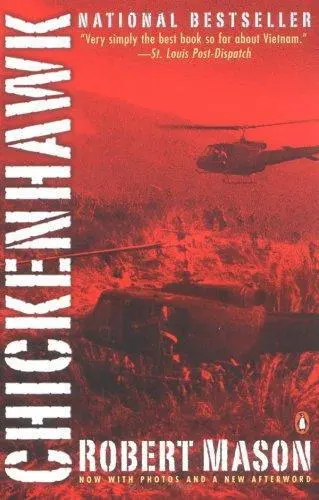
- Название:Chickenhawk
- Автор:
- Издательство:Penguin Books
- Жанр:
- Год:2005
- Город:New York
- ISBN:9780143035718
- Рейтинг книги:4 / 5. Голосов: 1
-
Избранное:Добавить в избранное
- Отзывы:
-
Ваша оценка:
Chickenhawk: краткое содержание, описание и аннотация
Предлагаем к чтению аннотацию, описание, краткое содержание или предисловие (зависит от того, что написал сам автор книги «Chickenhawk»). Если вы не нашли необходимую информацию о книге — напишите в комментариях, мы постараемся отыскать её.
have been sold since it was first published in 1983. Now with a new afterword by the author and photographs taken by him during the conflict, this straight-from-the-shoulder account tells the electrifying truth about the helicopter war in Vietnam. This is Robert Mason’s astounding personal story of men at war. A veteran of more than one thousand combat missions, Mason gives staggering descriptions that cut to the heart of the combat experience: the fear and belligerence, the quiet insights and raging madness, the lasting friendships and sudden death—the extreme emotions of a “chickenhawk” in constant danger.
Robert Mason enlisted in the army in 1964 and flew more than 1,000 helicopter combat missions before being discharged in 1968. [
]’s vertical plunge into the thickets of madness will stun readers.
(
) Mason’s gripping memoir… proves again that reality is more interesting, and often more terrifying, than fiction.
(
) Very simply the best book so far out of Vietnam.
(
)
Chickenhawk — читать онлайн бесплатно полную книгу (весь текст) целиком
Ниже представлен текст книги, разбитый по страницам. Система сохранения места последней прочитанной страницы, позволяет с удобством читать онлайн бесплатно книгу «Chickenhawk», без необходимости каждый раз заново искать на чём Вы остановились. Поставьте закладку, и сможете в любой момент перейти на страницу, на которой закончили чтение.
Интервал:
Закладка:
Kaiser lifted the collective. I radioed, “Roger.”
A mortar exploded at two o‘clock, fifty feet away.
Kaiser pulled the ship’s guts so hard that the rpm warning siren screamed in our ears. He let off enough pressure to silence the alarm and turned left to avoid a machine gun the grunts had warned us about.
As we crossed the edge of the meadow, I heard Rubenski’s gun blasting away, and then tick-tick-tick. Ah, must be another machine gun. I nodded to myself. Three rounds passed harmlessly through the sheet aluminum and lodged in the hell hole.
It was peaceful again. I lit another cigarette and watched the sunset.
“You guys really impressed that grunt commander,” said Nate, back at the Rifle Range. “I heard he’s putting you in for a DFC.”
“Wrong medal,” said Kaiser, already drunk. “It should be the ‘I Don’t Give a Crap’ medal with a V device for valor.”
After we dropped off four wounded men at LZ Dog, Banjo and I, Daisy, and Gillette found ourselves returning to the Rifle Range at night. Daisy led the flight and decided to climb to about 2500 feet and have the radar at Dog vector us back to the Rifle Range.
I had used radar vectoring only once or twice during the instrument-training phase of flight school. I wasn’t familiar enough with it to want to use it. It wouldn’t even have occurred to me to do anything but fly a compass course back. Daisy was nervous about flying into a mountain, but if we stayed away from the ridge to the west, we were well clear of the mountains.
So Banjo flew in formation with Daisy as he climbed up in a spiral above Dog.
“Preacher flight, take up a heading of one-seven-zero degrees,” said the radar station. This station was a four-by-four-foot box on the back of a trailer. It was olive drab.
Daisy turned to the heading, and Banjo skillfully turned with him. We found it easier to fly very close, so close that we could see the red cockpit lights of the other ship. At this distance you can hear the buzz of the tail rotor beside you.
“Preacher flight,” called the radar guy, “I have lost you.”
Lost us? We had been on course for all of two minutes.
At the same moment, we lost sight of Daisy’s ship as we flew into the clouds. It really was dark—no up, no down. Which way was Daisy flying? Left? Right? Up?
“Yellow Two, I’m breaking off to the left,” called Daisy.
“Roger,” Banjo said. He turned to the right. I watched the compass. We were turning right on around to the north, then to the west. West was where the mountains were.
“Hey, Banjo, we don’t want to go west,” I said.
“I know.”
“Okay.” I waited for him to change course, but he didn’t. Instead he was diving. The airspeed indicator was up past 120 knots. The vertical-speed indicator (VSI) showed we were going down at over 1000 feet a minute.
“Banjo, we’re diving.”
“I feel fine.”
“Look at the airspeed.” He did, and the ship slowed back to 90 knots, normal cruise. The VSI was showing a slight climb.
Where was Daisy?
“Yellow Two, Yellow One. We are descending to get out of the clouds. Recommend you do the same.”
I could just see it, Daisy wallowing around in the muck, trying to find the bottom of the cloud bank that ends right where a mountain begins. I could see the two of us trying to do this together and colliding before we hit the mountain.
“Banjo, don’t do it. Keep climbing. We’ll pop out at the top and shoot for Qui Nhon.”
“Daisy says to descend.”
“Daisy doesn’t know shit. Descend into what? Where exactly are we right now? Over the valley? Or are we over the mountains?”
“Okay, we’ll climb.”
“Do you want me to fly?”
“No, I’m okay.”
“Then could you come back to a south heading?”
Banjo began a turn in our featureless world. You can feel changes while flying in the blind, as when Banjo started his turn, but after the bank is established, you can’t tell it from straight and level flying. Banjo was staring straight ahead into nothingness, and the ship was diving again.
“Banjo, the VSI.”
He said nothing, but he stopped the dive and began a climb again.
I watched my set of instruments, monitoring Banjo. I wished that Gary was flying, or that I was. Banjo had gone through flight school years earlier, when helicopter instrument flying was not taught. Gary and I had completed instrument training at Fort Rucker, in the Huey. Banjo was an old salt with lots of time. In his mind I was still the rookie.
We were diving again.
“Banjo, if you keep diving like this, we’ll get into a world of shit.” The ship rocked back as he stopped the dive, but he was now turning to the west. “Compass,” I said, sounding like my old instrument instructor. “Compass.” He stopped the turn but started to dive again. “Airspeed.” The airspeed indicator will tell you immediately if you’re climbing or diving: If the airspeed increases, you are diving. Obviously Banjo was too proud to say he didn’t know what the fuck he was doing, especially to me. I had to talk him through this.
“Ninety knots,” I said. That airspeed would keep us in a climb.
Now he was turning again! “Compass.” He corrected. It’s true, I thought. The FAA had tested experienced pilots in flight simulators to see if they could somehow fly seat of the pants, with no visibility. A hundred percent of them crashed.
God, I would love to see something. What if the cloud goes to twenty thousand feet? Can’t go higher than ten or twelve thousand without oxygen. Probably it’s clear over the ocean. Yeah, go over the ocean and come back under the stuff. “Banjo, head farther east.”
The altimeter read 4000 feet. Jesus, it’s got to end soon.
“Mason, what if this shit doesn’t end?” said Banjo. “I think we should drop back down like Daisy.”
“No.”
“What do you mean, no? I’m the aircraft commander.”
“No, don’t let down; you don’t know where you are. Just a few hundred feet to go. I’m sure of it. Airspeed!” We had lost 500 feet while we talked.
Banjo wrestled with the Huey for a minute while I coached. Soon we were back in the climb, passing 4000 feet for the second time.
“I’ll take it to five thousand. If it’s not clear by then, I’m heading back down.”
I said nothing. The idea of letting down blind over mountainous terrain put me into a panic. It is correct to climb, I told myself.
“Airspeed!” I shrieked, letting some of the panic come through. “Damnit, Banjo, watch the airspeed. Keep us climbing.” Then I calmed myself and said, “Banjo, you sure you don’t want me to fly this last little bit?”
“No, I’ll fly. You just watch the instruments.”
“Okay. I’ll watch the instruments.”
Five thousand feet and more nothing.
“I’m going back down,” he said.
“Wait!” I yelled. “Keep climbing. We’re almost there. Besides, we’re heading for the sea, and the clouds end there, so we can’t lose by climbing, but we can lose by descending. You understand?”
“Goddamnit!” said Banjo. He maintained the climb.
I blinked. Spots before my eyes? Stars? Yes, stars! At nearly 6000 feet, we broke through. The crew chief and gunner cheered. We all cheered, even Banjo. The universe was back, warm and twinkling. We could make out the jewels of light from Qui Nhon.
By the time we landed, we were very angry at Daisy. He was the one who’d got us into that shit. Had we just flown a normal contact path back to the Rifle Range, we would never have been put into instrument flight. Banjo would not have been found lacking. I wouldn’t have had to talk him through the weather.
We saw Daisy as we walked in from the flight line. He had a sandwich from the mess tent. Banjo walked up to him.
Читать дальшеИнтервал:
Закладка:
Похожие книги на «Chickenhawk»
Представляем Вашему вниманию похожие книги на «Chickenhawk» списком для выбора. Мы отобрали схожую по названию и смыслу литературу в надежде предоставить читателям больше вариантов отыскать новые, интересные, ещё непрочитанные произведения.








Обсуждение, отзывы о книге «Chickenhawk» и просто собственные мнения читателей. Оставьте ваши комментарии, напишите, что Вы думаете о произведении, его смысле или главных героях. Укажите что конкретно понравилось, а что нет, и почему Вы так считаете.