Robert Mason - Chickenhawk
Здесь есть возможность читать онлайн «Robert Mason - Chickenhawk» весь текст электронной книги совершенно бесплатно (целиком полную версию без сокращений). В некоторых случаях можно слушать аудио, скачать через торрент в формате fb2 и присутствует краткое содержание. Город: New York, Год выпуска: 2005, ISBN: 2005, Издательство: Penguin Books, Жанр: Биографии и Мемуары, nonf_military, на английском языке. Описание произведения, (предисловие) а так же отзывы посетителей доступны на портале библиотеки ЛибКат.
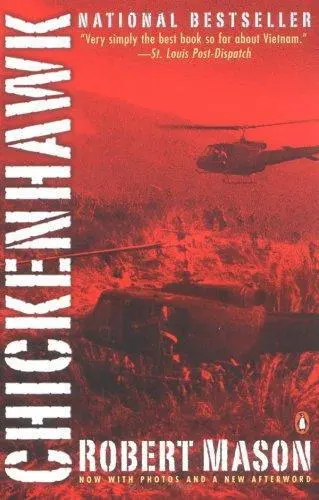
- Название:Chickenhawk
- Автор:
- Издательство:Penguin Books
- Жанр:
- Год:2005
- Город:New York
- ISBN:9780143035718
- Рейтинг книги:4 / 5. Голосов: 1
-
Избранное:Добавить в избранное
- Отзывы:
-
Ваша оценка:
Chickenhawk: краткое содержание, описание и аннотация
Предлагаем к чтению аннотацию, описание, краткое содержание или предисловие (зависит от того, что написал сам автор книги «Chickenhawk»). Если вы не нашли необходимую информацию о книге — напишите в комментариях, мы постараемся отыскать её.
have been sold since it was first published in 1983. Now with a new afterword by the author and photographs taken by him during the conflict, this straight-from-the-shoulder account tells the electrifying truth about the helicopter war in Vietnam. This is Robert Mason’s astounding personal story of men at war. A veteran of more than one thousand combat missions, Mason gives staggering descriptions that cut to the heart of the combat experience: the fear and belligerence, the quiet insights and raging madness, the lasting friendships and sudden death—the extreme emotions of a “chickenhawk” in constant danger.
Robert Mason enlisted in the army in 1964 and flew more than 1,000 helicopter combat missions before being discharged in 1968. [
]’s vertical plunge into the thickets of madness will stun readers.
(
) Mason’s gripping memoir… proves again that reality is more interesting, and often more terrifying, than fiction.
(
) Very simply the best book so far out of Vietnam.
(
)
Chickenhawk — читать онлайн бесплатно полную книгу (весь текст) целиком
Ниже представлен текст книги, разбитый по страницам. Система сохранения места последней прочитанной страницы, позволяет с удобством читать онлайн бесплатно книгу «Chickenhawk», без необходимости каждый раз заново искать на чём Вы остановились. Поставьте закладку, и сможете в любой момент перейти на страницу, на которой закончили чтение.
Интервал:
Закладка:
I heard the sounds of machine guns blasting out of the darkness overhead. Our gunships were on station, shooting streams of tracers into the foothills beyond the ROKs. Still, no mortars had come past the berm next to the gully. Our ships still idled, not taking off.
After fifteen minutes the mortars stopped. Only the familiar sound of outgoing rounds was left. I stood up and tried to dust the sand from my sweating body. My hands shook, and I cursed the Vietcong, the mortars, and the army.
The evacuation pilots were returning from the flight line.
“Listen, asshole, I was assigned Two-two-seven. What the fuck were you doing in my seat?” I heard someone say.
“The major told me I was supposed to fly it, numb nuts!”
The ships hadn’t got off the ground, because too many men tried to squeeze on board. The weight of the pilots and crew chiefs stuffed inside the machines kept them grounded while they argued about who was supposed to be flying.
The Koreans had sent out their Tiger teams. They came back with mortar tubes, base plates, and severed VC heads. The Koreans also complained that our gunships had killed some of their men.
We came off as a bunch of amateurs compared to the ROKs.
For the rest of the night I kept snapping awake as though something were happening. But nothing was.
“Preacher Six, there’s a machine-gun position on your takeoff path.”
The guns swooped back and forth in front of us, chattering.
Williams was up against the tree line in front of us, so he had to pull the guts out of his Huey to make it over. The gunships were in front of us, circling like sharks, firing down into the jungle.
“Preacher Six, turn left. You’re heading for the machine gun.”
No answer.
“Turn left. Turn left!” The gunship pilot was losing his cool as he watched us take off right over the position he’d warned us about.
It was a single gun. As we crossed above it, it raked us in the belly.
“Sir, one of the grunts just got hit!” said Miller, the crew chief.
The grunt, a black guy, had taken a round in the ass. I heard our gunner, Simmons, yelling incoherently over the noise of the ship.
“Sir, it’s Simmons’s brother,” Miller said.
“Preacher Six,” I called, “we have a wounded on board. We’re going to the aid station first.”
“Roger.”
We landed next to a MASH hospital pod that sky-cranes had lifted in from the Golf Course. The medics ran out and loaded the man onto a stretcher. Simmons ran around from the other side of the ship, crying, and hurried alongside the stretcher into the pod. We waited. He came back a few minutes later, his cheeks wet, but he was smiling.
“The doctors say he’ll be okay. He’ll be going home,” he said to the crew chief.
Ah, the proverbial million-dollar wound. Then I remembered that Simmons had discovered another brother at the bottom of a pile of bodies at Pleiku.
Neither brothers nor fathers and sons were supposed to be in the same combat theater at the same time. I knew of two people in Vietnam who didn’t have to be there.
I talked to Simmons after we got back to the Rifle Range.
“Yes, sir, I know,” he said.
“So why don’t you tell the CO. He’ll get you out of here. You’ve lost one brother, and another was just wounded. Your family has done enough.”
He smiled and said, “No. I’m staying.”
“Why?”
“Someone has to do it.” He really said that. I thought I was in a movie. Maybe he did, too.
The fighting had progressed from the valley floor near the village of Bong Son north to the narrow An Lao valley, surrounded by steep mountains. We landed on the valley floor in the rice paddies.
The grunts jumping out of the Hueys found themselves slogging slowly for cover next to the paddy dikes. The paddies were tricky. If we landed and laagered for a while, the ships sank up to their bellies in the quagmire, anchoring them. Leese had demonstrated the proper technique for takeoff from such places months before in Happy Valley.
“You can’t just pull up hard and race out of here,” he had said. “First you bring the nose up to start releasing the skids, then level the ship and pull up slowly, very slowly, until the skids slide free. If you don‘t, one skid will leave first, leaving the other still stuck. Then you’ll flip over and go crash.”
Resler, having just returned from his R&R, was with me. We landed in a paddy in An Lao to await grunts on their way to our position to be extracted.
Once on the ground, each Huey became a kind of island in the rice-paddy lake. The heat was sweltering. The humidity was as thick as the mud under us.
Helicopter pilots, like cats, were finicky about getting their feet wet. That was one of the reasons they were pilots. Grunts got dirty; pilots didn‘t—so the story went. Anyway, Resler and I crawled over the seats, sat in the shade on the cargo deck, and picked and pawed at the C-ration boxes for snacks.
When the pace of the action was broken by periods like this, we sometimes compensated by indulging in what the army called “grab-ass.” That is, we tried to make each other laugh.
“Hey, how’re we gonna heat the water for the coffee?” asked Resler.
“Here, gimme that can. I’ll make a stove.”
“Oh, yeah? How ya gonna get to the fuel drain?”
“You’re right. Let’s make Miller get the fuel.”
“No,” said Miller.
“Aw, come on. You want us to be alert, don’t you? What if we fall asleep and crash?” Resler coaxed.
“You ain’t gonna fall asleep, and I ain’t gonna go slog in that shit for the fuel.”
I looked at Rubenski in the pocket next to his gun. “Rubenski, grunts are supposed to love mud. Will you go get some JP-4 for me?”
“No. And I ain’t a grunt. I was a grunt; now I’m a gunner.”
“What’s the difference?”
“The difference is that a grunt would go get the fuel for you and I won’t.”
“Good point.” I glanced up and saw a tin-can stove burning on the dike next to the Huey beside us.
“Hey, you guys,” I yelled. “Give us some coffee, huh?”
“Get bent,” yelled Nate, grinning.
“Hey, have a heart. I’m nothing without my morning coffee.”
“You’re nothing anyway, Mason.”
“Shit, I can’t take this whining. I’ll go get some fucking fuel.” Rubenski jumped out and sank to his knees in the leech-infested bog.
“Now, that’s what I like to see—the true determination of an American grunt,” I yelled.
“Gunner!” Rubenski yelled back as he slogged heavily toward Nate’s ship.
When he was just about there, we heard “Crank ‘em!” from up front.
“Goddamnit!” Rubenski turned and slogged back through the morass. “Fuck!”
We cranked and checked in on the radios. The grunts were coming across the paddy, laboring at each step. They were tired and torn, unshaven and grim. Ammo cases clunked wearily on the deck. So did rifles and canteens and helmets. With eight of them in the back, the surface of the deck disappeared under mud and pieces of rice plants.
The flight leader gave us the word to go. One by one the ships wriggled loose from the slime. I rocked the ship back and forth and from side to side as I pulled the pitch. It was especially sticky stuff.
The ship in front of us, an attached ship from the Snakes, had a new pilot, or an old pilot in a hurry. He jerked up through the mud and promptly flipped over. The rotors hit the paddy, exploding into pieces. The mast came off. Parts flew everywhere. When the Huey stopped kicking, men started climbing out the cargo door, now the top of the bent and muddy fuselage. The command ship overhead told us to leave. He would get the men. While we circled back toward the valley ridge, I saw the command ship and a light gunship land and evacuate the men. I grinned while I imagined what the pilot who had crashed was thinking.
Читать дальшеИнтервал:
Закладка:
Похожие книги на «Chickenhawk»
Представляем Вашему вниманию похожие книги на «Chickenhawk» списком для выбора. Мы отобрали схожую по названию и смыслу литературу в надежде предоставить читателям больше вариантов отыскать новые, интересные, ещё непрочитанные произведения.








Обсуждение, отзывы о книге «Chickenhawk» и просто собственные мнения читателей. Оставьте ваши комментарии, напишите, что Вы думаете о произведении, его смысле или главных героях. Укажите что конкретно понравилось, а что нет, и почему Вы так считаете.