Robert Mason - Chickenhawk
Здесь есть возможность читать онлайн «Robert Mason - Chickenhawk» весь текст электронной книги совершенно бесплатно (целиком полную версию без сокращений). В некоторых случаях можно слушать аудио, скачать через торрент в формате fb2 и присутствует краткое содержание. Город: New York, Год выпуска: 2005, ISBN: 2005, Издательство: Penguin Books, Жанр: Биографии и Мемуары, nonf_military, на английском языке. Описание произведения, (предисловие) а так же отзывы посетителей доступны на портале библиотеки ЛибКат.
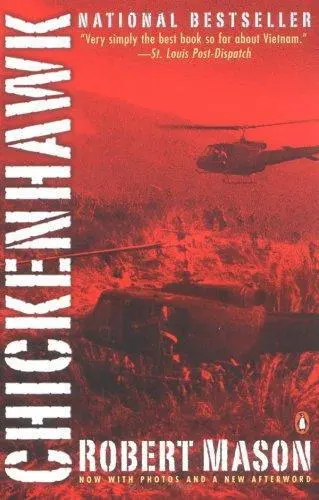
- Название:Chickenhawk
- Автор:
- Издательство:Penguin Books
- Жанр:
- Год:2005
- Город:New York
- ISBN:9780143035718
- Рейтинг книги:4 / 5. Голосов: 1
-
Избранное:Добавить в избранное
- Отзывы:
-
Ваша оценка:
Chickenhawk: краткое содержание, описание и аннотация
Предлагаем к чтению аннотацию, описание, краткое содержание или предисловие (зависит от того, что написал сам автор книги «Chickenhawk»). Если вы не нашли необходимую информацию о книге — напишите в комментариях, мы постараемся отыскать её.
have been sold since it was first published in 1983. Now with a new afterword by the author and photographs taken by him during the conflict, this straight-from-the-shoulder account tells the electrifying truth about the helicopter war in Vietnam. This is Robert Mason’s astounding personal story of men at war. A veteran of more than one thousand combat missions, Mason gives staggering descriptions that cut to the heart of the combat experience: the fear and belligerence, the quiet insights and raging madness, the lasting friendships and sudden death—the extreme emotions of a “chickenhawk” in constant danger.
Robert Mason enlisted in the army in 1964 and flew more than 1,000 helicopter combat missions before being discharged in 1968. [
]’s vertical plunge into the thickets of madness will stun readers.
(
) Mason’s gripping memoir… proves again that reality is more interesting, and often more terrifying, than fiction.
(
) Very simply the best book so far out of Vietnam.
(
)
Chickenhawk — читать онлайн бесплатно полную книгу (весь текст) целиком
Ниже представлен текст книги, разбитый по страницам. Система сохранения места последней прочитанной страницы, позволяет с удобством читать онлайн бесплатно книгу «Chickenhawk», без необходимости каждый раз заново искать на чём Вы остановились. Поставьте закладку, и сможете в любой момент перейти на страницу, на которой закончили чтение.
Интервал:
Закладка:
It was Riker.
“Somebody hurt?” said Riker. He did not know about Morris.
I stood next to the skid and tried to word what I was going to say while Riker finished freeing himself from the straps. As I began to speak, a painful grin possessed my face. “Morris was shot and killed.”
Riker’s face showed a second of shock and despair, before he too was possessed by the same animal grin. “Really? Morris?”
“Yes. Just a few minutes ago. At Quebec.” I spoke jerkily as I fought with the expression on my face. How could I be grinning?
Riker was having the same problem. His mouth curved into a smile, but his face showed pain. He tried to break the spell by speaking of other things.
“How bad is your ship?”
“Not bad. Fuel lines were hit.”
“Your ship is okay?” he said vacantly.
“Yep. Okay.”
“Where was he hit?” Riker said abruptly. The task of maintaining his composure was beyond him, and his face jerked involuntarily into that horrible grin.
“I don’t really know, but I think he got hit in the chest.”
“Yeah?”
“I think so.”
We were embarrassing each other, so we stopped talking and sat on the sandy grass and smoked a cigarette. The mechanics fiddled with my ship. Nate, who had been watching them curiously, walked over to join us.
“Bob tell you about Morris?” Nate seemed brave and businesslike.
“Yeah. By the way, is Decker all right?” Riker said.
“He’s still in the LZ,” said Nate.
“Really? Why didn’t somebody pick him up?”
“There was too much fire, and Decker jumped out and took cover on the ground. Besides, Williams wouldn’t let us wait to get him.”
“Why not?”
“Well, he was right. The next flight was right behind us, and we probably would’ve just got someone else hurt trying to get Decker to the ship.”
“It doesn’t seem right, just to leave him there.”
“He’ll be okay,” Nate said. “He’s got his trusty old shotgun with him.”
“Sir, the ship’s not flyable,” the mechanic called to Riker.
“Okay.” We all stood up. “You guys interested in a ride back to the Rifle Range for a new ship?”
“You bet,” I said. “Can’t wait to get back into the fight.”
Nate and Riker smiled at my false bravado. Then Riker said, “You guys remember that model he made of the Croatan ?”
“Uh-huh.”
“I wonder where it is now?”
An hour later, Nate and I were back in the air. We joined a flight taking more grunts into Quebec. Decker had got out on the next flight. Late that afternoon, after we had replaced two second lieutenants who had been killed and hauled reinforcements in and wounded out, the grunts finally took Quebec, both sandy acres of it. Two machine guns and ten rifles had been hidden in a long trench under that innocent-looking pile of brush. At twilight we landed back at the Rifle Range.
Decker was sitting on the end of his cot, elbows on his knees, hands on his cheeks, staring at the dirt.
I was glad to see him back. “Hey, Deck—” Someone stopped me with a shake of the head. I nodded. Instead of walking by him, I went outside and came in through the back flap and sat on my stretcher.
Nate, facing me on his cot, was pouring some Old Grandad into his canteen cup. “Want some?”
“Yeah, I think I will.” I poured about two inches in my cup and stirred in some water with my finger. We sat there silently. Nate reread one of his letters, and I watched Decker. Everyone else in the tent talked quietly, keeping a space around the mourning man.
He was pale. He looked up once, and his face showed that sad child within. He shook his head and made a weak smile. “He autorotated.”
We all looked at him, expecting more. But he was silent.
Sherman broke the silence. “Morris?”
“Yeah. As he died, he bottomed the pitch for an autorotation. But we were too close to the ground, and the ship nosed in and sank up to the canopy.” Decker squinted in pain and stopped talking.
I was thinking, “Nosed in”? There was nothing wrong with the ship. They’d hit harder than normal, but the ship was just sitting there running when Decker jumped out.
Decker continued solemnly. “The bullet came in through the triangle window and went through his flak vest like it wasn’t there and through his heart. The flak vest stopped it on the other side. He pushed the collective down like he was making an autorotation and we crashed before I could stop it.” He stopped for a moment. “If I had been a little faster, I could’ve kept us from crashing.”
“You didn’t do anything wrong,” said Sherman.
“That’s what you think. How would you feel if your best friend had just gotten killed and you couldn’t even keep the fucking ship from crashing? See, he did the right thing even while he was dying. He set us up for the autorotation, but I just wasn’t fast enough to save it.”
“But, Decker, Morris was already dead. It doesn’t matter about the landing,” Sherman said.
Decker stood up suddenly. “He’s dead and it’s my fault!” He grabbed his shotgun and walked outside.
“Jesus,” said Nate.
“I don’t see why he’s blaming himself,” said Sherman. “Morris was already dead. And besides that, the ship didn’t crash.”
We all looked at Sherman. Of course, he was right. But nobody wanted to be rational. It was so… out of place.
The old man said nothing about Morris except that we ought to get some money together for flowers for his wife, but Sherman took it upon himself to give a little speech that night.
“Well, we’ve been pretty lucky up to now. It was only a matter of time. The other companies have taken a lot more kills than we have, so it’s our turn now. It looks like the overall ratio is one in five. One pilot out of five will get killed. We’ve only lost two guys, which puts us five away from the average. We’ve just been lucky.”
I hated Sherman. Now we were delinquent in our deaths. Running behind in our proper death ratio were we? Well we’ll just see about that. C‘mon you guys, let’s get out there and die!
At dawn the next morning, a Chinook landed, dwarfing our Hueys. A deuce-and-a-half backed up to the door ramp, and men began loading chest protectors onto the truck. Hundreds of chest protectors.
8. Bong Son Valley
This country cannot escape its destiny as the champion of the free world—there is no running away from it.
—Gen. Maxwell Taylor, in U.S. News & World Report , February 14, 1966February 1966
The beach was slippery red clay. Connors claimed that it was better than the Caribbean. “In the Caribbean you can’t slide into the water because of the sand.”
True. If you sat on this beach without holding on to a bush, you slipped into the warm red water. Stepping toward the center of the pond, your feet accumulated layers of adhesive clay that made it seem like you were touching bottom when you weren’t. When I was chin deep, I stopped to watch the others.
Banjo ducked under and disappeared completely, an act of great courage in this slime, to reappear several feet away.
“Man, how can you stick your head under that shit?” said Kaiser. Kaiser, like me, wouldn’t go under for anything, but stood chin deep, soaking in the relative coolness.
Banjo only laughed and ducked under again. An old Vietnamese lady laughed at him while she weeded the fields around the pond. Four or five women and two men watched us skinny-dip in the buffalo watering pond. The women grinned self-consciously. These naked foreigners were clearly making fools of themselves. We interpreted their smiles as friendly approval.
Читать дальшеИнтервал:
Закладка:
Похожие книги на «Chickenhawk»
Представляем Вашему вниманию похожие книги на «Chickenhawk» списком для выбора. Мы отобрали схожую по названию и смыслу литературу в надежде предоставить читателям больше вариантов отыскать новые, интересные, ещё непрочитанные произведения.





Обсуждение, отзывы о книге «Chickenhawk» и просто собственные мнения читателей. Оставьте ваши комментарии, напишите, что Вы думаете о произведении, его смысле или главных героях. Укажите что конкретно понравилось, а что нет, и почему Вы так считаете.