Robert Mason - Chickenhawk
Здесь есть возможность читать онлайн «Robert Mason - Chickenhawk» весь текст электронной книги совершенно бесплатно (целиком полную версию без сокращений). В некоторых случаях можно слушать аудио, скачать через торрент в формате fb2 и присутствует краткое содержание. Город: New York, Год выпуска: 2005, ISBN: 2005, Издательство: Penguin Books, Жанр: Биографии и Мемуары, nonf_military, на английском языке. Описание произведения, (предисловие) а так же отзывы посетителей доступны на портале библиотеки ЛибКат.
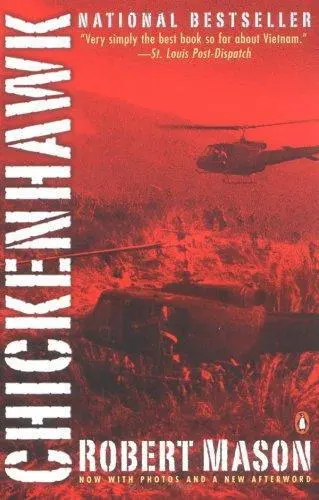
- Название:Chickenhawk
- Автор:
- Издательство:Penguin Books
- Жанр:
- Год:2005
- Город:New York
- ISBN:9780143035718
- Рейтинг книги:4 / 5. Голосов: 1
-
Избранное:Добавить в избранное
- Отзывы:
-
Ваша оценка:
Chickenhawk: краткое содержание, описание и аннотация
Предлагаем к чтению аннотацию, описание, краткое содержание или предисловие (зависит от того, что написал сам автор книги «Chickenhawk»). Если вы не нашли необходимую информацию о книге — напишите в комментариях, мы постараемся отыскать её.
have been sold since it was first published in 1983. Now with a new afterword by the author and photographs taken by him during the conflict, this straight-from-the-shoulder account tells the electrifying truth about the helicopter war in Vietnam. This is Robert Mason’s astounding personal story of men at war. A veteran of more than one thousand combat missions, Mason gives staggering descriptions that cut to the heart of the combat experience: the fear and belligerence, the quiet insights and raging madness, the lasting friendships and sudden death—the extreme emotions of a “chickenhawk” in constant danger.
Robert Mason enlisted in the army in 1964 and flew more than 1,000 helicopter combat missions before being discharged in 1968. [
]’s vertical plunge into the thickets of madness will stun readers.
(
) Mason’s gripping memoir… proves again that reality is more interesting, and often more terrifying, than fiction.
(
) Very simply the best book so far out of Vietnam.
(
)
Chickenhawk — читать онлайн бесплатно полную книгу (весь текст) целиком
Ниже представлен текст книги, разбитый по страницам. Система сохранения места последней прочитанной страницы, позволяет с удобством читать онлайн бесплатно книгу «Chickenhawk», без необходимости каждый раз заново искать на чём Вы остановились. Поставьте закладку, и сможете в любой момент перейти на страницу, на которой закончили чтение.
Интервал:
Закладка:
“If you had not moved at all, the bullet would probably have missed you altogether,” said Nate, back at the Rifle Range.
“That particular bullet hit me while I turned right. That means if I hadn’t turned, it would have come into the cockpit.”
“But you couldn’t know that. It was just luck.”
“Yeah. Good luck.”
“But just luck. What if you had turned into a bullet? The same technique could just as easily kill you.”
He was right of course, but I was convinced that I had actually dodged the bullet.
“But what about the takeoff? Everybody else got torn to ribbons,” I countered.
“Look, Mason, if it’s your turn to die, that’s it. You can’t control the odds. It just wasn’t your day to get zapped.”
“So you’re saying I should just sit there and fly smooth and neat with the rest of the flight? I can’t do that. I can imagine myself on the ground trying to shoot down a Huey. If one ship in the flight is going nuts like I do, I wouldn’t even try to hit it. I’d go for the others.
Nate nodded and sipped some coffee. “I guess if it makes you feel better, you should do it. But I think you’re just pissing into the wind.”
We learned that one gunner had taken a direct hit in the chest armor he was lucky enough to be wearing, and it had stopped the bullet cold. It reminded me of my near hit—which would have got me in the chest—so I got pissed off about the lack of chest protectors in our company. After all the fire we’d taken in the last five months, we still had only a few. We just hadn’t lost enough pilots yet.
The VC fire in this valley was intense. This was their home, and they were thoroughly dug in. No matter where we flew, we were shot at. In two days we had had forty-five ships seriously damaged in our slick battalions. The Chinooks in the 228th had been hit—which had not happened much at Ia Drang—and had lost ten pilots. We thought the C-130 that crashed and burned at the An Khe pass the day before, killing eighty, had been forced down by ground fire.
That night, Nate and I and Morris and Decker rode to the village down the road. I took some pictures of a group of smiling children. We all bought some candles and soap from the little store. On the way back, in the rear of the truck, we complained about our lack of chest armor. Morris sat with his arms folded as we bumped along.
“I talked to a friend of mine at battalion,” he said. “He says we should get a load of chest protectors any day now.”
The truck pulled up beside our mess tent, and as we got out, Decker said, “Yeah, any day now. I wonder how fast he’d get them here if he was flying in this shit.”
The next day, January 31, we launched another mission. This LZ was named Quebec. It was about five miles past Dog.
Dog was now a very large staging area where the bulk of our troopers stayed. If any place was secure in this valley, it was Dog. As the twelve ships on this mission crossed the river for the approach, somebody on the right side of the formation took a hit from the “friendly” village.
We hung around on the ground for about an hour, watching the air-force Phantoms as they hit Quebec with tons of bombs and napalm. I sat on the roof of my Huey and watched the show. At the bottom of their passes, the Phantoms would mush and they’d kick in their afterburners to power out. It was a pretty good show. I could’ve sat there and watched it all day.
While all this was going on, I idly watched two grunts walk out to/set up a claymore mine a hundred yards in front of us. I had gone through a demolition course in Advanced Infantry Training, so I felt a critical interest. The claymore mine is shaped like a crescent. The convex side is pointed toward the enemy. It’s detonated remotely, blasting millions of small wire pieces that shred its victims. As I watched them anchor it in position, it exploded. Both men, one on either side of the mine, were thrown back—torn, lifeless heaps.
What’s next in this carnival? I thought.
The Phantoms finished prepping Quebec, and the air show stopped.
“We’re up. Let’s go,” yelled Williams.
Eight grunts jumped on each ship. We cranked, checked in on the radios, and took off. Nate and I followed the number-two ship, Morris and Decker.
The smoke from the air-force bombing drifted lazily at Quebec as we flew past to set up an approach to the south.
“Preacher Six, Antenna Six. Head south now. VC automatic weapons on your route.” Antenna Six, the Colonel, flew overhead.
“Preacher Six, roger wilco.” Williams started his turn back to the LZ.
“Preacher Six, artillery is still preparing the LZ. Be careful.”
“Roger. Preacher Six now on short final.” The LZ was a narrow strip of brushy, dry sand next to the foothills on the west side of the valley. Following previous instructions, we moved into a staggered trail formation.
“Preacher Six, receiving small-arms fire from the west!” That was Connors.
“Yellow flight, this is Preacher Six. Pick your spots. The LZ is rough.” Williams was just off the ground in his landing flare. Morris and Decker were fifty feet off, and I was behind them maybe a hundred feet.
“Preacher Six, this is Yellow Two. Captain Morris is hit. Captain Morris is hit bad!” Morris’s ship suddenly dropped fast from twenty feet and landed hard.
“Yellow Four is receiving fire from the right.” There was nothing to see on our right except a long row of dead brush.
“Captain Morris is dead! Captain Morris is dead!”
“Roger, Yellow Two.”
“This ship is destroyed. I’m getting out!”
I saw Decker jump out of his Huey as we landed behind him. He leapt to the ground beside the ship, his sawed-off shotgun at the ready. He was faced away from the VC.
Nate called, “Preacher Six, Yellow Three. We’ll pick up Decker and his crew.”
“Negative, Yellow Three. Clear the LZ for the next flight.”
The grunts were off. Some of them scrambled toward Decker, under fire, and pointed him the right way. The troopers stayed low. Sand kicked up under the VC fire.
“Let’s go, Yellow flight.” Williams took off.
As I made the takeoff run beside Decker’s still-running ship, I glanced into the cockpit and saw Morris sitting in the right seat with his head slumped forward on his chest. He seemed to be taking a nap.
Tick. “We’re hit.” Tick-tick-tick.
The gunner that had got Morris was getting us. I pulled in a lot of power and climbed for the sky. I climbed much higher than Williams, and at about 1000 feet, the engine quit. Silence. I bottomed the pitch.
It was my first authentic forced landing, and I was extremely lucky. The spot I was aiming for was the spot I was supposed to land in anyway. It was secure. I skidded ten feet when I hit, and the rotors quietly slowed and stopped.
The crew chief was already inspecting the damage before I got out of the ship. “Four rounds through the fuel lines, sir.” We wouldn’t be flying that ship anymore today. Nate and I stood around while the flight returned to Quebec. I don’t know about him, but I felt cold and clammy while we stood in the blistering heat.
Battalion always had at least one maintenance ship on call for situations like ours. It landed in secure areas to determine whether or not a ship could be fixed on the spot.
I heard the loud whopping of the Huey as it crossed Dog, two miles away. How could anyone be taken by surprise by a flight of Hueys? The thudding slap of the main rotors grew quieter when the ship was a quarter of a mile away, replaced by the buzz of the tail rotor and the hissing whine of the turbine. It landed a hundred feet behind us, starting a brief sandstorm before the pitch was bottomed. The turbine shut off and the rotors spun down. Two specialists, mechanics, ran toward our ship. The crew chief showed them the damage under the engine cowling. They all stuck their noses into the Huey’s innards. Leaving them to their work, I walked back to the maintenance Huey to see who was flying.
Читать дальшеИнтервал:
Закладка:
Похожие книги на «Chickenhawk»
Представляем Вашему вниманию похожие книги на «Chickenhawk» списком для выбора. Мы отобрали схожую по названию и смыслу литературу в надежде предоставить читателям больше вариантов отыскать новые, интересные, ещё непрочитанные произведения.








Обсуждение, отзывы о книге «Chickenhawk» и просто собственные мнения читателей. Оставьте ваши комментарии, напишите, что Вы думаете о произведении, его смысле или главных героях. Укажите что конкретно понравилось, а что нет, и почему Вы так считаете.