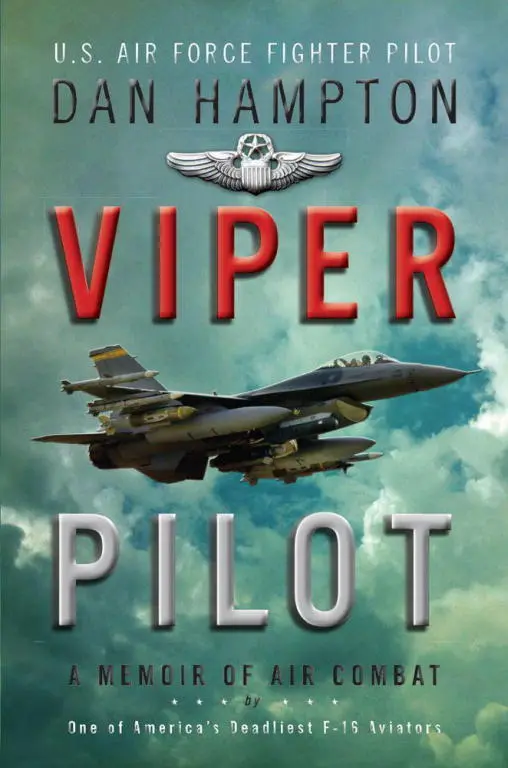
Dan Hampton - Viper Pilot
Здесь есть возможность читать онлайн «Dan Hampton - Viper Pilot» весь текст электронной книги совершенно бесплатно (целиком полную версию без сокращений). В некоторых случаях можно слушать аудио, скачать через торрент в формате fb2 и присутствует краткое содержание. Город: New York, Год выпуска: 2012, ISBN: 2012, Издательство: William Morrow, Жанр: Биографии и Мемуары, nonf_military, на английском языке. Описание произведения, (предисловие) а так же отзывы посетителей доступны на портале библиотеки ЛибКат.
- Название:Viper Pilot
- Автор:
- Издательство:William Morrow
- Жанр:
- Год:2012
- Город:New York
- ISBN:978-0-06-213035-8
- Рейтинг книги:4 / 5. Голосов: 1
-
Избранное:Добавить в избранное
- Отзывы:
-
Ваша оценка:
Viper Pilot: краткое содержание, описание и аннотация
Предлагаем к чтению аннотацию, описание, краткое содержание или предисловие (зависит от того, что написал сам автор книги «Viper Pilot»). Если вы не нашли необходимую информацию о книге — напишите в комментариях, мы постараемся отыскать её.
is the electrifying memoir of one of the most decorated F-16 pilots in American history: U.S. Air Force Lieutenant Colonel Dan Hampton, who served for twenty years, flying missions in the Iraq War, the Kosovo conflict, and the first Gulf War.
Both a rare look into the elite world of fighter pilots and a thrilling first-person account of contemporary air combat,
soars—a true story of courage, skill, and commitment that will thrill U.S. Special Forces buffs, aviation and military history aficionados, and fans of the novels of Tom Clancy and Dale Brown.
Viper Pilot — читать онлайн бесплатно полную книгу (весь текст) целиком
Ниже представлен текст книги, разбитый по страницам. Система сохранения места последней прочитанной страницы, позволяет с удобством читать онлайн бесплатно книгу «Viper Pilot», без необходимости каждый раз заново искать на чём Вы остановились. Поставьте закладку, и сможете в любой момент перейти на страницу, на которой закончили чтение.
Интервал:
Закладка:
As the tanker came around heading west, the last rays of sun were vanishing and the ugly haze looked a lot closer than it had before. Above me, the sky was already dark, but since we were still in Iraq we all kept our lights off. My jet was comfortably heavy with fuel again, and when we rolled out, the boomer said, “All full, sir.” He whistled softly. “Fourteen hundred and seventy gallons.”
I jotted it down and did the math in my head. More than 10,000 pounds of fuel.
Clicking the disconnect switch, I slid slowly back and down away from the boom, and waved to the boomer. Closing the refueling door, I added a little power and took up a loose formation on the tanker’s left wing. We’d stay with him until he got back across the border then we’d head south to Prince Sultan Air Base near Riyadh. I wanted a gallon of water to drink, and an enormous, hot meal. What a day.
“ROMAN 75… this is TENDON.” It was a different voice. Probably the tanker pilot.
I clipped the oxygen mask back over my face. “Go ahead.”
“Ah… AWACS just passed that KKMC, al-Batin, and Rafha are zero-zero, due to blowing dust.”
Zero-zero. Slang for “zero ceiling and zero visibility.” Another way to put it would be complete shit . No way to land. Those were all bases in northern Saudi along the border with Iraq. Glancing ahead of us there was nothing but a rolling carpet of dust and I wasn’t surprised. All 1.4 million square miles of Saudi (about one-third of the continental U.S.) could disappear under blowing sand in a matter of hours, and I’d been busy that long. This was worse than I’d ever seen it; picture an undulating, brown sea stretching as far as you can see. The haze generated by this monster was so high that the stars were dimmed. It was like staring through a brown frosted glass.
“TENDON… can you get the weather for Prince Sultan and Riyadh?”
“Already got it. Riyadh is a quarter-mile vis, blowing dust. Prince Sultan is still at one mile.”
“Good enough, TENDON. We’re RTB at this time. If you get any updates would you pass them on Victor 130.225?”
“Wilco.”
“And TENDON… thanks for coming to get me.”
“We heard what you were doing down there… how could we say no?”
I chuckled drily. “You could’ve said no… so thanks again.” I could barely make out the tanker pilot’s outline in his cockpit, and he waved.
“Be hard to sleep at night if I did that. Best of luck, ROMAN.”
I gently pulled up above the tanker, and my wingman followed from the other side. We were over a point called Customs House, on the Saudi-Iraq-Kuwaiti border, although I couldn’t see it. Beginning a gentle left turn, I automatically switched to the AWACS coordination frequency. This was a standard procedure over Customs House, and I knew my wingman would be there, too.
“LUGER, LUGER… this is ROMAN 75.”
Normally, jets coming out of Iraq would do a battle-damage check for holes, leaks, hung weapons, and generally anything bad that would keep you from getting home. But tonight it seemed the least of my problems. Centering the steering on Prince Sultan Air Base, I switched on the autopilot, pulled the night-vision goggles from their canvas bag, and clipped them on my helmet.
“ROMAN 75 this is LUGER. Go ahead.”
“ROMAN is two by Fox-16s, five hundred rounds of twenty mike mike expended, checking out, RTB.”
“Ah… ROMAN… confirm you’re RTB to PeeSab?” Prince Sultan’s identifying letters were PSAB—get it?
“Affirm.”
“PeeSab latest observation is one half-mile, sky obscured. Winds are three-zero-zero at thirty gusting to fifty.”
Nice.
I said it again—what a shitty day. The storm was moving west to east toward the bases along the Persian Gulf and in Kuwait, so there wasn’t much time.
“Copy that LUGER. What’s currently open?”
He had more good news. “Sheikh Isa is a half-mile, blowing dust, and Dhahran is one mile but falling.”
Sheikh Isa was in Bahrain and Dhahran was on the coast. Terrific. So the only reasonably clear air was where I was now flying, and it was disappearing fast. When I looked outside, it didn’t look that clear anyway. The lights from Kuwait and the big cities down the Saudi coast were usually visible, but now there was nothing. I couldn’t even see the oil fires through the goggles, and a tiny sliver of uneasiness poked up through my belly. I’d been in countless bad situations before, right? Right.
I keyed the Victor radio. “ROMAN Two… say gas.”
“7.1. Tanks dry.” I had 10,500 pounds, so fuel wasn’t the issue. Still—go where the gas is.
“LUGER… call TENDON 31 and see if we can RTB with him to al-Udeid.”
This was a big tanker-and-logistics base in Qatar on the southern end of the peninsula. I called up the steerpoint and came around, heading southeast.
“ROMAN… this is LUGER. TENDON 31 has no further gas available.”
I looked at the steering information: 355 miles. With all this fuel, that would be no problem. But the good news kept coming.
“Ah… ROMAN, be advised that al-Udeid is now reporting a half-mile and blowing dust. TENDON is diverting to Diego.”
Diego? I blinked. That was the tiny island of Diego Garcia in the Indian Ocean . Oh yeah, this was just getting better and better. I zippered the mike to wake up my wingman and began a slow left turn back to the north. There was only one choice, since Iran didn’t count.
“LUGER… get me the current weather for Kuwait.”
I pulled my Smart Pack off my leg and found the correct page. Flipping up the goggles, I turned on the white eyebrow light beneath the glare shield and squinted at the Divert card diagram. This was a depiction of the entire theater of operations, showing all suitable emergency airfields, their various frequencies, and other basic information. This annoying situation had just become an emergency, since the entire Middle East was vanishing beneath the dust. Al-Jaber would be my top pick. A-10 Warthogs and F-16s were based there. The food was okay, too.
I tapped the chart, then reached into the G-suit ankle pocket for my approach plate-book. This is a compilation of all the airfields in a given region and the instrument approaches available at each one. Instrument approaches are precise procedures that use specialized equipment on the ground and in the aircraft. The pilot then flies off his instruments through the weather down to a predetermined vertical and horizontal point. He either sees the runway or he doesn’t and executes a missed approach. Military pilots were rated to a half-mile visibility with 200-foot ceilings under normal conditions; this isn’t much when you’re landing at 150–175 knots.
“ROMAN… Al-Jaber reports a quarter-mile vis, intermittent to zero-zero.”
Swell.
Before I could ask, he added helpfully, “Kuwait International is closed. Say intentions.”
Say intentions? How about London or Madrid?
“ROMAN 75 is diverting to Ali al-Salem.” Apparently, the only place to land in friendly territory on this side of the planet.
“Roger that… Salem weather is three-quarters of a mile, blowing dust, wind is two-four-zero at twenty knots gusting to thirty.”
“ROMAN copies all.” I switched steerpoints and checked us a little right. Ali was about 110 miles from my present position, so I eased the throttle back to slow down while I studied the approach.
Approach? What approach? I thumbed through the book again. Nothing. Checking the four-letter airfield identifier, I looked again.
Nothing.
So, there was no published instrument-approach to the only field in this hemisphere where I could land. If the weather was better, day or night, we could simply fly in and land using eyes instead of instruments. But the weather sucked.
Читать дальшеИнтервал:
Закладка:
Похожие книги на «Viper Pilot»
Представляем Вашему вниманию похожие книги на «Viper Pilot» списком для выбора. Мы отобрали схожую по названию и смыслу литературу в надежде предоставить читателям больше вариантов отыскать новые, интересные, ещё непрочитанные произведения.







Обсуждение, отзывы о книге «Viper Pilot» и просто собственные мнения читателей. Оставьте ваши комментарии, напишите, что Вы думаете о произведении, его смысле или главных героях. Укажите что конкретно понравилось, а что нет, и почему Вы так считаете.