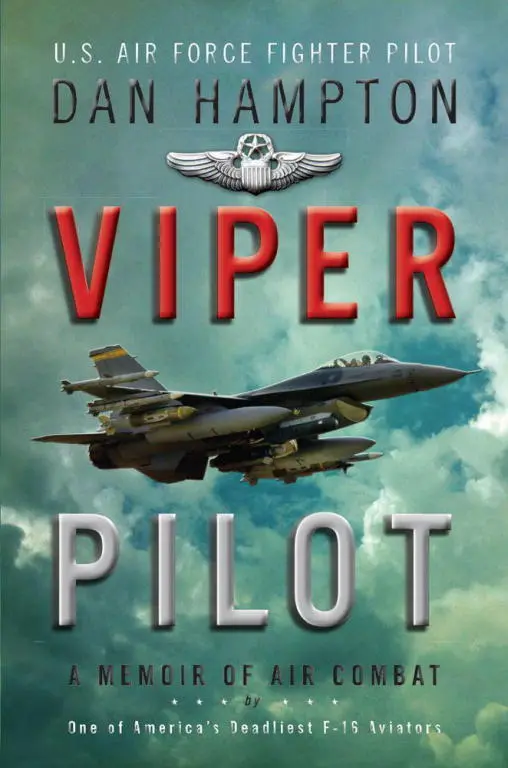
Dan Hampton - Viper Pilot
Здесь есть возможность читать онлайн «Dan Hampton - Viper Pilot» весь текст электронной книги совершенно бесплатно (целиком полную версию без сокращений). В некоторых случаях можно слушать аудио, скачать через торрент в формате fb2 и присутствует краткое содержание. Город: New York, Год выпуска: 2012, ISBN: 2012, Издательство: William Morrow, Жанр: Биографии и Мемуары, nonf_military, на английском языке. Описание произведения, (предисловие) а так же отзывы посетителей доступны на портале библиотеки ЛибКат.
- Название:Viper Pilot
- Автор:
- Издательство:William Morrow
- Жанр:
- Год:2012
- Город:New York
- ISBN:978-0-06-213035-8
- Рейтинг книги:4 / 5. Голосов: 1
-
Избранное:Добавить в избранное
- Отзывы:
-
Ваша оценка:
Viper Pilot: краткое содержание, описание и аннотация
Предлагаем к чтению аннотацию, описание, краткое содержание или предисловие (зависит от того, что написал сам автор книги «Viper Pilot»). Если вы не нашли необходимую информацию о книге — напишите в комментариях, мы постараемся отыскать её.
is the electrifying memoir of one of the most decorated F-16 pilots in American history: U.S. Air Force Lieutenant Colonel Dan Hampton, who served for twenty years, flying missions in the Iraq War, the Kosovo conflict, and the first Gulf War.
Both a rare look into the elite world of fighter pilots and a thrilling first-person account of contemporary air combat,
soars—a true story of courage, skill, and commitment that will thrill U.S. Special Forces buffs, aviation and military history aficionados, and fans of the novels of Tom Clancy and Dale Brown.
Viper Pilot — читать онлайн бесплатно полную книгу (весь текст) целиком
Ниже представлен текст книги, разбитый по страницам. Система сохранения места последней прочитанной страницы, позволяет с удобством читать онлайн бесплатно книгу «Viper Pilot», без необходимости каждый раз заново искать на чём Вы остановились. Поставьте закладку, и сможете в любой момент перейти на страницу, на которой закончили чтение.
Интервал:
Закладка:
UNFORTUNATELY, THE 1990S GAVE RISE TO SCORES OF CAREERISTS who filled all the squares, went to the correct staffs and knew all the right people. The problem was that they couldn’t fight their way out of a wet paper bag. Our own squadron commander, who bravely ran away from the Khobar fence, had never held any field-grade squadron leadership positions prior to being given a command. And it showed. There are guys who fly fighters and there are fighter pilots. This guy was definitely not a fighter pilot.
Some of these men were on decoration quests—either for vanity or career enhancement. Personally, I think most decorations are absurd. Even some of the respected ones can be given away for horseshit reasons. I knew of a major (now, unbelievably, a major general) who put together PowerPoint briefings for generals during Desert Storm and got a Bronze Star for it. He would always say that he’d gotten it during Desert Storm, which was true but disingenuous. Someone would inevitably ask which squadron he’d been with or how many combat missions he’d flown and this guy would always manage to change the subject. The Air Force also permits combat flying time to be logged if you are physically in a designated combat zone, even if there is no fighting going on. This is how some men, like Schwalier, are able to log combat time without ever actually fighting. Again, to me, disingenuous.
My point is not to necessarily pick on men like Schwalier but to illustrate the weaknesses of the system that created them. Loyalty is a fine thing and one of the cornerstones of any combat profession—but so is accountability. I’ve seen officers fired because their subordinates were having affairs, or had drinking problems or for a score of other things completely beyond a commander’s control. It is wildly hypocritical and inconsistent to then permit a commander to be exonerated for loss of life that may well have been preventable.
Anyway, as the 1990s waffled on, we saw more and more of this. Kosovo and Operation Allied Force seem to have been wholly fought to deflect national attention away from Bill Clinton’s perennially open pants. That, and General Wesley Clark’s narcissistic dream of being considered a latter-day Eisenhower. In any event, neither worked out very well. Clark actually ordered his subordinate commanders to attack Russian soldiers at Pristina airport. Fortunately, the senior British officer, General Sir Mike Jackson, refused point-blank. In fact, he replied, “I’m not going to start the Third World War for you.”
Out of the 120-something kills claimed on Serbian armor, we could only find a dozen vehicles destroyed. We did find a lot of destroyed decoys—plywood tanks with little kerosene stoves inside to provide heat signatures, or old World War II relics without treads. The Yugoslavs simply lit fires under the bellies to heat up the metal so we’d see them with our infrared systems.
After the war, a battle-damage assessment team was told to go back in and “find” the correct number of wrecked tanks. The Air Force major in charge of the team came back with twelve confirmed tank kills and refused to inflate the numbers to help Clark’s entry into politics. This didn’t do the major’s career any good, so he transferred to the National Guard. Guys like that get a scotch from me on sight.
As time rolled on, the Vietnam-era pilots eventually retired, and most of us who’d fought the First Gulf War slowly staggered up the ladder. We became flight leads, instructor pilots, and commanders. A very few of us became Weapons and Tactics Officers. We’d spent the years between the wars over Iraq occasionally getting shot at, working out system limitations, and deriving tactics. There were tireless efforts by many talented guys to improve our systems and weapons.
For the F-16CJ, the HARM Targeting System (HTS), thankfully, evolved into something that had less and less to do with lobbing anti-radiation missiles and more to do with precision-targeting. HTS was initially fairly inaccurate, since the HARM didn’t require a very tight firing solution. The missile was supposed to “see” the radar signal, called a “beam,” and follow that beam back to impact. Think of standing in a dark room with a pistol and shooting at pulsating flashlight beams, and you get the idea. However, shooting at the beam doesn’t mean you have much of a chance of hitting the source. You might scare it though, and force it to turn off. That’s okay for the moment, but the flashlight is still alive and may get you another time.
So, lobbing HARMs at radar beams and calling it Weaseling is an extremely dangerous notion. Threats rarely do what you expect, and that early version of the HARM, in many opinions, was really a very crappy missile. If the threat didn’t emit, then the HARM had nothing to guide on and went “stupid.” The concept had worked in the 1960s and 1970s, when SAMs had to actively emit to shoot missiles, but by the 1990s SAMs utilized optics, infrared, or other guidance sources.
The Texas Instrument marketing folks were obviously very good, because I thought, as did many others, that the missile was generally a waste of a weapon station. I shot over thirty of these things in combat and have no idea what they hit except the earth or maybe some poor Iraqi jabbering on a cell phone at the wrong time. So HTS was only initially designed with enough accuracy for the HARM, and the end effect was a targeting solution that wasn’t good enough for precision weapons.
Yet.
A very gifted engineer named Gregg helped me rough out a design for what eventually became HTS R7. This would permit much faster targeting solutions with accuracies tight enough to employ precision-guided munitions. We actually drew this up on a napkin (no kidding) at a place called AJ’s on the beach in Panama City.
Then there were those of us who passionately believed in suppressing a threat by killing it. I mean, if the thing is in a million pieces on the ground, then it’s suppressed, right? Then it won’t be back to bother you tomorrow, next week, or in the next war. It’s dead. Some of us had seen this in combat and recognized the flaws in the anti-radiation, suppression-only mind-set. This would take almost a decade to change, but HTS was a step in the right direction and the system would undergo dramatic improvements. More to the point, it was all we had.
The pilot was the other reason the CeeJay concept was successful. There was now an entire generation of officers who’d always flown the F-16, and we were very comfortable with fourth-generation technology and doing everything ourselves. Sensor management was, and is, a huge part of a young F-16 pilot’s training. To be able to monitor and interpret radars, targeting pods, weapons, and all onboard systems while physically flying a Mach-2 jet is not a common ability. To do it at night, a hundred feet off the ground, while other men are trying to kill you, is extraordinary. I once took an F-15E WSO for an orientation flight in a two-seat F-16. He came back amazed (and worried) that I could do alone what it took his crew to accomplish in a Strike Eagle. Fighter pilots tend to rise to the occasion, whether it’s impressing young girls in the O’Club or mastering lethal technology.
So we rose.
AMERICA’S ENTHUSIASM FOR WAR HAD BEEN FLAGGING DURING the 1990s. The world saw through the Kosovo mess, and the general public was, frankly, not convinced that Hussein was much of a threat. Budgets were being cut and drawdowns were looming when the Twin Towers came down on September 11, 2001.
My squadron had rotated home from Southwest Asia two weeks earlier, and that terrible Tuesday morning was our second day back to normal stateside operations. There were mountains of paperwork to catch up on and a myriad of flying currencies to refresh. On September 11, I’d just landed from an early-morning mission when everyone began buzzing about the first plane strike. It was 0846, and I clearly remember wondering how some amateur pilot could end up over New York City and be so stupid as to fly himself into the Twin Towers. We all thought it was an accident. Turned out, it was a Boeing 767 that had the misfortune of being American Airlines Flight 11.
Читать дальшеИнтервал:
Закладка:
Похожие книги на «Viper Pilot»
Представляем Вашему вниманию похожие книги на «Viper Pilot» списком для выбора. Мы отобрали схожую по названию и смыслу литературу в надежде предоставить читателям больше вариантов отыскать новые, интересные, ещё непрочитанные произведения.








Обсуждение, отзывы о книге «Viper Pilot» и просто собственные мнения читателей. Оставьте ваши комментарии, напишите, что Вы думаете о произведении, его смысле или главных героях. Укажите что конкретно понравилось, а что нет, и почему Вы так считаете.