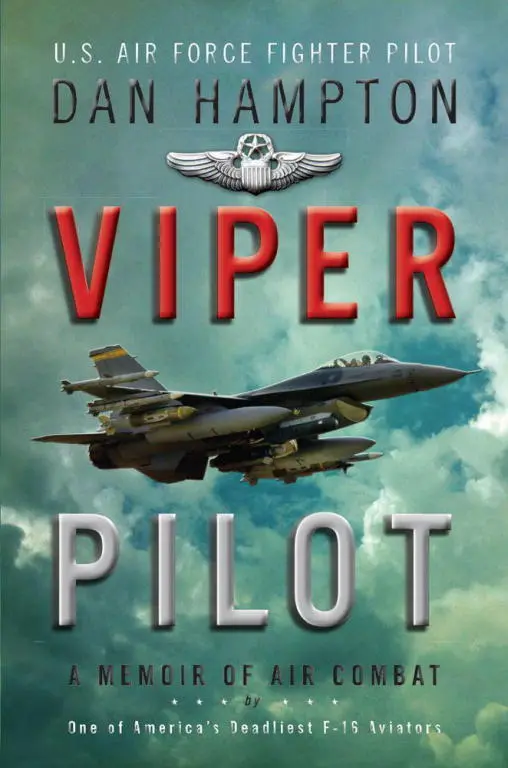
Dan Hampton - Viper Pilot
Здесь есть возможность читать онлайн «Dan Hampton - Viper Pilot» весь текст электронной книги совершенно бесплатно (целиком полную версию без сокращений). В некоторых случаях можно слушать аудио, скачать через торрент в формате fb2 и присутствует краткое содержание. Город: New York, Год выпуска: 2012, ISBN: 2012, Издательство: William Morrow, Жанр: Биографии и Мемуары, nonf_military, на английском языке. Описание произведения, (предисловие) а так же отзывы посетителей доступны на портале библиотеки ЛибКат.
- Название:Viper Pilot
- Автор:
- Издательство:William Morrow
- Жанр:
- Год:2012
- Город:New York
- ISBN:978-0-06-213035-8
- Рейтинг книги:4 / 5. Голосов: 1
-
Избранное:Добавить в избранное
- Отзывы:
-
Ваша оценка:
Viper Pilot: краткое содержание, описание и аннотация
Предлагаем к чтению аннотацию, описание, краткое содержание или предисловие (зависит от того, что написал сам автор книги «Viper Pilot»). Если вы не нашли необходимую информацию о книге — напишите в комментариях, мы постараемся отыскать её.
is the electrifying memoir of one of the most decorated F-16 pilots in American history: U.S. Air Force Lieutenant Colonel Dan Hampton, who served for twenty years, flying missions in the Iraq War, the Kosovo conflict, and the first Gulf War.
Both a rare look into the elite world of fighter pilots and a thrilling first-person account of contemporary air combat,
soars—a true story of courage, skill, and commitment that will thrill U.S. Special Forces buffs, aviation and military history aficionados, and fans of the novels of Tom Clancy and Dale Brown.
Viper Pilot — читать онлайн бесплатно полную книгу (весь текст) целиком
Ниже представлен текст книги, разбитый по страницам. Система сохранения места последней прочитанной страницы, позволяет с удобством читать онлайн бесплатно книгу «Viper Pilot», без необходимости каждый раз заново искать на чём Вы остановились. Поставьте закладку, и сможете в любой момент перейти на страницу, на которой закончили чтение.
Интервал:
Закладка:
Tactics took up most of my brain bytes. We all knew there would be a reckoning with Iraq. The Air Force closet had been cleaned out, so to speak, and almost all of the older weapons and jets had been retired. What was left was considerably streamlined and there were a lot fewer of us around to fight. The technological advances had evened this up but it was left to us to make the most of these advantages.
Iraq was a relatively simple theater for combat, and the terrain, at least from the air, was fairly permissive. Mountains were only in the far north and east. The far west, near the Jordanian and Syrian borders, was a morass of twisted wadis and rugged low hills. Most of the population was concentrated in Mesopotamia, the land between the Tigris and Euphrates Rivers.
So it makes sense, defensively, to protect the large important focal points rather than the entire country, and this is precisely what the Iraqis did. The cities of Kirkuk and Mosul in the north, Baghdad in the center, Nasiriyah and Basrah in the south were all heavily defended. There were dozens of fortified rings for smaller towns or military complexes, and mobile SAM systems could be anywhere. In fact, the Iraqis had over eight thousand mobile SAMs, not including the thousands of shoulder-launched MANPADS that any soldier could carry. These complimented and overlapped the four hundred larger SA-2s, SA-3s, and SA-6s. Anti-aircraft artillery estimates were in the tens of thousands.
The big stuff was centered around important cities to protect airfields, train stations, communications nodes, and other vital bits of infrastructure. Tracking information from surveillance radars, air traffic radars, and long-range search radars was all brought together in an Integrated Air Defense System (IADS) called KARI. In theory, this would tie all inbound radar tracks on people like me together into a consolidated air “picture.” Based on this, the Iraqi Air Defense Commander would then parcel out the interception and targeting responsibilities to the appropriate Iraqi SAM and fighter units.
There were several problems with this. First, KARI was designed by the French, who, though first-class vintners, are usually hopeless as warriors. Ask the Germans or the Vietnamese or the Algerians. Second, Iraqi systems didn’t handle jamming very well, and Americans are masters of electronic combat. We could, and did, blank out entire sectors so the Iraqis couldn’t see what was coming. Many of our initial targets were long-range search radars that could detect us crossing the Saudi border. We would also destroy telephone relay stations, cell towers, and all other forms of communications equipment. It’s a basic concept in any fight: punch out their eyes and mouth so they can’t see to react or call for help.
The Russians, who trained most of the Iraqis, are very centralized in their battlefield thinking, and they instilled this in their students. So, cutting units off from their commanders would force independent thought, and this was something most Iraqis didn’t handle well. Battles are chaotic enough anyway, and without direction from above many Iraqi units initially did nothing at all.
Then there was saturation. KARI worked okay against the ten or twenty aircraft-strike packages from the Iran-Iraq War, but we had over three hundred aircraft hitting them every day and they were overwhelmed. Throw in the communications disruption and jamming that had them chasing false targets, and it’s obvious why we gained air supremacy in two days.
When their MiGs and Mirages did take off to gloriously battle the infidel invaders (that would be us again), none of them ever came back. I helped chase a flight of Mirage fighters into Iran one day as they bravely ran away. Another morning, I watched two MiG-23s fly into the ground as they tried to shake off a horde of U.S. jets swarming in their direction. So, in addition to their technical shortcomings, the Iraqis had a critical morale problem.
We’d gone into this more or less ad hoc in 1991, but by 2003 we’d figured it out. Extreme adaptability is one of the most defining characteristics of the American military, and we adapted. We also function very well as small independent units that don’t require a lot of supervision. In fact, supervision is usually highly resented.
Now, with lots of time between the wars, we had the luxury of really picking the threat apart and studying it. Remember, the goal of Operation Desert Storm had been to save Kuwaiti and Saudi oil, not to invade Iraq. But we knew the next war would be different. Next time we’d have to go to Baghdad.
No one liked rotating to Saudi or Kuwait twice per year, but we made the most of it. It was, in fact, terrific practical experience and afforded us a superb opportunity to know the terrain, the weather, and build up our knowledge of a threat we’d face eventually. We still hated it.
The Weasels from the 20th Fighter Wing did this from Dhahran, Saudi Arabia. This base was left over from Desert Storm and sat south of Iraq on the Persian Gulf. Dhahran wasn’t too bad for several reasons. First, it was only a hundred miles from the Iraqi border, and in a region so vast this made response times very quick and our missions that much shorter. Second, unlike the rest of the Kingdom, the city of Dhahran actually had a few amenities. The downtown area had been built with petrodollars and boasted good restaurants and even a shopping mall. Because of the oil fields, the locals were accustomed to Westerners and were relatively tolerant.
Last (and most important), there was a causeway across the water to the island of Bahrain. This causeway had been built for Saudis who needed a break from condemning godless Americans and Europeans. They’d race across the narrow highway, shedding robes and headdresses as they drove, to get to the bars and women on the island—apparently, Allah doesn’t see them if they’re not in Saudi Arabia. We didn’t care. We’d go there to eat and shop and sometimes spend the night at a nice beachside resort. No scorpions, camel spiders, or military meals. Bahrain was only a few miles off the coast but was truly another world compared to the Arabian Peninsula.
In 1979, the Saudi government, feeling nostalgic about its desert past, built a complex outside Dhahran for Bedouin tribesmen. This was intended for the elderly, the sick, and those awaiting air-transportation to Mecca for the annual hajj. Over fifty modern condos were built, with four units per floor and eight floors per building. Each unit had a large living room with a kitchen on one end and a window wall opening to a narrow balcony on the opposite side. Four bedrooms, each with a bath and bidet, were accessible from this central area. Everything the modern Bedouin family needed.
Except Bedouins don’t live in condos.
They don’t put their sick or old in hospitals and they don’t fly to the hajj. So, this huge complex stood empty for eleven years until housing was needed for American, British, and French pilots who arrived in 1990 to save the Ghawar oil fields. Sorry—to save the peaceful and progressive Saudi people from their monstrous northern neighbor.
The war ended but the infidels remained. The presence of non-Muslim soldiers in the holy kitty-litter box of Saudi Arabia began to cause great offense throughout the Kingdom and the Islamic world. It was fine for us to fight and even die for them and their oil, but now that the danger was past they wanted us out. Even though Saddam was a genocidal, homicidal butcher, he was, after all, a Muslim and therefore preferable to the bacon-loving degenerate soldiers who had just saved the day.
The temporary solution was to house us someplace out of the way and relatively discreet. Dhahran was chosen, and the 4404th Combat Wing (Provisional) took up permanent residence in the Bedouin compound outside the city.
Читать дальшеИнтервал:
Закладка:
Похожие книги на «Viper Pilot»
Представляем Вашему вниманию похожие книги на «Viper Pilot» списком для выбора. Мы отобрали схожую по названию и смыслу литературу в надежде предоставить читателям больше вариантов отыскать новые, интересные, ещё непрочитанные произведения.








Обсуждение, отзывы о книге «Viper Pilot» и просто собственные мнения читателей. Оставьте ваши комментарии, напишите, что Вы думаете о произведении, его смысле или главных героях. Укажите что конкретно понравилось, а что нет, и почему Вы так считаете.