Джон Пристли - Benighted
Здесь есть возможность читать онлайн «Джон Пристли - Benighted» весь текст электронной книги совершенно бесплатно (целиком полную версию без сокращений). В некоторых случаях можно слушать аудио, скачать через торрент в формате fb2 и присутствует краткое содержание. Жанр: Триллер, на английском языке. Описание произведения, (предисловие) а так же отзывы посетителей доступны на портале библиотеки ЛибКат.
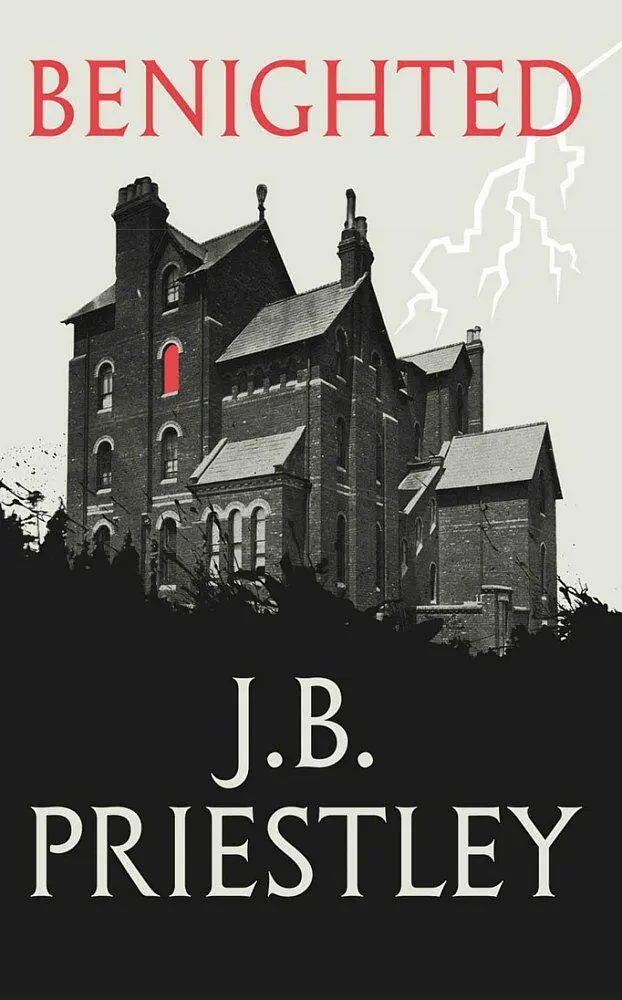
- Название:Benighted
- Автор:
- Жанр:
- Год:неизвестен
- ISBN:нет данных
- Рейтинг книги:3 / 5. Голосов: 1
-
Избранное:Добавить в избранное
- Отзывы:
-
Ваша оценка:
Benighted: краткое содержание, описание и аннотация
Предлагаем к чтению аннотацию, описание, краткое содержание или предисловие (зависит от того, что написал сам автор книги «Benighted»). Если вы не нашли необходимую информацию о книге — напишите в комментариях, мы постараемся отыскать её.
On the house's top floor are two locked doors; behind one of them lies the mysterious, unseen Sir Roderick Femm, and behind the other lurks an unspeakable terror. Which is more deadly: the apocalyptic storm outside the house or the unknown horrors that await within? And will any of them survive the night?
The book was written and published in 1927. And in 1932 it was adapted for the screen: "The Old Dark House" (1932) with Boris Karloff and Charles Laughton
Benighted — читать онлайн бесплатно полную книгу (весь текст) целиком
Ниже представлен текст книги, разбитый по страницам. Система сохранения места последней прочитанной страницы, позволяет с удобством читать онлайн бесплатно книгу «Benighted», без необходимости каждый раз заново искать на чём Вы остановились. Поставьте закладку, и сможете в любой момент перейти на страницу, на которой закончили чтение.
Интервал:
Закладка:
"Why," he cried aloud, "it's all bosh!"
"What!" She withdrew her hand instantly. "What d"you mean?"
"Sorry! I didn't mean about us, you know, though we come into it. I'd been thinking and had just made a discovery."
She regarded him indulgently. "You'd better get it off your chest, hadn't you? Go on. I'm listening."
"We all get on a romantic switchback – up and down, up and down all the time." He was talking to himself rather than to her. "First we can know everything and it's wonderful, then we can know nothing and it's all rotten. Just as if there wasn't a way in between! There always is, all the time, and we're simply too damned proud and lazy and egoistical to find it and go down it. The thing we won't bother with is just plain common sense. It frightens us. It makes us seem less important. Why, after all, Gladys, I know you – - "
"Do you though?" she interrupted. "That's what I've just been wondering about. You don't really, do you? I don't really know you, though I seem to better than anybody. That's funny, isn't it?" She was very eager, excited.
"Yes, I do," he replied sturdily. "I don't know all about you, but I feel I know a devil of a lot. If I've made it up, I've made it up, and that's that. But I can go on learning. There's a truth to come out." He was excited himself now and sat up as if to proclaim his discovery to the world. He felt as if he had turned a corner. "That's what we really don't want to believe, that there's a truth to come out. We don't want to sit tight, wait, and learn anything. We pretend we're above sensible compromise, when all the time we're below it. All this disillusion's egoistical bunkum."
"I dare say it is, though I don't know what you mean. I never knew anybody who went on at such a rate. And who are you talking about, with your 'we pretend' this and 'we do' that?" She wasn't eager now, but amused and worshipping, as if he had just done something rather clever with a box of bricks. "Now, who d"you mean?"
"Oh – er – people like me, I suppose, gloomy young asses," he told her. "I speak," he added, with mock pompousness, "for my own generation, though whether you are a member of that generation or not, my dear Gladys, I am not prepared to say."
"You're prepared to say anything, if you ask me." She leaned forward. "And you're a funny boy and I don't know why I'm bothering myself about you." Her cheek was lightly brushed across his and a hand passed over his head.
"That was benediction," he said. "Now we must go. We'll begin again – never to end – in the house. Ready?" He rose from the seat and discovered that his feet were very cold and his legs were cramped.
"No, Roger, no!" She was holding his arm. "Don't let's go back there. Let's stay here."
He turned to stare at her. "Why, what's the matter? We can finish the night comfortably there. It may be queerish, but at least there's a fire. Why don't you want to go?"
"Because there's something – oh! I dunno. I'm silly I suppose. P"raps it's just because I don't want to leave this funny little place – I'd almost forgotten it's the back seat of a car; if you've been happy in a place, no matter what it's like, you don't want to leave it, do you? It's a risk moving on, isn't it? I expect that's it." But she sounded very doubtful.
He switched off the small lights of the car, found the torch, and stepped out into about a foot of water. "We shall have to wade back," he told her, flashing the light inside. "I wonder if I could carry you."
"No, you couldn"t," she replied. "I'm an awful weight." Nevertheless he swooped upon her, just as she was getting out, and went splashing forward with her in his arms, contriving at the same time to send the light of the torch before them. That tiny fantastic journey was for them both like the mingling of a nightmare, in which all familiar things suddenly lost their identity, crawling into nothingness or taking on shapes of terror, and one of those clear dreams in which the enchanted heart recognises and claims its most secret desires as if they were children long-lost. Here the dream, their sense of one another, their nearness and warmth, threaded through the nightmare made up of the sight of that obliterating black water, the air that seemed like hanging crape, the corners of the house that gleamed sharply in the light of his torch like naked bone, and a fear, swelling beyond sensible dimensions, lest his foot should slip and they should fall. More than once she protested, but he would not put her down, and twice he had to rest, leaning heavily against the wall of the house, with one arm still holding her tight. Wet and aching, he was staggering now past a lighted window. The door could not be far away. Gladys threw out a hand, found the wall, and steadied them both, wondering all the while at his odd determination to indulge his whim at any cost. She found herself slipping down out of his arms, and her feet touched the highest of the three steps. He came scrambling up after her, sank back against the side of the door, and fought for his breath. And now, for the second time that night, he had his hand upon the knocker.
CHAPTER XI
Once inside the room, Margaret peeped round Philip's shoulder. It was a large room and Margaret had a vague impression that it was full of lovely old things; but their candle, the only light there, merely illuminated a tiny space and then simply conjured the rest of the room, the circling darkness, into rich dusk, in which there wavered and shone, from unseen polished surfaces, little reflections of its flame. Thus she saw a background of shadows and some twinkling points of light, like a night sky. Then she stepped out from behind Philip and cleared her eyes. They were in a very large bedroom, heavy with old furniture. The bed itself was a huge shadowy affair, a great four-poster, canopied with dark curtains at the head.
A voice came from the gloom there, and they moved forward. The light now fell on a hand resting on the counterpane, the hand of a very old man, a featherweight of brittle bone. "Who are you?" the voice was asking. Leaving Philip behind, still holding the candle, Margaret drew nearer to the bed. Now she could dimly see the man who was lying there, could see his white hair and long white beard; his face was vague yet curiously luminous; it moved a little; he must be looking at her. "Who are you?" The question was repeated. Even here, his voice seemed nothing more than a whisper.
Philip had heard it too, but remained where he was for the moment, feeling sure that Margaret wanted to reply herself, to explain why they were there. He was more than content that she should. Who were they? It was a question that came very aptly, pointedly, ironically from that bed.
"I am Mrs. Waverton and this is my husband," Margaret was saying. "Are you Sir Roderick Femm?"
"Yes . . . Sir Roderick . . ." The voice came as faintly as before; the words might have been spoken by the very air of that dim place.
Margaret nodded and tried to smile at that blur of face with its ghostly sheen. "We have had to take shelter here for the night. There has been a very bad storm. We came in because we thought we heard you calling. Can we get you anything?"
The hand that had been lying on the counterpane seemed to raise itself, and, like something clumsily floating, it moved uncertainly towards the right of the bed, where there was a little table. It's horrible, Philip thought as he stared; it's like watching a ghost, no, worse than that, a spirit coming back to try and make the old, rusty, creaky machinery of the body work again. The real Sir Roderick had already retired from life. Yet he hadn"t; he was wanting something; yes, he was still wanting something; and that made it all the worse. What was he saying?
"Water," came the whisper. "Glass empty . . . Water over there . . .'
Читать дальшеИнтервал:
Закладка:
Похожие книги на «Benighted»
Представляем Вашему вниманию похожие книги на «Benighted» списком для выбора. Мы отобрали схожую по названию и смыслу литературу в надежде предоставить читателям больше вариантов отыскать новые, интересные, ещё непрочитанные произведения.






Обсуждение, отзывы о книге «Benighted» и просто собственные мнения читателей. Оставьте ваши комментарии, напишите, что Вы думаете о произведении, его смысле или главных героях. Укажите что конкретно понравилось, а что нет, и почему Вы так считаете.