Dan Brown - Origin
Здесь есть возможность читать онлайн «Dan Brown - Origin» весь текст электронной книги совершенно бесплатно (целиком полную версию без сокращений). В некоторых случаях можно слушать аудио, скачать через торрент в формате fb2 и присутствует краткое содержание. Город: London, Год выпуска: 2017, ISBN: 2017, Издательство: Bantam Press, Transworld, Penguin Random House, Жанр: Триллер, на английском языке. Описание произведения, (предисловие) а так же отзывы посетителей доступны на портале библиотеки ЛибКат.
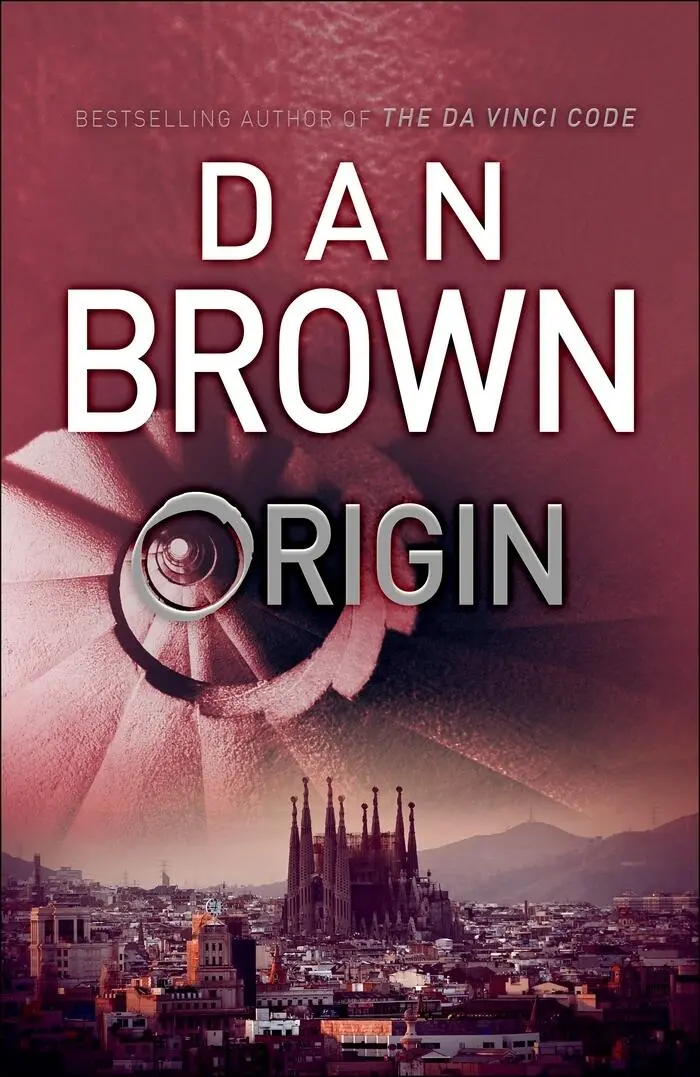
- Название:Origin
- Автор:
- Издательство:Bantam Press, Transworld, Penguin Random House
- Жанр:
- Год:2017
- Город:London
- ISBN:978-0-593-07875-4
- Рейтинг книги:5 / 5. Голосов: 1
-
Избранное:Добавить в избранное
- Отзывы:
-
Ваша оценка:
Origin: краткое содержание, описание и аннотация
Предлагаем к чтению аннотацию, описание, краткое содержание или предисловие (зависит от того, что написал сам автор книги «Origin»). Если вы не нашли необходимую информацию о книге — напишите в комментариях, мы постараемся отыскать её.
But Langdon and several hundred other guests are left reeling when the meticulously orchestrated evening is blown apart before Kirsch’s precious discovery can be revealed. With his life under threat, Langdon is forced into a desperate bid to escape, along with the museum’s director, Ambra Vidal. Together they flee to Barcelona on a perilous quest to locate a cryptic password that will unlock Kirsch’s secret.
In order to evade a tormented enemy who is one step ahead of them at every turn, Langdon and Vidal must navigate labyrinthine passageways of hidden history and ancient religion. On a trail marked only by enigmatic symbols and elusive modern art, Langdon and Vidal uncover the clues that will bring them face-to-face with a world-shaking truth that has remained buried — until now.
Origin — читать онлайн бесплатно полную книгу (весь текст) целиком
Ниже представлен текст книги, разбитый по страницам. Система сохранения места последней прочитанной страницы, позволяет с удобством читать онлайн бесплатно книгу «Origin», без необходимости каждый раз заново искать на чём Вы остановились. Поставьте закладку, и сможете в любой момент перейти на страницу, на которой закончили чтение.
Интервал:
Закладка:
A catenary model , he thought, having always marveled at these ingenious Gaudí prototypes. “Catenary” was an architectural term that referred to the curve that was formed by a cord hanging loosely between two fixed points — like a hammock or the velvet rope suspended between two stanchions in a theater.
In the catenary model before Langdon, dozens of chains had been suspended loosely from the top of the case — resulting in long lengths that swooped down and then back up to form limply hanging U-shapes. Because gravitational tension was the inverse of gravitational compression, Gaudí could study the precise shape assumed by a chain when naturally hanging under its own weight, and he could mimic that shape to solve the architectural challenges of gravitational compression.
But it requires a magic mirror , Langdon mused, moving toward the case. As anticipated, the floor of the case was a mirror, and as he peered down into the reflection, he saw a magical effect. The entire model flipped upside down — and the hanging loops became soaring spires.
In this case, Langdon realized, he was seeing an inverted aerial view of Gaudí’s towering Basílica de la Sagrada Família, whose gently sloping spires quite possibly had been designed using this very model.
Pressing on down the hall, Langdon found himself in an elegant sleeping space with an antique four-poster bed, a cherrywood armoire, and an inlaid chest of drawers. The walls were decorated with Gaudí design sketches, which Langdon realized were simply more of the museum’s exhibit.
The only piece of art in the room that seemed to have been added was a large calligraphied quote hanging over Edmond’s bed. Langdon read the first three words and immediately recognized the source.
God is dead. God remains dead. And we have killed him. How shall we comfort ourselves, the murderers of all murderers?
— NIETZSCHE“God is dead” were the three most famous words written by Friedrich Nietzsche, the renowned nineteenth-century German philosopher and atheist. Nietzsche was notorious for his scathing critiques of religion, but also for his reflections on science — especially Darwinian evolution — which he believed had transported humankind to the brink of nihilism, an awareness that life had no meaning, no higher purpose, and offered no direct evidence of the existence of God.
Seeing the quote over the bed, Langdon wondered if perhaps Edmond, for all his antireligious bluster, might have been struggling with his own role in attempting to rid the world of God.
The Nietzsche quote, as Langdon recalled, concluded with the words: “ Is not the greatness of this deed too great for us? Must we ourselves not become gods simply to appear worthy of it? ”
This bold idea — that man must become God in order to kill God — was at the core of Nietzsche’s thinking, and perhaps, Langdon realized, partially explained the God complexes suffered by so many pioneering technology geniuses like Edmond. Those who erase God... must be gods.
As Langdon pondered the notion, he was struck by a second realization.
Nietzsche was not just a philosopher — he was also a poet!
Langdon himself owned Nietzsche’s The Peacock and the Buffalo , a compilation of 275 poems and aphorisms that offered thoughts on God, death, and the human mind.
Langdon quickly counted the characters in the framed quote. They were not a match, and yet a surge of hope swelled within him. Could Nietzsche be the poet of the line we’re seeking? If so, will we find a book of Nietzsche’s poetry in Edmond’s office? Either way, Langdon would ask Winston to access an online compilation of Nietzsche’s poems and search them all for a line containing forty-seven characters.
Eager to get back to Ambra and share his thoughts, Langdon hurried through the bedroom into the restroom that was visible beyond.
As he entered, the lights inside came on to reveal an elegantly decorated bathroom containing a pedestal sink, a freestanding shower unit, and a toilet.
Langdon’s eyes were drawn immediately to a low antique table cluttered with toiletries and personal items. When he saw the items on the table, he inhaled sharply, taking a step back.
Oh God. Edmond... no.
The table before him looked like a back-alley drug lab — used syringes, pill bottles, loose capsules, and even a rag spotted with blood.
Langdon’s heart sank.
Edmond was taking drugs?
Langdon knew that chemical addiction had become painfully commonplace these days, even among the rich and famous. Heroin was cheaper than beer now, and people were popping opioid painkillers like they were ibuprofen.
Addiction would certainly explain his recent weight loss , Langdon thought, wondering if maybe Edmond had been pretending to have “gone vegan” only in an attempt to cover for his thinness and sunken eyes.
Langdon walked to the table and picked up one of the bottles, reading the prescription label, fully expecting to find one of the common opioids like OxyContin or Percocet.
Instead he saw: Docetaxel.
Puzzled, he checked another bottle: Gemcitabine.
What are these? he wondered, checking a third bottle: Fluorouracil. Langdon froze. He had heard of Fluorouracil through a colleague at Harvard, and he felt a sudden wave of dread. An instant later, he spied a pamphlet lying among the bottles. The title was “Does Veganism Slow Pancreatic Cancer?”
Langdon’s jaw dropped as the truth hit him.
Edmond wasn’t a drug addict.
He was secretly fighting a deadly cancer.
Chapter 53
Ambra Vidal stood in the soft light of the attic apartment and ran her eyes across the rows of books lining the walls of Edmond’s library.
His collection is larger than I remembered.
Edmond had transformed a wide section of curved hallway into a stunning library by building shelves between the vertical supports of Gaudí’s vaults. His library was unexpectedly large and well stocked, especially considering Edmond had allegedly planned to be here for only two years.
It looks like he moved in for good.
Eyeing the crowded shelves, Ambra realized that locating Edmond’s favorite line of poetry would be far more time-consuming than anticipated. As she continued walking along the shelves, scanning the spines of the books, she saw nothing but scientific tomes on cosmology, consciousness, and artificial intelligence:
THE BIG PICTURE
FORCES OF NATURE
ORIGINS OF CONSCIOUSNESS
THE BIOLOGY OF BELIEF
INTELLIGENT ALGORITHMS
OUR FINAL INVENTION
She reached the end of one section and stepped around an architectural rib into the next section of shelves. Here she found a wide array of scientific topics — thermodynamics, primordial chemistry, psychology.
No poetry.
Noting that Winston had been quiet for some time now, Ambra pulled out Kirsch’s cell phone. “Winston? Are we still connected?”
“I am here,” his accented voice chimed.
“Did Edmond actually read all of these books in his library?”
“I believe so, yes,” Winston replied. “He was a voracious consumer of text and called this library his ‘trophy room of knowledge.’”
“And is there, by any chance, a poetry section in here?”
“The only titles of which I’m specifically aware are the nonfiction volumes that I was asked to read in e-book format so Edmond and I could discuss their contents — an exercise, I suspect, that was more for my education than for his. Unfortunately, I do not have this entire collection cataloged, so the only way you will be able to find what you are looking for will be by an actual physical search.”
Читать дальшеИнтервал:
Закладка:
Похожие книги на «Origin»
Представляем Вашему вниманию похожие книги на «Origin» списком для выбора. Мы отобрали схожую по названию и смыслу литературу в надежде предоставить читателям больше вариантов отыскать новые, интересные, ещё непрочитанные произведения.

Обсуждение, отзывы о книге «Origin» и просто собственные мнения читателей. Оставьте ваши комментарии, напишите, что Вы думаете о произведении, его смысле или главных героях. Укажите что конкретно понравилось, а что нет, и почему Вы так считаете.