Dan Brown - Origin
Здесь есть возможность читать онлайн «Dan Brown - Origin» весь текст электронной книги совершенно бесплатно (целиком полную версию без сокращений). В некоторых случаях можно слушать аудио, скачать через торрент в формате fb2 и присутствует краткое содержание. Город: London, Год выпуска: 2017, ISBN: 2017, Издательство: Bantam Press, Transworld, Penguin Random House, Жанр: Триллер, на английском языке. Описание произведения, (предисловие) а так же отзывы посетителей доступны на портале библиотеки ЛибКат.
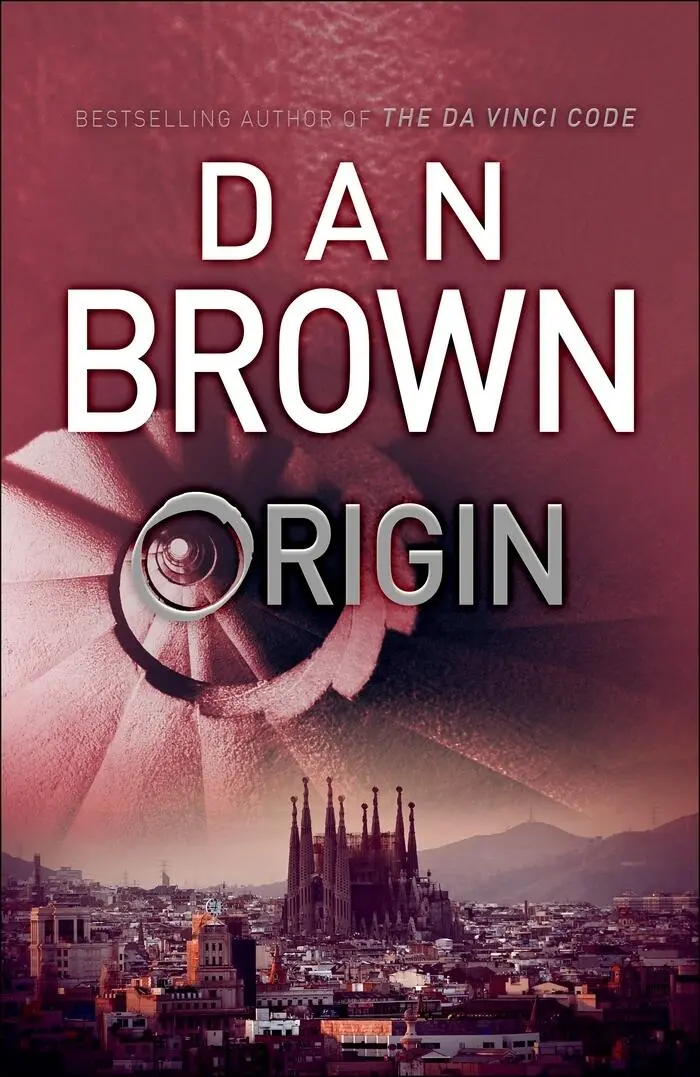
- Название:Origin
- Автор:
- Издательство:Bantam Press, Transworld, Penguin Random House
- Жанр:
- Год:2017
- Город:London
- ISBN:978-0-593-07875-4
- Рейтинг книги:5 / 5. Голосов: 1
-
Избранное:Добавить в избранное
- Отзывы:
-
Ваша оценка:
Origin: краткое содержание, описание и аннотация
Предлагаем к чтению аннотацию, описание, краткое содержание или предисловие (зависит от того, что написал сам автор книги «Origin»). Если вы не нашли необходимую информацию о книге — напишите в комментариях, мы постараемся отыскать её.
But Langdon and several hundred other guests are left reeling when the meticulously orchestrated evening is blown apart before Kirsch’s precious discovery can be revealed. With his life under threat, Langdon is forced into a desperate bid to escape, along with the museum’s director, Ambra Vidal. Together they flee to Barcelona on a perilous quest to locate a cryptic password that will unlock Kirsch’s secret.
In order to evade a tormented enemy who is one step ahead of them at every turn, Langdon and Vidal must navigate labyrinthine passageways of hidden history and ancient religion. On a trail marked only by enigmatic symbols and elusive modern art, Langdon and Vidal uncover the clues that will bring them face-to-face with a world-shaking truth that has remained buried — until now.
Origin — читать онлайн бесплатно полную книгу (весь текст) целиком
Ниже представлен текст книги, разбитый по страницам. Система сохранения места последней прочитанной страницы, позволяет с удобством читать онлайн бесплатно книгу «Origin», без необходимости каждый раз заново искать на чём Вы остановились. Поставьте закладку, и сможете в любой момент перейти на страницу, на которой закончили чтение.
Интервал:
Закладка:
Apprehend the shooter.
As Díaz arrived at the site of the telltale flash, he found a slit in the fabric wall and plunged his hand through the opening, violently tearing the hole all the way down to the floor and clambering out of the dome into a maze of scaffolding.
To his left, the agent caught a glimpse of a figure — a tall man dressed in a white military uniform — sprinting toward the emergency exit at the far side of the enormous space. An instant later, the fleeing figure crashed through the door and disappeared.
Díaz gave pursuit, weaving through the electronics outside the dome and finally bursting through the door into a cement stairwell. He peered over the railing and saw the fugitive two floors below, spiraling downward at breakneck speed. Díaz raced after him, leaping five stairs at a time. Somewhere below, the exit door crashed open loudly and then slammed shut again.
He’s exited the building!
When Díaz reached the ground floor, he sprinted to the exit — a pair of double doors with horizontal push bars — and threw all of his weight into them. The doors, rather than flying open like those upstairs, moved only an inch and then jammed to a stop. Díaz’s body crashed into the wall of steel, and he landed in a heap, a searing pain erupting in his shoulder.
Shaken, he pulled himself up and tried the doors again.
They opened just far enough to allow him to glimpse the problem.
Strangely, the outer door handles had been bound shut by a loop of wire — a string of beads wrapped around the handles from the outside. Díaz’s confusion deepened when he realized the pattern of the beads was quite familiar to him, as it would be to any good Spanish Catholic.
Is that a rosary?
Using all of his force, Díaz heaved his aching body into the doors again, but the string of beads refused to break. He stared again through the narrow opening, baffled both by the presence of a rosary and also by his inability to break it.
“ ¿Hola? ” he shouted through the doors. “ ¡¿Hay alguien?! ”
Silence.
Through the slit in the doors, Díaz could make out a high concrete wall and a deserted service alley. Chances were slim that anyone would be coming by to remove the loop. Seeing no other option, he grabbed his handgun from the holster beneath his blazer. He cocked the weapon and extended the barrel through the doorway slit. He pressed the muzzle into the string of rosary beads.
I’m firing a bullet into a holy rosary? Qué Dios me perdone.
The remaining pieces of the crucifix bobbed up and down before Díaz’s eyes.
He pulled the trigger.
The gunshot thundered in the cement landing, and the doors flew open. The rosary shattered, and Díaz lurched forward, staggering out into the empty alley as rosary beads bounced across the pavement all around him.
The assassin in white was gone.
A hundred meters away, Admiral Luis Ávila sat in silence in the backseat of the black Renault that now accelerated away from the museum.
The tensile strength of the Vectran fiber on which Ávila had strung the rosary beads had done its job, delaying his pursuers just long enough.
And now I am gone.
As Ávila’s car sped northwest along the meandering Nervión River and disappeared among the fast-moving cars on the Avenida Abandoibarra, Admiral Ávila finally permitted himself to exhale.
His mission tonight could not have gone any more smoothly.
In his mind, he began to hear the joyful strains of the Oriamendi hymn — its age-old lyrics once sung in bloody battle right here in Bilbao. ¡Por Dios, por la Patria y el Rey! Ávila sang in his mind. For God, for Country, and King!
The battle cry had long since been forgotten... but the war had just begun.
Chapter 22
Madrid’s palacio real is Europe’s largest royal palace as well as one of its most stunning architectural fusions of Classical and Baroque styles. Built on the site of a ninth-century Moorish castle, the palace’s three-story facade of columns spans the entire five-hundred-foot width of the sprawling Plaza de la Armería on which it sits. The interior is a mind-boggling labyrinth of 3,418 rooms that wind through almost a million and a half square feet of floor space. The salons, bedrooms, and hallways are adorned with a collection of priceless religious art, including masterpieces by Velázquez, Goya, and Rubens.
For generations, the palace had been the private residence of Spanish kings and queens. Now, however, it was used primarily for state functions, with the royal family taking residence in the more casual and secluded Palacio de la Zarzuela outside the city.
In recent months, however, Madrid’s formal palace had become the permanent home for Crown Prince Julián — the forty-two-year-old future king of Spain — who had moved into the palace at the behest of his handlers, who wanted Julián to “be more visible to the country” during this somber period prior to his eventual coronation.
Prince Julián’s father, the current king, had been bedridden for months with a terminal illness. As the fading king’s mental faculties eroded, the palace had begun the slow transfer of power, preparing the prince to ascend to the throne once his father passed. With a shift in leadership now imminent, Spaniards had turned their eyes to Crown Prince Julián, with a single question on their minds:
What kind of ruler will he turn out to be?
Prince Julián had always been a discreet and cautious child, having borne the weight of his eventual sovereignty since boyhood. Julián’s mother had died from preterm complications while carrying her second child, and the king, to the surprise of many, had chosen never to remarry, leaving Julián the lone successor to the Spanish throne.
An heir with no spare , the UK tabloids coldly called the prince.
Because Julián had matured under the wing of his deeply conservative father, most traditionalist Spaniards believed he would continue their kings’ austere tradition of preserving the dignity of the Spanish crown through maintaining established conventions, celebrating ritual, and above all, remaining ever reverential to Spain’s rich Catholic history.
For centuries, the legacy of the Catholic kings had served as Spain’s moral center. In recent years, though, the country’s bedrock of faith seemed to be dissolving, and Spain found herself locked in a violent tug-of-war between the very old and the very new.
A growing number of liberals were now flooding blogs and social media with rumors suggesting that once Julián was finally able to emerge from his father’s shadow, he would reveal his true self — a bold, progressive, secular leader finally willing to follow the lead of so many European countries and abolish the monarchy entirely.
Julián’s father had always been very active in his role as king, leaving Julián little room to participate in politics. The king openly stated that he believed Julián should enjoy his youth, and not until the prince was married and settled down did it make sense for him to engage in matters of state. And so Julián’s first forty years — endlessly chronicled in the Spanish press — had been a life of private schools, horseback riding, ribbon cuttings, fund-raisers, and world travel. Despite having accomplished little of note in his life, Prince Julián was, without a doubt, Spain’s most eligible bachelor.
Over the years, the handsome forty-two-year-old prince had publicly dated countless eligible women, and while he had a reputation for being a hopeless romantic, nobody had ever quite stolen his heart. In recent months, however, Julián had been spotted several times with a beautiful woman who, despite looking like a retired fashion model, was in fact the highly respected director of Bilbao’s Guggenheim Museum.
Читать дальшеИнтервал:
Закладка:
Похожие книги на «Origin»
Представляем Вашему вниманию похожие книги на «Origin» списком для выбора. Мы отобрали схожую по названию и смыслу литературу в надежде предоставить читателям больше вариантов отыскать новые, интересные, ещё непрочитанные произведения.


Обсуждение, отзывы о книге «Origin» и просто собственные мнения читателей. Оставьте ваши комментарии, напишите, что Вы думаете о произведении, его смысле или главных героях. Укажите что конкретно понравилось, а что нет, и почему Вы так считаете.