Джонатан Келлерман - Night Moves
Здесь есть возможность читать онлайн «Джонатан Келлерман - Night Moves» весь текст электронной книги совершенно бесплатно (целиком полную версию без сокращений). В некоторых случаях можно слушать аудио, скачать через торрент в формате fb2 и присутствует краткое содержание. Город: New York, Год выпуска: 2018, ISBN: 2018, Издательство: Ballantine Books, Жанр: Триллер, Детектив, на английском языке. Описание произведения, (предисловие) а так же отзывы посетителей доступны на портале библиотеки ЛибКат.
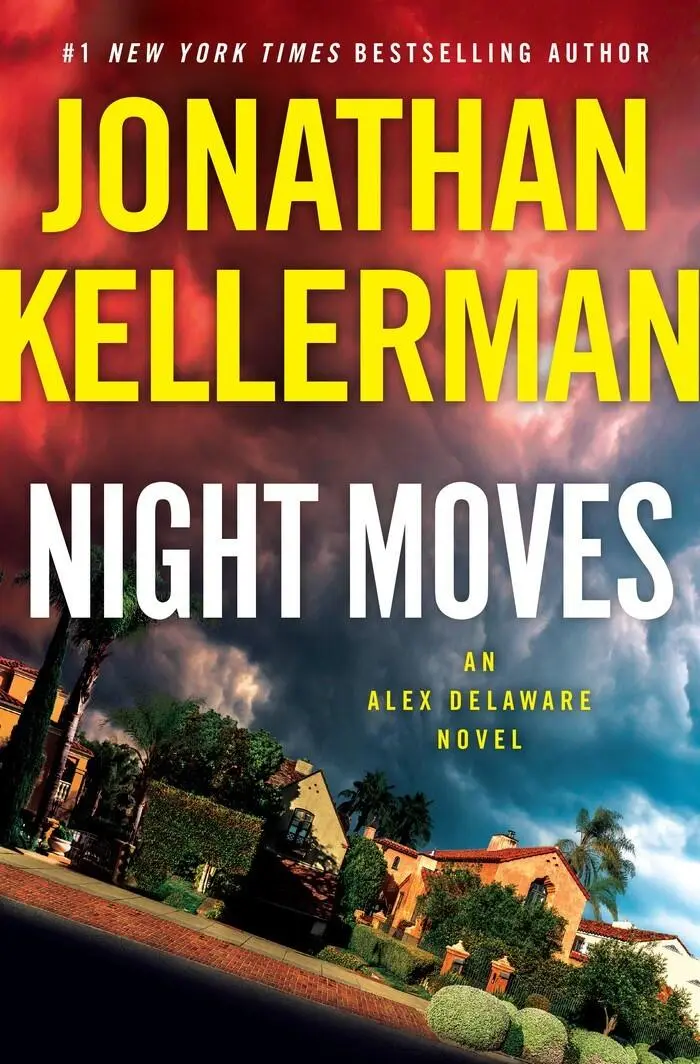
- Название:Night Moves
- Автор:
- Издательство:Ballantine Books
- Жанр:
- Год:2018
- Город:New York
- ISBN:978-0-345-54146-8
- Рейтинг книги:4 / 5. Голосов: 2
-
Избранное:Добавить в избранное
- Отзывы:
-
Ваша оценка:
Night Moves: краткое содержание, описание и аннотация
Предлагаем к чтению аннотацию, описание, краткое содержание или предисловие (зависит от того, что написал сам автор книги «Night Moves»). Если вы не нашли необходимую информацию о книге — напишите в комментариях, мы постараемся отыскать её.
There’s no spilled blood, no evidence of a struggle, and, thanks to the victim’s missing face and hands, no immediate means of identification. And no telling why the disfigured corpse of a stranger has appeared in an upscale L.A. family’s home. Chet Corvin, his wife, and their two teenage children are certain the John Doe is unknown to them. Despite that, their cooperation seems guarded. And that’s more than Milo and Alex can elicit from the Corvins’ creepy next-door neighbor — a notorious cartoonist with a warped sense of humor and a seriously antisocial attitude.
As the investigation ensues, it becomes clear that this well-to-do suburban enclave has its share of curious eyes, suspicious minds, and loose lips. And as Milo tightens the screws on potential persons of interest — and Alex tries to breach the barriers that guard their deepest secrets — a strangling web of corrupted love, cold-blooded greed, and shattered trust is exposed. Though the grass may be greener on these privileged streets, there’s enough dirt below the surface to bury a multitude of sins. Including the deadliest.
Night Moves — читать онлайн бесплатно полную книгу (весь текст) целиком
Ниже представлен текст книги, разбитый по страницам. Система сохранения места последней прочитанной страницы, позволяет с удобством читать онлайн бесплатно книгу «Night Moves», без необходимости каждый раз заново искать на чём Вы остановились. Поставьте закладку, и сможете в любой момент перейти на страницу, на которой закончили чтение.
Интервал:
Закладка:
I said, “So there’s nothing about the Corvins you can—”
“The wife works, I’ll give her that. I know that because I see her load the kids in the morning and she doesn’t come back until late afternoon when she brings them home — now, those are a couple of...” Finally, at a loss for words.
“The kids.”
“The boy looks to me like a potential reprobate,” said Edna San Felipe. “One day I heard my garbage cans clunk to the ground and when I went out to check, that one was skateboarding up the block.”
“Did you complain?”
“What good would that do, there’s no discipline anymore.” She smiled crookedly. “What I did do was line the lid of my cans with habanero paste, that’s a chile pepper able to blow a hole in your colon. If the brat tried it again and touched his face, he’d learn.”
She held my gaze. “You think that’s child abuse? I call it education. Same for someone’s dog nosing around, habanero the grass, let the mutt learn by experience. And don’t worry about risk to the garbagemen, they’ve got these automatic trucks, sit on their keisters and use a power hoist.”
She folded her arms across a scrawny chest. Daring me to argue.
When I didn’t she said, “Then there’s the girl. There’s obviously something wrong, there. Is she retarded or autistic? It’s one or the other, that blank look in her eyes. She walks around at night. I’ve come home late from my place at the beach, seen her. At night. Late. Where’s the parental supervision?”
The door swung a few inches wider. “The police have no idea so they called you in to psychoanalyze?”
“Something like that,” I said. “I’d like to ask about another of your neighbors—”
“No one’s a neighbor, here,” said Edna San Felipe. “We co-reside but there’s no socializing. It wasn’t that way in Honduras. Our workers were happy as clams to be picking bananas, everyone socialized, from all levels of the social ladder. Who?”
I said, “Trevor Bitt.”
“That one was my first thought when I heard about it.”
“Why’s that?”
“Basic logic. Something bizarre happens, look for a bizarre person.”
“Have you had dealings with him?”
“None whatsoever. But he’s also not normal, no question about it.”
“A person on the block witnessed what might’ve been an argument between Mr. Bitt and Mr. Corvin.”
She glanced at Tabatchnik’s house. “He sent you to me?”
“No, ma’am.”
“I happened to see it, I don’t rubberneck. Unlike him, what do those people call snoopers — yentas. Like the Streisand movie. Love her voice but never bought her as a man.”
“What can you tell me about the encounter between Bitt and Corvin?”
“I saw two grown men acting like children in a playground.”
“Aggressive.”
“Facing off,” said Edna San Felipe. “Like brats.”
“Any idea what the conflict was about?”
“Not a clue.”
“Professor Tabatchnik said Mr. Corvin was doing all the talking.”
“He was.”
“And Mr. Bitt just stood there.”
“Like the Sphinx,” she said. “He wasn’t happy, that was obvious from what you people call body language. I’d take a long, hard look at him. Like I said, not random and the man’s clearly unhinged. Slouches around looking like a robot. Pretends not to hear when you say hello. Which I did just once, believe me.”
I said, “At least he didn’t kick your cans over.”
She glared at me. If faces were tools, hers was a filleting knife. “That supposed to be a joke?”
The door closed.
A crank, but her instincts were good: nothing random about the body dump, focus on the unusual neighbor. Now that I knew about Bitt absorbing Chet Corvin’s anger, he deserved further observation.
Chapter 31
Evada Lane, one a.m. A starless sky sagged like a rain-soaked tarp, a malnourished moon cast anemic light.
The first time I’d been here after dark, LEDs on poles and flashing bars atop cruisers had turned the cul-de-sac into a miniature theater district. No show tonight; the silence was constricted — that of a gagged victim.
I parked a block farther than this afternoon, wanting to avoid some antsy resident’s memory jog. My sneakers had the squeak long run out of them; my sweatpants and shirt were black. I could be taken for a burglar. If Moe Reed or Sean Binchy was on watch, he’d figure it out.
No sign of either detective as I made my way. Maybe because they were pros. Or the overtime budget had run out.
As my eyes adjusted, contours of rooftops suggested themselves. Where the street wasn’t as inky as my clothing, specks of purple and lilac showed like pinprick wounds. Lights on in front of Bart Tabatchnik’s house but his car was gone. If I was a burglar, I’d be interested.
Illumination appeared at only three other residences, one of them Trevor Bitt’s Tudor, where a single second-story window facing the street formed a flesh-colored rectangle.
Lights off at the Corvins’. I wondered how the kids were doing.
I covered a third of the block feeling like a prowler. Made my way halfway up with still no sign of either young D. The trunks of street trees were too thin to provide cover and I saw no obvious hiding spots unless you got uncomfortably close to houses.
Not on watch.
I kept going, planning to reach the end of the cul-de-sac, circle back, and repeat before returning home and hoping for sleep.
A sound from up the block froze me midstep.
Sound duo: a thump, then a click.
I shifted off the sidewalk onto someone’s drought-scratchy lawn, squinted and focused on the origin of the noise. Purple specks helped me, strobing movement from the side of the Corvin house.
The barest suggestion of human form emerged before flicking out of sight.
I trotted closer.
The form headed toward Bitt’s house, stopped below Bitt’s street window.
Chelsea Corvin, slightly stooped, standing there.
She did something with her arms. A yellow tongue flicked, an orange dot appeared, and the flame turned into sprinkles of earthbound stars plummeting to the ground.
A lit match flung to the ground. A cigarette end brightened under the force of a long inhalation.
Chelsea smoked it dead, tossed the butt away, let it burn itself out, and did nothing for a while. Then she moved, heading for the side of Bitt’s house that bordered hers.
I race-walked, stopped two houses away.
The scrape of feet shuffling on cement.
She coughed. A signal? Or tobacco having its way with young lungs?
She’d done this before. For all any of us knew, Bitt had no idea she preferred his property for surreptitious teenage rebellion.
Most likely, she’d sneak back home.
Two more coughs that sounded intentional. Then: faint, drum-like rapping.
Shave and a haircut six bits.
A squeal as hinges rotated.
“You’re here,” said a man’s voice. “Good.”
Squeal, hiss, clap as the door closed.
I waited a few seconds before sneaking over. The cigarette butt had landed near a patch of agave, losing the battle of survival to night-dewed succulents.
Bitt’s street window went dark. Another rectangle on the side of the house lit up, as if in compensation. A window that faced the Corvin house. Chelsea’s bedroom.
I hung around for a while and when the girl didn’t exit, I got out of there. Waiting until I’d passed Bart Tabatchnik’s house before making the call.
Milo’s semi-awake voice was a spit-clogged tuba. He recovered fast; all those years of late-night homicide calls. “Hold on, let me go to another room.”
Moments later, he was back, a saliva-free trombone. “We surveil, get zilch, you show up once. Keeping your lottery ticket in a safe place?”
Читать дальшеИнтервал:
Закладка:
Похожие книги на «Night Moves»
Представляем Вашему вниманию похожие книги на «Night Moves» списком для выбора. Мы отобрали схожую по названию и смыслу литературу в надежде предоставить читателям больше вариантов отыскать новые, интересные, ещё непрочитанные произведения.










Обсуждение, отзывы о книге «Night Moves» и просто собственные мнения читателей. Оставьте ваши комментарии, напишите, что Вы думаете о произведении, его смысле или главных героях. Укажите что конкретно понравилось, а что нет, и почему Вы так считаете.