Джонатан Келлерман - Night Moves
Здесь есть возможность читать онлайн «Джонатан Келлерман - Night Moves» весь текст электронной книги совершенно бесплатно (целиком полную версию без сокращений). В некоторых случаях можно слушать аудио, скачать через торрент в формате fb2 и присутствует краткое содержание. Город: New York, Год выпуска: 2018, ISBN: 2018, Издательство: Ballantine Books, Жанр: Триллер, Детектив, на английском языке. Описание произведения, (предисловие) а так же отзывы посетителей доступны на портале библиотеки ЛибКат.
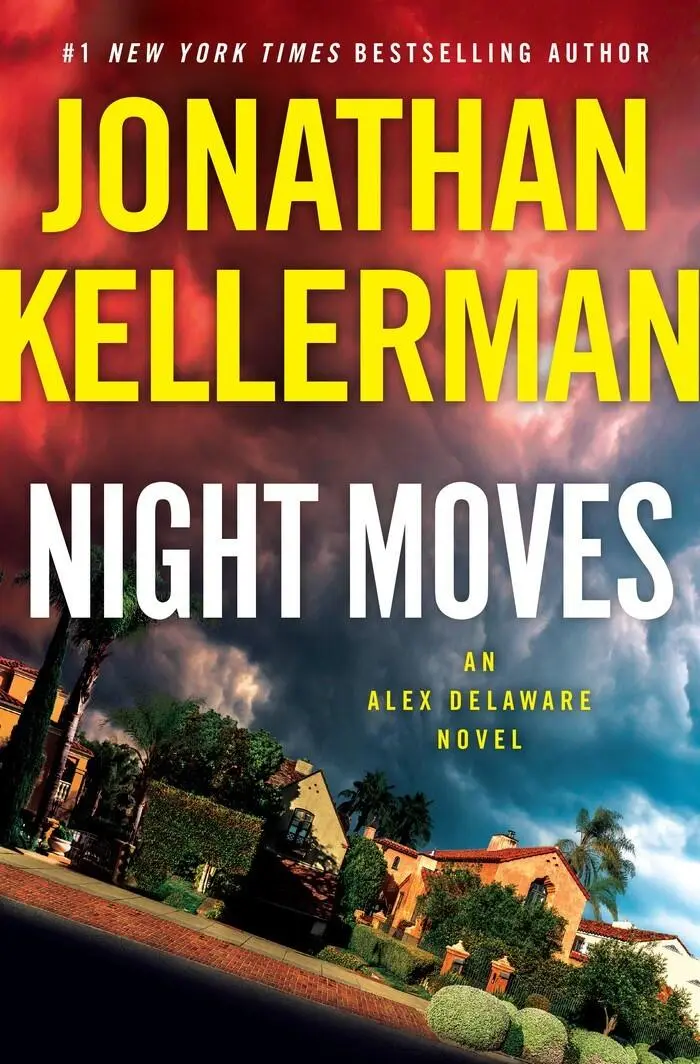
- Название:Night Moves
- Автор:
- Издательство:Ballantine Books
- Жанр:
- Год:2018
- Город:New York
- ISBN:978-0-345-54146-8
- Рейтинг книги:4 / 5. Голосов: 2
-
Избранное:Добавить в избранное
- Отзывы:
-
Ваша оценка:
Night Moves: краткое содержание, описание и аннотация
Предлагаем к чтению аннотацию, описание, краткое содержание или предисловие (зависит от того, что написал сам автор книги «Night Moves»). Если вы не нашли необходимую информацию о книге — напишите в комментариях, мы постараемся отыскать её.
There’s no spilled blood, no evidence of a struggle, and, thanks to the victim’s missing face and hands, no immediate means of identification. And no telling why the disfigured corpse of a stranger has appeared in an upscale L.A. family’s home. Chet Corvin, his wife, and their two teenage children are certain the John Doe is unknown to them. Despite that, their cooperation seems guarded. And that’s more than Milo and Alex can elicit from the Corvins’ creepy next-door neighbor — a notorious cartoonist with a warped sense of humor and a seriously antisocial attitude.
As the investigation ensues, it becomes clear that this well-to-do suburban enclave has its share of curious eyes, suspicious minds, and loose lips. And as Milo tightens the screws on potential persons of interest — and Alex tries to breach the barriers that guard their deepest secrets — a strangling web of corrupted love, cold-blooded greed, and shattered trust is exposed. Though the grass may be greener on these privileged streets, there’s enough dirt below the surface to bury a multitude of sins. Including the deadliest.
Night Moves — читать онлайн бесплатно полную книгу (весь текст) целиком
Ниже представлен текст книги, разбитый по страницам. Система сохранения места последней прочитанной страницы, позволяет с удобством читать онлайн бесплатно книгу «Night Moves», без необходимости каждый раз заново искать на чём Вы остановились. Поставьте закладку, и сможете в любой момент перейти на страницу, на которой закончили чтение.
Интервал:
Закладка:
Pausing. “If he’s already told you about it, I have nothing to add.”
No idea Corvin was dead. It takes a village to breed gossip. The residents of Evada appeared to relate on the emotional level of cans on a pantry shelf.
I said, “What did you see?”
“I’d have to term it an encounter between Bitt and Corvin. I won’t call it an exchange because Corvin was doing all the talking. Quite a bit of talking. His body language seemed somewhat assertive.” He demonstrated by leaning forward.
I said, “How did Mr. Bitt react?”
“Not at all, he just stood there. I felt there might be tension brewing, though I had no overt indication of that. But living on the South Side, you develop a feel for that. I felt as though something might occur.”
“Physical violence.”
“It struck me as a possibility. I didn’t want any part of that so I went inside, put my things away, returned to my front window. Whatever had begun was over. Corvin was walking back toward his house and Bitt had crossed the street and was headed in the opposite direction. I came out to smoke a cigar — my landlord won’t allow it in the house. And the woman who lives right there” — pointing to the left — “came out and asked if I’d seen the ‘fuss.’ I said I had, she called them a couple of stupid little boys, went on a rant about paying huge property taxes to live in a nice neighborhood and still having to deal with stupidity.”
He smiled. “She’s a bit of a crank.”
I said, “Name?”
“Don’t know — if you’re going to speak to her, please keep me out of it.”
“You bet. Bitt and Corvin live at the other end of the block but they took their issues here.”
“I did wonder about that,” said Bart Tabatchnik. “Perhaps they were out walking, encountered each other, and some sort of prior issue rose. As to what that might be, sorry, no idea.”
“Appreciate the input, Professor. Anything else you’d like to tell me?”
“Nope and please keep my name out of everything. My interest is in spotting micro-trends, I tend to be more observant than most. But I really don’t want anyone in my face.”
“Of course.”
Lifting his shopping bag, he trotted to his front door, turned toward me, fist-bumped air, and went inside.
He hadn’t taken a single look at my badge.
Chapter 30
Nothing like the neighborhood crank when you wanted details.
The mat in front of the house adjoining Tabatchnik’s said Not Buying What You’re Selling. No answer to my knocks or the doorbell.
I returned to the Seville, called Milo’s office phone, relayed Tabatchnik’s account.
He said, “The guy made Moe last night. Damn. An encounter, huh?”
“It doesn’t sound friendly,” I said, “so the mutual interest in chocolate may not mean camaraderie.”
“Okay, good to know. I was gonna call you, Moe spotted Chelsea doing one of her night moves at one a.m. She slipped through that joke of a gate, meaning she left through the rear door. She headed straight for Bitt’s place, lit up a cigarette, looked up at Bitt’s window, and went back home. Bitt’s lights were out so maybe she didn’t want to wake him. Or I’m dead wrong about something creepy going on, she just wants to sneak a smoke. The other bit of nothing is no prints or DNA on the phone I lifted at the A-frame, and the unidentified one from the motel is too incomplete to analyze.”
A car drove past me. Older gun-metal gray Mercedes diesel, an intent, white-haired woman scowling and crawling forward, two hands clenching the wheel. She turned into the driveway bordering Tabatchnik’s.
I said, “Call you back,” and watched as the car lurched to a squeaking stop, bucked, and repeated that staccato performance several times.
The white-haired woman, tiny, thin, ponytailed, dressed in black knit pants and top and black flats, walked around to the passenger side. Opening the door with effort, she extricated a black purse, positioned the strap on a narrow shoulder. Next came a paper shopping bag — Gelson’s — that she placed on the ground. It took two attempts to shut the Merc’s heavy door. She manually locked the car on both sides, retrieved the bag, and held it in two hands as she approached the front door.
I was a Boy Scout as a kid, have that impulse to help, but the hostile doormat killed any idea of chivalry. I waited until she’d managed to bring her groceries inside and shut her front door. The dead bolt snicked. I gave her additional time to settle before ringing the bell.
A raspy voice said, “Who is it?”
“Police.”
“Prove it.”
I unclipped my badge and held it up to the peephole.
“Hmph,” said the voice. Nothing happened for a few moments and I wondered if she was calling the station. Without Milo pre-notified, that could complicate matters. But the door opened and she stared at me, then the badge.
“Let me see that.”
One of the few. I handed it over. She squinted. Maybe farsightedness would save me.
“You’re a good-looking guy, this does nothing for you... Ph.D.? What kind of police is that?”
“I’m a psychologist who works with the police.”
“Have a niece who’s a psychologist. She’s also a tattooed lunatic.” Giving me the once-over. “What can I do for you, I guess it’s Doctor.”
“We’re doing some follow-up on the incident at the Corvin house.”
“That’s their name, huh?” She snorted. “The incident? Just come out and say it, a lunatic sliced someone up and left body parts in their house.”
“That’s another way to put it,” I said, smiling. She didn’t reciprocate.
“Don’t soft-pedal for my sake, I was an emergency room nurse for thirty years. Before that, I was in the military.” A bony hand shot out. “Edna San Felipe.”
She squeezed hard, flung my hand away like a used tissue. “Know anything about hospitals?”
Strange question. “Used to work at Western Peds.”
“The kids’ hospital,” said Edna San Felipe. “Even so. The name ‘Horatio San Felipe’ ring a bell?”
“Sorry, no.”
“My brother was the greatest heart surgeon who ever lived. Pig-valve substitution for the pneumonic, he figured out how to repair with minimal invasion. Our father was U.S. ambassador to Honduras. Our grandfather and great-grandfather grew more bananas than Dole.”
She shook her head. “No one learns history, anymore. So what can I do for you, Doctor ?” Making my degree sound like a correspondence-course joke.
“If there’s anything you want to tell me about the murder—”
“A stranger’s corpse ends up in someone’s house? That’s not random. How’d it get there? Why them? It’s still not solved, they have to be hiding something.”
“Is there something about them—”
“No, I’m just being logical.”
“Do you have any impressions of them?”
“So I’m right,” she said.
“At this point—”
“No, I haven’t any impressions,” she said. “Never had dealings with them except once in a while I’d see him — the husband — and he’d try to chitchat. He’s an oily type, pretending we know each other when we don’t. Like a politician.”
“Any contact with Mrs. Corvin?”
“She’s a typical one,” said Edna San Felipe. “The tinted hair, the clothes, the manicure.” Displaying her own nails, blunt and unpolished. “The E.R., you’re elbow-deep in someone’s bowels, you don’t fool around with talons.”
“One of my friends is an E.R. surgeon.”
“Where?”
“Cedars. Dr. Richard Silverman.”
“What does he patch?”
“He’s a trauma surgeon.”
“Bet his nails are short.” She began to close the door.
Читать дальшеИнтервал:
Закладка:
Похожие книги на «Night Moves»
Представляем Вашему вниманию похожие книги на «Night Moves» списком для выбора. Мы отобрали схожую по названию и смыслу литературу в надежде предоставить читателям больше вариантов отыскать новые, интересные, ещё непрочитанные произведения.





Обсуждение, отзывы о книге «Night Moves» и просто собственные мнения читателей. Оставьте ваши комментарии, напишите, что Вы думаете о произведении, его смысле или главных героях. Укажите что конкретно понравилось, а что нет, и почему Вы так считаете.