Джонатан Келлерман - Night Moves
Здесь есть возможность читать онлайн «Джонатан Келлерман - Night Moves» весь текст электронной книги совершенно бесплатно (целиком полную версию без сокращений). В некоторых случаях можно слушать аудио, скачать через торрент в формате fb2 и присутствует краткое содержание. Город: New York, Год выпуска: 2018, ISBN: 2018, Издательство: Ballantine Books, Жанр: Триллер, Детектив, на английском языке. Описание произведения, (предисловие) а так же отзывы посетителей доступны на портале библиотеки ЛибКат.
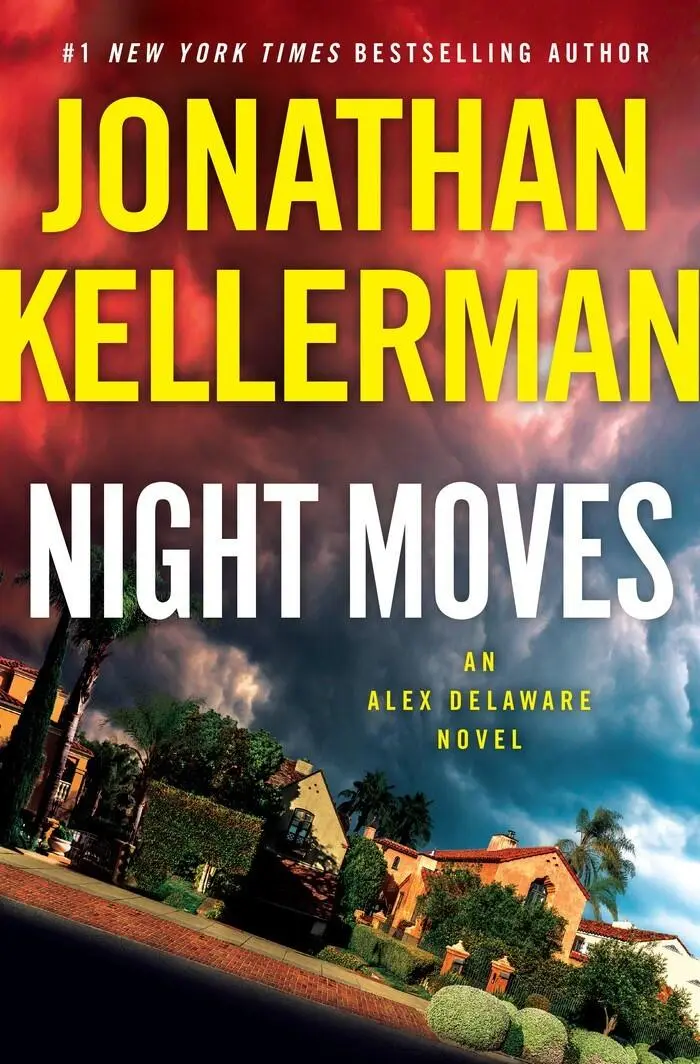
- Название:Night Moves
- Автор:
- Издательство:Ballantine Books
- Жанр:
- Год:2018
- Город:New York
- ISBN:978-0-345-54146-8
- Рейтинг книги:4 / 5. Голосов: 2
-
Избранное:Добавить в избранное
- Отзывы:
-
Ваша оценка:
Night Moves: краткое содержание, описание и аннотация
Предлагаем к чтению аннотацию, описание, краткое содержание или предисловие (зависит от того, что написал сам автор книги «Night Moves»). Если вы не нашли необходимую информацию о книге — напишите в комментариях, мы постараемся отыскать её.
There’s no spilled blood, no evidence of a struggle, and, thanks to the victim’s missing face and hands, no immediate means of identification. And no telling why the disfigured corpse of a stranger has appeared in an upscale L.A. family’s home. Chet Corvin, his wife, and their two teenage children are certain the John Doe is unknown to them. Despite that, their cooperation seems guarded. And that’s more than Milo and Alex can elicit from the Corvins’ creepy next-door neighbor — a notorious cartoonist with a warped sense of humor and a seriously antisocial attitude.
As the investigation ensues, it becomes clear that this well-to-do suburban enclave has its share of curious eyes, suspicious minds, and loose lips. And as Milo tightens the screws on potential persons of interest — and Alex tries to breach the barriers that guard their deepest secrets — a strangling web of corrupted love, cold-blooded greed, and shattered trust is exposed. Though the grass may be greener on these privileged streets, there’s enough dirt below the surface to bury a multitude of sins. Including the deadliest.
Night Moves — читать онлайн бесплатно полную книгу (весь текст) целиком
Ниже представлен текст книги, разбитый по страницам. Система сохранения места последней прочитанной страницы, позволяет с удобством читать онлайн бесплатно книгу «Night Moves», без необходимости каждый раз заново искать на чём Вы остановились. Поставьте закладку, и сможете в любой момент перейти на страницу, на которой закончили чтение.
Интервал:
Закладка:
He demolished a few more chips. “My atonement is I call Ventura PD, ask for some drive-bys at her place.”
He followed through, got referred up the chain, per usual, ended up with a tepid “We’ll see,” from someone of his own rank.
He said, “Long as we’re in the Ventura groove,” and called Henry Prieto. This time, he hung up laughing. “He’s already got his eyes peeled, don’t I think he’d let me know if he knew something?”
Twin mountains of marinated beef each ringed with slices of avocado and radishes arrived. Side bowls of refried beans, rice, and posole stew, supplemented by a coarse, black-stone bowl of guacamole and a platter of glazed, pepper-rubbed pork ribs.
“Whoa,” said Milo.
“She says mucho gusto, ” said the server, pointing to Lourdes Briseno, holding an armful of menus as she shepherded a party of eight across the room. Grumpy octet, the squinty-eyed look of plane-wreck survivors assessing their friends’ nutritional value.
Milo waved at her.
She returned the gesture wearily.
“At least someone likes me,” he said. “Too bad she’s really irrelevant.”
I was hungry and adrenalized, put away more food than usual before hitting the satiation wall. I pushed my plate away. Milo’s attention was fixed on his own dinner, his arms food-ingesting turbines. I was drinking tea when he came up for air.
A glance at my partially eaten alp. “ She probably did that. Ms. Armani.”
“Did what?”
“Sat there like you, self-righteous and slim, while ol’ Chet packed it away.”
I said, “You engaging in culinary snobbery?”
“Just pointing out the sin of moderation. It’s a cross I bear. Not just you, Rick. The rest of the unreasonably reasonable world.”
He hunched over his food and got back on task. Another avocado heard from.
His remark made me think about Chet Corvin and his mistress, rendezvousing, dining, partying at several locations. That sparked another thought.
I said, “This is far-fetched but what if Donna Weyland — the woman who just left her husband — is a brunette around Chet’s age or younger?”
He put his utensils down. “What brought that on?”
“Mental meandering. I thought of that scene we saw a few nights ago, Paul Weyland, driving up, all hangdog, telling Felice his marriage was over. In all this time, we’ve never seen Donna. A new relationship would explain that, and where do people find lovers? At work and close to home.”
“The old neighbor game,” he said. His eyes sparked. “Hey, Felice was pretty touchy-feely with Weyland. Otherwise she’s been an ice queen. What if the infidelity cut both ways?”
“Chet and Donna, Felice and Paul.”
“Sounds like a movie, but why not, your basic steamy suburbia. Hell, the whole goddamn cul-de-sac could be a nest of sin — Bitt and Chelsea on one side, marital messes on the other.”
He frowned. “Be great for prime time but how does Black Camaro fit in? Not to mention Braun... hell, there’s one thing I can do.”
He phone-Googled an image search, handed me the cell.
Five Donna Weylands, three of them in their twenties. A gorgeous black cheerleader at the University of Houston was caught in midair, an Alaska Air flight attendant from Vancouver, British Columbia, posed in a bikini on an unnamed beach, a game-show developer from Williamsburg, Brooklyn, sported more iron in her face than a high-power magnet, Donna Ethelina Weyland of Paterson, New Jersey, had passed away in 1937.
Donna A. Weyland, an employee of the L.A. Unified School District, appeared once, in a group shot of an educational task force convening in Reno.
Middle-aged, full-faced and zaftig, hair that could be gray or blond clipped in a no-nonsense page, oversized eyeglasses, a hesitant smile.
Milo said, “She mighta broken Paul’s heart, but I’m not getting Armani, pricey chocolates, and vino from someone like Chet.”
I handed the phone back. He swabbed at his mouth with a napkin, motioned the busboy over, and ordered coffee.
Milo drank two cupfuls, pried his bulk upward, and tossed cash on the table. No need to wait for the check, he always surpasses.
I said, “Let’s split it.”
“Like that’s gonna happen.”
Scooping more chips out of the bowl, he tilted his head toward the front door. “Pitchforks are gone, let’s head back to alleged civilization.”
Chapter 29
Not a word from Milo the following day. Nothing on my Saturday calendar other than dinner with Robin. Meanwhile, she was working.
I drove to the Palisades, parked a quarter mile from the Corvins’, and walked.
Using your legs in L.A. when you’re not accompanied by a dog makes people nervous. When I was a block away I clipped my expired LAPD consultant badge to my belt. It entitles me to nothing but can mute anxiety.
At the mouth of Evada Lane, that was put to the test.
As I entered the cul-de-sac, an older, pale-blue BMW 6 drove past me, stopped for a moment, then rolled up the driveway of the second house on the north side of the block. Illinois plates, the paint salt-pocked and grimy.
A man got out carrying a macramé shopping bag. Forties, thick mop of gray hair, matching beard. He wore a tweed jacket, pressed jeans, a blue work shirt, brown-and-tan wingtips. Standing near his driver’s door, he pressed a finger to his chin as if considering options.
I kept going, positioning myself so the badge was easy to spot.
“Police?” he said.
I stopped. He put his bag down. “If I’m correct, I’ve noticed another one of you guys, looked like a weight lifter? I was coming home after a weekend away, early morning, saw him around the corner. When he saw me, he started jogging, which seemed odd at that hour. I hope he’s one of you and not some muscle-bound burglar.”
I smiled.
He said, “Knew it! I’m pretty impressed with how you guys are sticking with it. How long’s it been — weeks.”
“Exactly.”
“Kudos. Where I’m from, good luck getting follow-up.”
“Where’s that?”
“South Side of Chicago.”
“Professor?”
“It’s that obvious?”
“You don’t look like a gangster.”
He chuckled. “South Side’s all thugs and academics? That’s a little facile. Actually, you’re right. Actually, there’s considerable spillover between thugs and academics.”
I laughed and walked over to him. The macramé bag was filled with groceries. Packaged steak on top; grass-fed, organic, Whole Foods.
I held out my hand. “Alex Delaware.”
His grip was firm. “Bart Tabatchnik. I’m at the U. for a semester teaching economics. I hope I’m not about to oversell something I observed. I really didn’t think it was important, still don’t, but seeing you, I figured why not? Seeing as it’s still unsolved.”
I said, “Anything you can offer would be appreciated.”
“This was a couple of weeks before it happened,” said Bart Tabatchnik.
“Even so.”
“Okay. I’m sure you know that the fellow who lives to the left is an artist named Bitt. After the murder, people were murmuring about him, apparently they think he’s odd. I’ve had no contact with him but it made me curious so I looked him up and his work is pretty out there. Normally, I’d assume a clash of norms is at play — it’s a pretty conservative neighborhood, I wouldn’t want to get anyone in trouble. But then I saw his face and I realized I’d seen him before. Only once, but it might be substantive. Then again, it might not.”
He stroked his beard. “Sorry, I tend to get prolix, occupational hazard, get paid to lecture, cut to the chase: Around a week after the murder I saw Bitt and another man having a confrontation. I wondered if that was Corvin — on the off chance, I don’t know anyone here but it was his house — anyway, I looked him up and it was Corvin.”
Читать дальшеИнтервал:
Закладка:
Похожие книги на «Night Moves»
Представляем Вашему вниманию похожие книги на «Night Moves» списком для выбора. Мы отобрали схожую по названию и смыслу литературу в надежде предоставить читателям больше вариантов отыскать новые, интересные, ещё непрочитанные произведения.









Обсуждение, отзывы о книге «Night Moves» и просто собственные мнения читателей. Оставьте ваши комментарии, напишите, что Вы думаете о произведении, его смысле или главных героях. Укажите что конкретно понравилось, а что нет, и почему Вы так считаете.