Ranulph Fiennes - Killer Elite
Здесь есть возможность читать онлайн «Ranulph Fiennes - Killer Elite» весь текст электронной книги совершенно бесплатно (целиком полную версию без сокращений). В некоторых случаях можно слушать аудио, скачать через торрент в формате fb2 и присутствует краткое содержание. Жанр: Триллер, на английском языке. Описание произведения, (предисловие) а так же отзывы посетителей доступны на портале библиотеки ЛибКат.
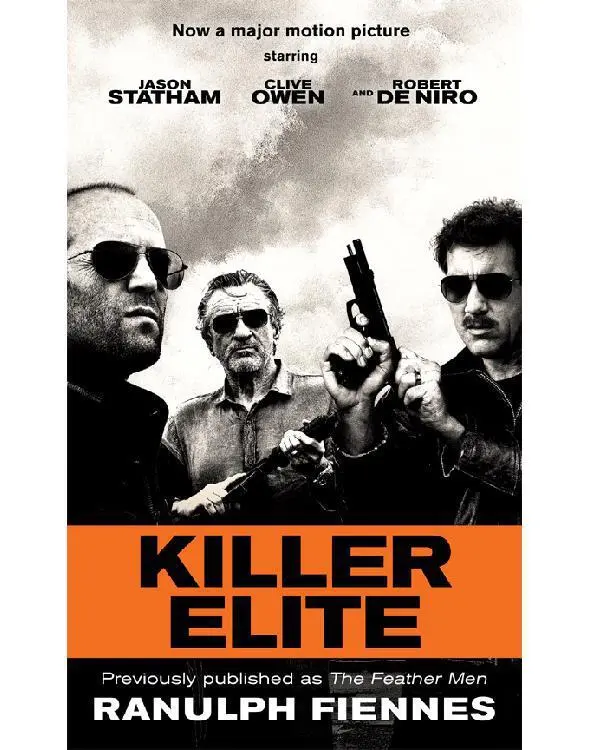
- Название:Killer Elite
- Автор:
- Жанр:
- Год:неизвестен
- ISBN:нет данных
- Рейтинг книги:3 / 5. Голосов: 1
-
Избранное:Добавить в избранное
- Отзывы:
-
Ваша оценка:
Killer Elite: краткое содержание, описание и аннотация
Предлагаем к чтению аннотацию, описание, краткое содержание или предисловие (зависит от того, что написал сам автор книги «Killer Elite»). Если вы не нашли необходимую информацию о книге — напишите в комментариях, мы постараемся отыскать её.
Killer Elite — читать онлайн бесплатно полную книгу (весь текст) целиком
Ниже представлен текст книги, разбитый по страницам. Система сохранения места последней прочитанной страницы, позволяет с удобством читать онлайн бесплатно книгу «Killer Elite», без необходимости каждый раз заново искать на чём Вы остановились. Поставьте закладку, и сможете в любой момент перейти на страницу, на которой закончили чтение.
Интервал:
Закладка:
The Escort passed by the main house and parked in front of two small cottages down a tarmac lane. Bob had seen enough. He returned home to Hereford and his wife, Lyn.
Spike Allen spent forty minutes six mornings a week jogging in Hyde Park. He seldom enjoyed the exercise but, in his mid-forties, he had to compensate for his love of good food or join the pear-shaped majority. At 8:30 a.m., when he returned to his flat, his wife had already left for the British Museum, where she worked as a curator’s assistant.
As always, Spike checked his answering machine. He was to call a number in Worcester. The number was not that of a Local but it did figure on his Informant Sheet. This was a list of noncommittee individuals, mostly from the Midlands, Wales and the South of England, who volunteered pertinent information to which the committee might wish to react.
The number responded.
“Hallo, Ken. Spike calling back.”
Ken Borthwick, an ex-SAS sergeant-major and currently a detective constable, did not waste time on pleasantries. “Spike, you may think this is a long shot but here goes anyway. Last night I had a drink at the Grapes with Bob Bennett, an ex-B Squadron lad on leave from Germany. I left the pub early but Bob called me early this morning with a potential problem. He does not know about you or our connection. He called me merely because I’m with the Force and because I saw the Welshman before I left.”
“The Welshman?” Spike queried.
“Yes. He had a light Borders accent and made out he’d been with the Welsh Fusiliers. He mingled with some of the lads and said he’d been seconded to the SAF in the early seventies. Bob thought nothing of it at first but, for a Sultan’s Armed Forces man, this fellow was pretty damned ignorant. He kept referring to the lads down in Dhofar as SAS not BATT, and he told a story about an SAS officer whose name he had forgotten but whose batman was a cousin of his. Since no SAS officer has ever had a batman, this grated on Bob.”
“Hardly enough to brand the Welshman as undesirable,” Spike commented.
“True, but as the evening progressed the fellow kept muttering about Mirbat and in particular about the 1972 shindig there. Bob thought he was fishing and, since Bob was himself involved that day at Mirbat, he decided to follow the Welshman. He left him at a bed and breakfast on the Hay road.”
There was a pause. “So?” said Spike.
“So we may have another case like Tim Shand. Remember, the lad from G Squadron who the IRA traced to his home in Ross last year. We put a watch on him for a week but nothing happened, so we cleared out and, a month later, he found a key-set two-pound car bomb clamped to his Peugeot.”
“But,” Spike said, feeling he was missing the point, “I thought you said this Welshman was fishing for Dhofar, not Belfast, connections?”
“Poor Spike,” Ken’s voice oozed sympathy, “menopausal run-down and hemorrhoids of the brain. If you were trying to identify which of the Grapes clientele were with the Regiment and not merely ex-Army, would you sew your web of Belfast silk? ’Course not. Give the Provos a break, mate.”
Spike did not rise to this. “So you go along with Bob’s suspicions, do you, Ken?”
“In principle,” was the firm reply. “I saw the Welshman, only briefly, but I sensed unease and the guy had a hard, mean cut to his features. Listen, Spike, us boys in blue would not react to this sort of random suspicion without more evidence of intent. There’s no point in my even trying to alert my bosses. I’d merely get a lecture on the current lack of manpower and the sorting out of priorities.”
“Okay, Ken,” Spike sighed. “Give me the details of the bed and breakfast and I’ll do what I can.”
Spike ate a bowl of Alpen cereal laced with maple syrup and washed down with percolated Douwe Egbert coffee. Mastication always helped him think. He decided on John Smythe, a freelance photographer who had left the SAS Territorials a year before because of a heavy demand for roof insulation. John was on the lump and dabbled in any highly paid work, normally scaffold erection, that could be done without the tax man’s knowledge. He had phoned Spike a couple of months before to complain that life was slow and what was the point of being a Local if Spike never called him.
Although Hertford, John Smythe’s hometown, was close to Hitchin and a recruitment basin for C Squadron, 21 SAS, Spike had received no calls in that area for many months. He would leave Hallett, the usual West Country Local, alone, but respond to Borthwick’s call by putting Smythe on to the Welshman.
At 5 p.m. Muscat time de Villiers took a booked call to England from one of the booths at the Cable amp; Wireless office in the town center, the only available way of placing an international call from Oman.
Davies, at Brobury House, was waiting and explained in cryptic terms that the SAS were a closed-mouthed, hypersuspicious crowd of bastards and he had nothing to report.
“Never mind,” said de Villiers, “ we have positive identification and need you over here like yesterday. The office will give you details but you must speed up your visa by going to the embassy soonest.”
Two hours after Smythe was installed with binoculars, vacuum flask and his car radio tuned to Radio 4, the red Escort turned right out of the drive of Brobury House and sped east.
Smythe had learned a good deal about surveillance merely through past failures. He now carried a box of accessories to improve his results. When Davies parked the Escort in Trebovir Road, close to Earls Court underground station, Smythe stayed with the car. Once the Welshman was gone, he took a slightly crushed Coca-Cola can from his box of tricks and placed it in front of one of the Escort’s rear tires. Back in his own car, he settled down to sleep as soon as he had switched on the receiver unit of his Coca-Cola gizmo. A green light pulsed at him. It would continue to pulse until a set of contacts in the can were mated by pressure. The light would then go out, to be replaced by a series of beeps loud enough to waken Smythe from the deepest of slumbers.
On February 27, 1977, eight of the committee met at Bob Mantell’s home in Richmond, a quiet semidetached house close to the East Sheen Gate to Richmond Park.
The meeting had been called by Spike at short notice and absentees included Bletchley, who had been hospitalized for a checkup, according to his housekeeper.
Colonel Macpherson, who detested meetings on Sundays, was in a testy mood and keen to speed up procedures. This suited Spike. He explained the Hereford background to Smythe’s surveillance activities.
“The day after the Welshman arrived in London, he visited 64 Ennismore Gardens, the Omani Embassy, and our Local followed him into the Visa Section. After a long wait, during which both men filled in No Objection Certificate application forms, the Welshman was summoned into the inner office. Mr. Alfred Jones was the name called out by the Omani official. We have no further details other than the number of his rented Avis car and a rather poorly focused photograph taken by our Local.”
“When does this Welshman Jones fly to Oman?” Macpherson asked.
“That is the reason I asked for this snap meeting,” Spike replied. “Calling myself Alfred Jones, I telephoned Gulf Air Reservations and asked for confirmation of when my secretary had booked my flight to Muscat. I said she was sick and had taken my diary out of the office.” Spike paused to check his notes. “Jones is scheduled to fly to Muscat via Doha and Dubai on Gulf Air Flight 006 next Saturday.”
“Do we have contacts in Oman?” Michael Panny asked.
“No one,” Spike said, having checked with Mantell. “But I have a friend at Kendall’s who handles contract officers’ liaison with the Omanis. He can fix visas for me without too many questions being asked.”
Читать дальшеИнтервал:
Закладка:
Похожие книги на «Killer Elite»
Представляем Вашему вниманию похожие книги на «Killer Elite» списком для выбора. Мы отобрали схожую по названию и смыслу литературу в надежде предоставить читателям больше вариантов отыскать новые, интересные, ещё непрочитанные произведения.











Обсуждение, отзывы о книге «Killer Elite» и просто собственные мнения читателей. Оставьте ваши комментарии, напишите, что Вы думаете о произведении, его смысле или главных героях. Укажите что конкретно понравилось, а что нет, и почему Вы так считаете.