Elizabeth Hand - Generation Loss
Здесь есть возможность читать онлайн «Elizabeth Hand - Generation Loss» весь текст электронной книги совершенно бесплатно (целиком полную версию без сокращений). В некоторых случаях можно слушать аудио, скачать через торрент в формате fb2 и присутствует краткое содержание. Город: Northampton, MA, Год выпуска: 2007, ISBN: 2007, Издательство: Small Beer Press, Жанр: Триллер, Ужасы и Мистика, на английском языке. Описание произведения, (предисловие) а так же отзывы посетителей доступны на портале библиотеки ЛибКат.
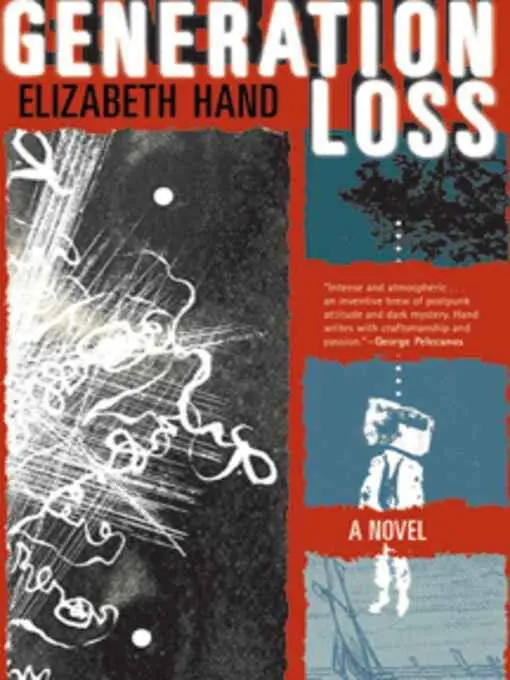
- Название:Generation Loss
- Автор:
- Издательство:Small Beer Press
- Жанр:
- Год:2007
- Город:Northampton, MA
- ISBN:978-1-931520-21-8
- Рейтинг книги:3 / 5. Голосов: 1
-
Избранное:Добавить в избранное
- Отзывы:
-
Ваша оценка:
Generation Loss: краткое содержание, описание и аннотация
Предлагаем к чтению аннотацию, описание, краткое содержание или предисловие (зависит от того, что написал сам автор книги «Generation Loss»). Если вы не нашли необходимую информацию о книге — напишите в комментариях, мы постараемся отыскать её.
Thirty years later she is adrift, on her way down, and almost out when an old acquaintance sends her on a mercy gig to interview a famously reclusive photographer who lives on an island in Maine. When she arrives Down East, Cass stumbles across a decades-old mystery that is still claiming victims, and she finds one final shot at redemption.
Patricia Highsmith meets Patti Smith in this mesmerizing literary thriller.
Praise for Elizabeth Hand’s previous novels: Amazon.com Review
“Inhabits a world between reason and insanity—it’s a delightful waking dream.”
—
“One of the most sheerly impressive, not to mention overwhelmingly beautiful books I have read in a long time.”
—Peter Straub
Generation Loss — читать онлайн бесплатно полную книгу (весь текст) целиком
Ниже представлен текст книги, разбитый по страницам. Система сохранения места последней прочитанной страницы, позволяет с удобством читать онлайн бесплатно книгу «Generation Loss», без необходимости каждый раз заново искать на чём Вы остановились. Поставьте закладку, и сможете в любой момент перейти на страницу, на которой закончили чтение.
Интервал:
Закладка:
“It’s amazing.”
“Wait’ll you see Lucien’s place.”
We began walking up a narrow gully. I was glad I had the boat hook to help steady me against the slick rocks underfoot. As we climbed, the gully widened into the remnants of a road.
“That story you told me before,” I said. “About Denny’s girlfriend. The one who died.”
“Hanner.”
“Right, Hannah.” The gale picked up. I looked back to where the Northern Sky bobbed in the water like a gull at rest. “Those masks everyone made—did she have one? Did she have a totem?”
“I don’t think so. I think she just went along with whatever Denny did.”
“Your totem animal? It was a frog?”
“Yeah. Because they’re amphibious. They live on the land and the water both. Like me.”
I hitched my bag from one shoulder to the other. “What about Denny? What was his totem?”
“Denny?” Toby drew thoughtfully on his cigarette. “Good question. It was a long time ago, but—”
He pinched the cigarette out between his fingers then flicked it onto the slick stones at our feet. “I think it was a snapping turtle.”
22
Lucien Ryel’s house showed what you could do with Ray Provenzano’s scrap-metal ethic and several million dollars. It resembled an ancient temple crossed with the remains of a lunar lander, built in the lee of a granite dome above the ocean and surrounded by a stand of massive pine trees and withered rosebushes. A cantilevered deck made of steel girders and I beams ran the length of the building, all glass and weathered metal, inset with blocks of carved granite: huge feathered wings, a colossal arm, an immense, preternaturally calm face. Solar panels carpeted a roof bristling with satellite dishes. The windows were pocked with silhouetted cut-outs of flying birds.
“First summer Lucien was here, we had so many dead birds we had to pick ‘em up with a shovel.” Toby paused to catch his breath. “They’d fly right into the windows. So he put those stickers up. Kind of messes with the view.”
The road wound toward the back of the house. Two large propane tanks were set alongside the wall. I stared at the roof. “He looks pretty plugged in.”
“That’s nothing. Lucien comes all the way out here and then he never leaves the house, just spends all his time in the studio or online. He got a digital switch so he could get high-speed Internet. Paid a bundle to run it here. He keeps talking about getting a windmill, but right now everything’s powered off batteries. I’ve got to make sure they haven’t drained. Denny’s supposed to check them, but he forgot once. He comes up here to use the phone and Internet but never bothers to check the goddam power.”
He stopped and stared at a small outbuilding tucked into the trees. A modular utility shed, its doors flapping in the wind.
“That shouldn’t be open.” Toby walked over to peer inside. “Huh. He took the tractor out too.”
He shut the doors and fastened them with a padlock. “Okay. Now we can get inside and maybe get you warm again.” He pulled out a key ring. “Eureka.”
After the onslaught of wind and cold, inside was eerily silent, save for a soft, rhythmic ticking sound.
“Solar batteries,” said Toby, shucking his rain gear.
We were in a long, open room, its vaulted ceiling crisscrossed by steel I beams. The polished wooden floor shone like bronze. No rugs, no cushions, but a lot of 1980s furniture made of welded copper and steel. The standing lamps resembled carnivorous insects. A Viking stove lurked behind a wall of industrial glass, along with a free-standing wine closet. The effect was of being on board the battleship Potemkin .
“So.” I wandered over to the window. “Did he really build all this? Or was it delivered directly from the gulag?”
Toby dumped his toolbox on the floor. “You wouldn’t believe what this place cost.”
“Yeah, I would. Taste this bad, you have to be so rich no one ever argues with you.”
“It’s very fuel efficient. See that south-facing window? You get incredible passive-solar gain from that.”
“When? On the Fourth of July?”
“No, really—it stays pretty warm in here, relatively speaking. Speaking of which, I got to go drain the water tanks. You try and warm up, I’ll be back up in a bit.”
“Here.” He fiddled with a dial on the wall. “That’ll make it easier. Heat.”
He got his tools and went downstairs. I peeled off my anorak, then my boots and wet socks. My feet felt like frozen lumps of meat. I warmed them as best I could with my hands, found some dry socks in my bag and put them on. I stuck my boots on top of the heater and set off on a quick circuit of the house.
It wasn’t exactly a party pad. The wine closet was locked. Other rooms contained yet more minimalist furniture, a plasma-screen TV, small recording studio. A powder room—no medicine cabinet—where I tried to clean myself up. The water was brackish, but it was warm. Right then I wouldn’t have traded warm water for the best sex or drugs I’d ever had.
I emerged feeling, if not appearing, a bit more human. I forced myself to stand in front of the mirror, staring at a face that looked more like Scary Neary than it ever had. I resembled my own skeleton, tarted up with bloodshot eyes and wind-burned skin.
I bared my teeth in a grimace and wandered into the master bedroom suite. It seemed to float among giant pine trees. Lucien Ryel had sunk a ton of money into building this place and heating it all winter long, not to mention keeping a caretaker on retainer.
Now I understood why.There was a fortune in artwork on those bedroom walls. And not the usual stuff your aging rock stars collect, Warhols and Schnabels and Koons and Curtins.
Ryel had a taste for the art equivalent of rough trade, or what had been considered rough trade up until about ten years ago, when, like bondage equipment, outsider art became mainstreamed. There were two Chris Mars canvases, a Joe Coleman, paintings by artists whose names I didn’t recognize but which were the sorts of things that would give you bad dreams, if you’re susceptible to them.
The stuff was amazing. Some, like a Lori Field collage of women with animal heads and pencil-thin limbs, were ethereal. Others, like a Nick Blinko drawing of a skeleton eating its own skull, were nightmarish.
There were photographs too. A couple of eerie Fred Resslers where you could faces in the trees. An early Mapplethorpe portrait of Patti Smith. A vacant lot by Lee Friedlander. Works by Brian Belott, Branka Jukic … I would have been happy to take whatever could fit into my pockets, if I’d had room.
Then I saw the photos beside his bed.
There were three of them. Oversized color prints, handmade frames, no glass. Monotypes, like the photos at Ray Provenzano’s place and Toby’s apartment. All three had the same childish signature.
S.P.O.T.
Nothing else to identify them. No title. No song lyrics.
Yet I knew they formed a sequence with the others. And even though I still couldn’t pin down what these were photos of , I knew they were linked, somehow, with the older photos I’d seen in Aphrodite’s room—those crudely manipulated SX-70 prints—and Toby’s picture of Hannah Meadows.
I couldn’t tell how they fit. The pattern was there, but because it wasn’t my own craziness I couldn’t put a finger on what held them together. But I knew they were all images of the same thing.
What?
From some angles it resembled a body, from others an island, or the humped form of some kind of animal. The colors were murky greens and browns and viscous blues, shot through with glints of red and orange. Like the others, these used handmade emulsion paper distressed with a needle or fingernail. In spots the dyes had flaked or been rubbed off. Stuff was embedded in the layers of pigment—a fly’s wing; hair; shreds of newsprint. Messy, but it gave the prints a strange depth, as though they’d captured some of the real world the photo sought to hold on to.
Читать дальшеИнтервал:
Закладка:
Похожие книги на «Generation Loss»
Представляем Вашему вниманию похожие книги на «Generation Loss» списком для выбора. Мы отобрали схожую по названию и смыслу литературу в надежде предоставить читателям больше вариантов отыскать новые, интересные, ещё непрочитанные произведения.








Обсуждение, отзывы о книге «Generation Loss» и просто собственные мнения читателей. Оставьте ваши комментарии, напишите, что Вы думаете о произведении, его смысле или главных героях. Укажите что конкретно понравилось, а что нет, и почему Вы так считаете.