Elizabeth Hand - Generation Loss
Здесь есть возможность читать онлайн «Elizabeth Hand - Generation Loss» весь текст электронной книги совершенно бесплатно (целиком полную версию без сокращений). В некоторых случаях можно слушать аудио, скачать через торрент в формате fb2 и присутствует краткое содержание. Город: Northampton, MA, Год выпуска: 2007, ISBN: 2007, Издательство: Small Beer Press, Жанр: Триллер, Ужасы и Мистика, на английском языке. Описание произведения, (предисловие) а так же отзывы посетителей доступны на портале библиотеки ЛибКат.
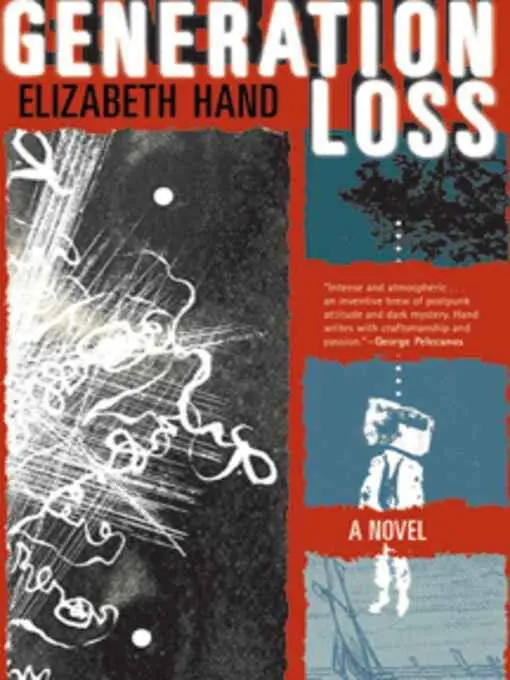
- Название:Generation Loss
- Автор:
- Издательство:Small Beer Press
- Жанр:
- Год:2007
- Город:Northampton, MA
- ISBN:978-1-931520-21-8
- Рейтинг книги:3 / 5. Голосов: 1
-
Избранное:Добавить в избранное
- Отзывы:
-
Ваша оценка:
Generation Loss: краткое содержание, описание и аннотация
Предлагаем к чтению аннотацию, описание, краткое содержание или предисловие (зависит от того, что написал сам автор книги «Generation Loss»). Если вы не нашли необходимую информацию о книге — напишите в комментариях, мы постараемся отыскать её.
Thirty years later she is adrift, on her way down, and almost out when an old acquaintance sends her on a mercy gig to interview a famously reclusive photographer who lives on an island in Maine. When she arrives Down East, Cass stumbles across a decades-old mystery that is still claiming victims, and she finds one final shot at redemption.
Patricia Highsmith meets Patti Smith in this mesmerizing literary thriller.
Praise for Elizabeth Hand’s previous novels: Amazon.com Review
“Inhabits a world between reason and insanity—it’s a delightful waking dream.”
—
“One of the most sheerly impressive, not to mention overwhelmingly beautiful books I have read in a long time.”
—Peter Straub
Generation Loss — читать онлайн бесплатно полную книгу (весь текст) целиком
Ниже представлен текст книги, разбитый по страницам. Система сохранения места последней прочитанной страницы, позволяет с удобством читать онлайн бесплатно книгу «Generation Loss», без необходимости каждый раз заново искать на чём Вы остановились. Поставьте закладку, и сможете в любой момент перейти на страницу, на которой закончили чтение.
Интервал:
Закладка:
I finished my coffee. “You got any food down there?”
“Yeah, go and poke around in the galley, you’ll find something.”
I went below. It wasn’t exactly warm, but it was out of the wind and rain. Quiet, too. Well, not quiet, exactly, but the sounds were different. Rain slashing against the porthole windows, mildly ominous creakings, the drone of the engine. I sat and pulled a blanket around my shoulders. After a few minutes I went to the galley to see what I could find to eat.
There was enough rum and Moxie to qualify as an alternative energy source, but not a lot of what you’d call food. A few sprouting potatoes, a couple cans of tomato sauce. I found a half-full bag of green apples that seemed okay, also a box of blueberry Pop Tarts. I ate an apple then wolfed down Pop Tarts while rummaging through cupboards to see what more there was.
String, a corkscrew, plastic condiment packets. A bottom drawer held a first-aid kit, fishing line and hooks, matches in a waterproof tin. Aspirin, Ipecac, Benadryl. I shoved them aside and saw something else.
A flare gun.
I picked it up. About five inches long, made of plastic, with a black barrel and orange trigger. I checked the barrel. There was a single red canister inside. I held it, thinking, put it into the drawer and went back up on deck.
“Find something?”
“Some Pop Tarts.”
“Yeah, I bought a case of those for Y2K.”
I stood beside him at the tiller and watched black water slop against blocks of rose-colored stone. In the sleety mist it was hard to tell where the pier ended and the beach began. Granite blocks blended into boulders, boulders faded into reddish sand indistinguishable from stunted trees killed by salt and cold. A line of spruces well above the waterline glowed a green so deep it was almost black. Here and there, a black gleam as of eyes gazed back from the trees. A house.
“Is that where we’re going?” I asked.
“That’s it. Mr. Ryel’s Dream House.”
I thought we’d pull up to the pier. Instead, the Northern Sky angled off toward a pair of round floats. A lobster buoy bobbed nearby.
“Take this,” said Toby, leaving the tiller to me. “I’m going to cut the engine. Try to keep us from drifting away from those floats.”
He went below. The engine died. The only thing I could hear was the roar of the wind and the crash of waves on the rocky beach.
“This is a good mooring,” Toby shouted as he headed toward the stern. “We’ll tie up here and take the dinghy to shore. The boat’ll be safer if the weather gets rough.”
“Will it get worse?”
“Don’t know. It seems to be dying down now, but that could just be the eye. Whyn’t you get your stuff from below. That way if we end up staying over at Lucien’s place you’ll have it.”
He started to tie off the boat. I climbed down to the cabin and got my bag, put my camera back inside, checked to make sure my copy of Deceptio Visus was still safe. I opened it, flipping through the pages until I found the prints I’d made in the basement, the contact sheets and the other two. Aphrodite’s photo of the naked man I now knew must be Denny Ahearn, and Denny’s photo of Hannah Meadows. I looked at them then put them aside and stared at the snapshot of Gryffin.
I shut my eyes and recalled his face as I’d first seen it, the emerald flaw in his iris. The green ray . I thought of the photo in Aphrodite’s room—a different green-flecked eye—and the larger picture of Hannah Meadows in Toby’s apartment. Painted eyes, one with a green star inside it.
I couldn’t make sense of it. There was no sense to it, not to anyone except the person who’d shot those pictures.
I’ve heard alcoholics say they can recognize another alcoholic without ever seeing them take a drink, that they can read a book or hear a song and know that the person who wrote it was a drunk. I’m not crazy 24/7, but I’ve been crazy enough that I recognize someone else who’s nuts.
Especially another photographer. Like Diane Arbus. She was a genius, and maybe I’m not. But I know what she saw out there when she looked at the world through her viewfinder. I know what she saw when she killed herself. Just like I know what I saw when I watched Aphrodite die, what I felt: the stench of damage like my own sweat, and my own reflected face like a flaw in her iris.
I rode a wave of grief that left nothing in its wake, not memory or remorse or rage. When it passed I looked down and saw Gryffin’s photo still in my hand. I slid it into Deceptio Visus and put the book into the bag with my camera. I went back on deck.
“We’re all set,” announced Toby. His cheeks were white with cold. “You got everything? Grab one of those life jackets.”
The rain had nearly stopped, but the sky remained nickel colored, swollen with cloud. I fished out another Adderall and washed it down with a mouthful of whiskey. There was something behind those clouds, something behind that black lowering bulk of granite and stunted trees, something I couldn’t see yet. I got the life jacket and waited in the stern by the dinghy. Toby returned with another life jacket, the canvas bag, and a toolbox.
“I think this is everything. You sure you’re okay?” His brow furrowed.
“I think so.” I picked up the boat hook. “What about this? Can it come along?”
“Yeah, sure, go ahead and bring it. Just don’t leave it behind.”
We loaded the dinghy then rowed to shore. It was rough but not scary. Or maybe I was just getting used to it. I scanned the sea for signs of another boat, saw nothing but a few floats. No planes in the sky, no sign of the mainland; just a few black shapes that seemed to flicker above the dark water. Fish, I thought, or maybe dolphins or seals. Toby said they were rocks.
“Another reason Denny never leaves,” he said, pulling at the oars. “Summer it’s okay, but winter—forget it.”
We reached the shore and got out. I helped him pull the boat well above the highwater mark, kicking through tangles of seaweed encrusted with dead crabs. When we were done, he straightened and shaded his eyes, staring out to sea.
“I don’t see Lucien’s boat.” He frowned. “Huh. Denny must’ve moved it.”
I hoisted my bag and the boat hook. Toby dug a cigarette from his pocket and looked at me. “So. What do you think?”
It was beyond desolate: it was where desolation goes to be by itself. Stone pilings reared from the water, skeletal remains of a dock. I couldn’t see a house. Surf-pounded stones lay on the beach between skeins of weed and blackened driftwood. Farther up, those huge blocks of blood red granite were the only jolts of color in a scoured gray world. My entire body ached with cold and fatigue, but somehow that seemed like the right way to feel here. It was a place that had the flesh stripped from it. Just above the shoreline reared a stand of dead trees—cat spruce, said Toby—trunks bleached white and every needle stripped from their branches. Overturned tree stumps surrounded them, roots exposed like tentacles, and the wing of a seabird, its feathers eaten away so it resembled a shattered Chinese fan.
And everywhere, red granite. Not boulders or rocks but immense blocks and overturned pillars, Greek columns covered with lichen, poison green, blaze orange, white, half-carven angels and a monolithic horse and rider.
“This is incredible.” I walked to an angel whose face was veiled with black mold and ran my hand across its eyes. “It’s not all rotted away.”
“That’s why they call it granite.” Toby took a drag from his cigarette. “Back when everyone left here, they just packed their clothes and what they could carry. Obviously they weren’t going to cart off the granite. They left things you wouldn’t believe. When Lucien built his place, I found saw blades and drills. Beautiful stuff; I’ve got some of ‘em back in my place. Not to mention the carvings. They had a hundred guys out here quarrying the stuff, but there were men stayed in the sheds and just carved stone. You know how you see all those memorials from a hundred, hundred-fifty years ago? Well, a lot of them were carved here then shipped out to Boston and New York. Angels, statues … if the carvers made a mistake, they’d just leave it here.”
Читать дальшеИнтервал:
Закладка:
Похожие книги на «Generation Loss»
Представляем Вашему вниманию похожие книги на «Generation Loss» списком для выбора. Мы отобрали схожую по названию и смыслу литературу в надежде предоставить читателям больше вариантов отыскать новые, интересные, ещё непрочитанные произведения.






Обсуждение, отзывы о книге «Generation Loss» и просто собственные мнения читателей. Оставьте ваши комментарии, напишите, что Вы думаете о произведении, его смысле или главных героях. Укажите что конкретно понравилось, а что нет, и почему Вы так считаете.