Elizabeth Hand - Generation Loss
Здесь есть возможность читать онлайн «Elizabeth Hand - Generation Loss» весь текст электронной книги совершенно бесплатно (целиком полную версию без сокращений). В некоторых случаях можно слушать аудио, скачать через торрент в формате fb2 и присутствует краткое содержание. Город: Northampton, MA, Год выпуска: 2007, ISBN: 2007, Издательство: Small Beer Press, Жанр: Триллер, Ужасы и Мистика, на английском языке. Описание произведения, (предисловие) а так же отзывы посетителей доступны на портале библиотеки ЛибКат.
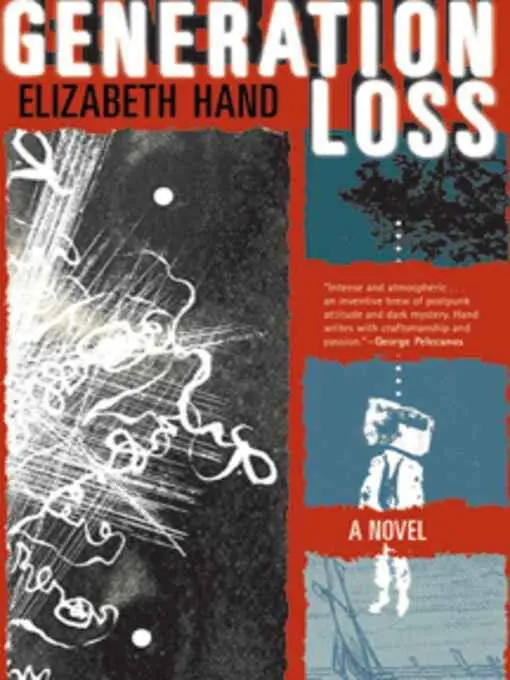
- Название:Generation Loss
- Автор:
- Издательство:Small Beer Press
- Жанр:
- Год:2007
- Город:Northampton, MA
- ISBN:978-1-931520-21-8
- Рейтинг книги:3 / 5. Голосов: 1
-
Избранное:Добавить в избранное
- Отзывы:
-
Ваша оценка:
Generation Loss: краткое содержание, описание и аннотация
Предлагаем к чтению аннотацию, описание, краткое содержание или предисловие (зависит от того, что написал сам автор книги «Generation Loss»). Если вы не нашли необходимую информацию о книге — напишите в комментариях, мы постараемся отыскать её.
Thirty years later she is adrift, on her way down, and almost out when an old acquaintance sends her on a mercy gig to interview a famously reclusive photographer who lives on an island in Maine. When she arrives Down East, Cass stumbles across a decades-old mystery that is still claiming victims, and she finds one final shot at redemption.
Patricia Highsmith meets Patti Smith in this mesmerizing literary thriller.
Praise for Elizabeth Hand’s previous novels: Amazon.com Review
“Inhabits a world between reason and insanity—it’s a delightful waking dream.”
—
“One of the most sheerly impressive, not to mention overwhelmingly beautiful books I have read in a long time.”
—Peter Straub
Generation Loss — читать онлайн бесплатно полную книгу (весь текст) целиком
Ниже представлен текст книги, разбитый по страницам. Система сохранения места последней прочитанной страницы, позволяет с удобством читать онлайн бесплатно книгу «Generation Loss», без необходимости каждый раз заново искать на чём Вы остановились. Поставьте закладку, и сможете в любой момент перейти на страницу, на которой закончили чтение.
Интервал:
Закладка:
Several yards from the road, a single pine reared from a black thicket of underbrush. The crow sat in the tree’s uppermost branches. It stared at me and gave another harsh croak, lifted its wings, and flew down toward the beach.
I watched it go then squinted at the tree’s lower branches, at a dark tangle like what I’d seen in that other tree overlooking the quarry: a shapeless mass like a squirrel’s nest.
Only this was way too big for a squirrel’s nest. I tugged my jacket tighter and headed toward the tree. Between the failing light and the thicket, it was difficult to see clearly.
The tree was huge. In its shadow, a mossy area had been meticulously cleared of everything save a few sticks and dead leaves. Here a number of small, flattish objects had been set in a circle about eight feet across.
I crouched and turned on my flashlight.
At first I thought they were rocks, maybe as big as my hand. But they weren’t rocks.
They were shells. Not seashells—turtle shells.
I picked one up and grimaced.
It was a baby snapping turtle. I used to find them as a kid in Kamensic; they’d fall into swimming pools and you’d have to retrieve them with a skimmer. The most vicious little things I’d ever seen—after you rescued them, they’d run at you hissing, tiny jaws wide.
It had been a while since this one had attacked anyone. I tipped it back and forth. It seemed empty. But I caught a whiff of something, a musky reek like rotting fish and skunk.
I set the shell back down and stared at the others: a dozen baby turtle shells in a circle. In the center of the circle, four small indentations formed a square.
That circle had a definite ritual appearance. The indentations looked more like holes left by tent pegs. But the area was too small for a tent, only the size of a Porta-Potty. I straightened, saw a small white object beside one of the turtle shells.
A candle nub. I rolled it between my fingers, thinking, and put it in my pocket.
The sky was nearly black. Icy rain spattered my face as I slowly traced the flashlight’s beam across the circle. A few tiny objects shone white against the ground, like bits of broken crockery. I picked one up.
An eggshell. Not a turtle egg or something exotic, just the broken shell of an ordinary egg. I chucked it away, continued searching the ground until I saw a faint gleam, as though my light struck glass.
I got on my knees, searched until I saw a glint like gray metal. A nail head, I thought; but when I tried to pick it up, there was nothing there.
What the hell?
I pointed the flashlight at the ground. The reflected light was gone.
But when I looked at my finger, I saw a grayish smudge. Not dirt, more like the residue left when you kill a silverfish, greasy and dark. I sniffed my finger: no smell. I wiped my hand on my jeans, stood, and trained the flashlight on the tree.
The jumble of sticks was about ten feet above me, caught in the crotch of two large branches that splayed into smaller limbs, their stiff needles shaking in the wind. The tree held other things as well. A torn bag, hanks of dead grass.
I walked toward it. When I stepped outside the circle of turtle shells, something cracked beneath my boot. I bent to pick it up.
An antler, mottled white, thin and slightly curved, with tiny ridges along one edge where it had been gnawed by an animal. I ran my finger along it, felt hardened shreds of tissue like splinters of wood, then held it to the flashlight.
My mouth went dry. I’d spent enough hours thirty years ago, photographing myself with a lifesize model of a human skeleton to know this wasn’t an antler.
It was a human rib.
I turned it to clearly see the crosshatch of teethmarks at one end, panicked and flung it into the darkness. I spat on my fingers and rubbed them frantically on my jeans. Then, clutching the boat hook, I walked the last few steps to the pine tree and slowly raised my flashlight until, at last, I saw what was there.
A body. What remained of it, anyway, caught in the crook of the branches like a burst trash bag. A T-shirt and ragged jeans still clung to it, the shirt dangling so I could see the faded Nike wing emblazoned on the chest. What I had taken for sticks was a tangled mass of bones, blotched with dried shreds of sinew. Part of the ribcage protruded through the T-shirt. What I had taken for dead grass was black hair, matted with leaves and hanging from something that resembled a deflated soccer ball.
I backed away, my boots sliding on slick rock and moss.
I’d just seen Martin Graves.
25
I stumbled back to the road. I’d seen bodies before—I’d sought them out, back in the day—but nothing like this.
No animal could have dragged that body into the crotch of a tree. Denny Ahearn had—but why?
The wind whipped up from the sea, carrying gusts of rain. I took a few deep breaths then swallowed, tasting salt and blood. I spat, leaned on the boat hook and willed the throbbing in my head to stop. A few hundred yards below me, buildings yawned black in the gathering dusk—all save that one house with its malign yellow windows. I thought of what I’d just seen in the tree, and of the other tangled mass by the first quarry’s edge.
Yellow light pulsed. Someone whispered my name.
Cass, Cass .
It never ends. It’s always 4 am. beneath a broken streetlamp. And afterward every step, every drink, every person whispers the same thing: You didn’t fight.
Until now.
I swallowed some whiskey and gulped another Adderall, hefted the boat hook, and started toward the house.
Denny’s compound consisted of several outbuildings scattered between stunted trees. A few buildings had been repaired with plywood or driftwood. Others were little more than cellar holes patched with drywall and plastic sheeting, roofed with sheets of blue Styrofoam.
One building, an old barn, had been more carefully renovated. Its doors were open. I shone the flashlight inside and saw a small tractor and stacks of plastic storage containers, a chainsaw.
I moved on. The ground was slippery. There was rubble everywhere. Granite obelisks and broken columns, an arm as tall as a man. Cemetery figures of angels and grieving women. On each the same symbol had been painted: two concentric circles with a dot in the center.
I realized then what I had seen on the standing stone by Denny’s abandoned bus.
Not a bullseye: an eye. And every single one held a blotched green star.
Sleet rattled against the outbuildings. I crouched alongside a low shed with a wire run. A gleam showed through windows covered with blue tarps, and I could hear the low murmur of birds roosting inside. A henhouse.
The main house was about fifty feet away. At the back stretched a small, windowless addition, its shingles raw and unstained. I recalled what Toby had said about building a darkroom. There were solar panels on the roof, and a jerry-rigged water system—plastic tubing, oil drums, a large metal holding tank. I headed toward the rear of the house.
As I drew close I could hear music. Woodsmoke wafted through the icy rain. I approached one darkened window and then the next, and tried to peer inside.
It was hopeless. Sheets of plastic opaque with grime had been nailed across each window. Everything stank of urine and that now-familiar reek of musk and fish. At the back of the house I found a liquid propane tank and a woodshed. I continued to the other side.
Windows boarded up with plywood; flapping bits of plastic. Something crunched beneath my boots—a pile of eggshells. I took a few more steps and halted by a big wooden box, about five feet tall, no lid. I shone the flashlight inside and shaded my eyes, dazzled. It was filled with splintered plate glass.
Читать дальшеИнтервал:
Закладка:
Похожие книги на «Generation Loss»
Представляем Вашему вниманию похожие книги на «Generation Loss» списком для выбора. Мы отобрали схожую по названию и смыслу литературу в надежде предоставить читателям больше вариантов отыскать новые, интересные, ещё непрочитанные произведения.





Обсуждение, отзывы о книге «Generation Loss» и просто собственные мнения читателей. Оставьте ваши комментарии, напишите, что Вы думаете о произведении, его смысле или главных героях. Укажите что конкретно понравилось, а что нет, и почему Вы так считаете.