Nicola Griffith - Always
Здесь есть возможность читать онлайн «Nicola Griffith - Always» весь текст электронной книги совершенно бесплатно (целиком полную версию без сокращений). В некоторых случаях можно слушать аудио, скачать через торрент в формате fb2 и присутствует краткое содержание. Город: New York, Год выпуска: 2007, ISBN: 2007, Издательство: Riverhead Books, Жанр: Триллер, на английском языке. Описание произведения, (предисловие) а так же отзывы посетителей доступны на портале библиотеки ЛибКат.
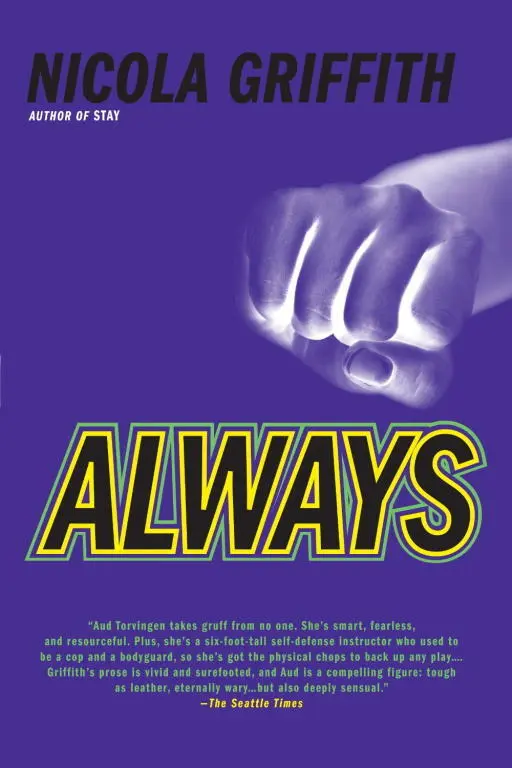
- Название:Always
- Автор:
- Издательство:Riverhead Books
- Жанр:
- Год:2007
- Город:New York
- ISBN:9781594482946
- Рейтинг книги:3 / 5. Голосов: 1
-
Избранное:Добавить в избранное
- Отзывы:
-
Ваша оценка:
Always: краткое содержание, описание и аннотация
Предлагаем к чтению аннотацию, описание, краткое содержание или предисловие (зависит от того, что написал сам автор книги «Always»). Если вы не нашли необходимую информацию о книге — напишите в комментариях, мы постараемся отыскать её.
) returns in an exhilarating new thriller. It doesn’t matter how well trained you are, how big, how fast, how strong; there will always be someone out there bigger or faster or stronger. Always. That’s what Aud Torvingen teaches the students in her self-defense class. But the question is whether Aud really believes this lesson herself-and if not, what it will take for her to learn it.
Aud has trained herself to achieve a fierce, machine-like precision, in hand-to-hand combat as well as life. But in Always she is abruptly confronted with the limits of her own power. Her self-defense classes spin violently out of her grasp and, still reeling from the consequences, she embarks on a seemingly simple investigation of Seattle real estate fraud that pulls her into something far more complicated and dangerous than she had imagined.
Always — читать онлайн бесплатно полную книгу (весь текст) целиком
Ниже представлен текст книги, разбитый по страницам. Система сохранения места последней прочитанной страницы, позволяет с удобством читать онлайн бесплатно книгу «Always», без необходимости каждый раз заново искать на чём Вы остановились. Поставьте закладку, и сможете в любой момент перейти на страницу, на которой закончили чтение.
Интервал:
Закладка:
I closed the door quietly, and stood for a moment on the tarmac with my eyes closed, remembering the feel of the world when I was grieving— like a cold wind on a chipped tooth.
Kick’s white van was backed up five yards from the warehouse door. Someone, hidden by the back doors which were both open, was pulling something heavy along the bed preparatory to hefting it out, someone humming Kevin Barry. Dornan.
A pause in the humming, followed by a low oomph, and a murmured, “What do they put in these things?” He stepped backwards into view, holding two cases of soda with one of bottled water balanced on top. He started to lift one hand to push the van door closed, but the weight was too much for one arm. He pondered. Tried with the other hand.
I stepped up behind him. “I’ve got it.”
“Christ almighty.” He clutched convulsively at the water, which nearly slid off, and started a smile which was abruptly extinguished. “Torvingen. What are you doing here?”
I raised my eyebrows. “It’s my property.” The words glinted between us, naked as a sword jerked halfway from its sheath. My property.
“So it is.”
Nothing on his face but wariness. “Do you need a hand?”
“I’ve got it. Thanks.” No. More than wariness. Resentment? Anger?
“I’ll get the doors, then.” I put my hand on the warm metal. Kick’s van. “You’ll have to back off.” After a moment he backed up two steps. My biceps bunched as I swung the doors shut. “Kick around?”
“She’s at her sister’s.”
“Her sister’s.”
The case of coffee slipped a little. He had to grab it with one hand. I made no move to help. Her sister’s.
“You should carry those in.”
“My time is my own, I believe.”
“They look heavy,” I said.
“Well, yes, I suppose they are.” He didn’t budge.
We measured each other. I could break his spine with one hand. We both knew it. “Is she coming here later?”
“I’m not her keeper,” he said.
“No?” He lifted his chin, and it would have taken just one step, one swing with a crossing elbow, to break his jaw. “You look tired. Did you have a long evening?”
His pupils were tight and I saw him swallow, but he kept his voice steady. “We had a perfectly lovely evening, thank you.”
He had cried when Tammy left him. He had helped me countless times. He was my friend. I breathed, in and out, and took a step back. Gravel rolled and crunched under my boots as I walked away.
I got in my car. Reversed carefully. Signaled before I merged with Alaskan Way, then I called Corning’s cell phone. “You know who this is,” I said. “You missed our Monday meeting, but don’t worry, I’ll find you.”
I would find Corning and slam her head in a car door. First I would find Edward Thomas Hardy and break both his thumbs.
I hadn’t even known Kick had a sister.
I CALLED AHEAD,and this time a bouncy-voiced assistant answered. I explained that I was in Seattle visiting some real estate interests and checking up on the yacht they were building for me down at the lake. I was considering the possibility of moving here, of making a significant contribution to Hardy’s campaign, assuming I liked the cut of his jib. The assistant was very happy to slot me in, right away. I gave my name as Catherine Holt. I’d be there in fifteen minutes. They wouldn’t have time for meeting prep or any kind of background check.
Hardy’s reelection offices were in Fremont, a neighborhood immediately west of Wallingford, along the ship canal. I drove back north. The Audi’s lack of connection with the feel of the road annoyed me. I drove faster than I should, longing for the bite of tire on pavement.
When I got there, the assistant ushered me into Hardy’s office—which, with its pressed-wood furniture and artificial-fiber carpet did not give the impression of wealthy corruption, though perhaps he was just smart—and left us alone.
Old Ed Tom Hardy stood and smiled a politician’s smile, and came out from behind his desk. He extended his hand.
I studied him. Medium height. Face thinner than his body.
“Hardy,” he said, in a resonant voice, hand still out. “It’s a pleasure.”
“Not really,” I said, and sat.
He wasn’t stupid. He pulled in his hand and studied me in turn. “I take it you don’t really intend to make a huge campaign contribution.”
“No.”
“And that your name isn’t Catherine Holt.”
“No.”
“Should I call the police?”
“Have you done something wrong?”
“You look as though you want me to have.” His voice buzzed very slightly and he edged prudently behind his desk, but like Dornan, he wasn’t going to roll over without a fight. The difference was, Edward Thomas Hardy wasn’t my friend.
“I’m considering making you eat your chair.”
Unlike Dornan, his chin went down, rather than up. “I have no doubt you could do that.” His Adam’s apple bobbed, but when he spoke again his voice was admirably steady. “We could begin by you telling me what you think I’ve done.”
“The zoning committee.”
“Ah.” He sat wearily. “I’m sorry if your parents have lost their lease, or your brother his job, but Seattle needs the South Lake Union development.”
“I don’t have an opinion about South Lake Union.”
“I don’t understand.” No apology, no irritation, no fake smile. He was pretty good.
“Do you know somebody called Karenna Beauchamps Corning?”
He opened his mouth, and his lips began to shape no, but then his eyes flickered, up and left, as he remembered something.
I nodded. “You’re meeting her Friday. Johnson Bingley set it up.”
“He’s one of the council admins.” No guilt in his voice. But perhaps he was an excellent poker player.
“I know.”
He was smart enough to wait and see where I was going.
“Did you read about that drug incident in the warehouse district last week?” Wary nod. “The drugs were administered by Corning’s proxy. She wants the leaseholder to go bankrupt and leave the land vacant so that she can buy from the owner at a reduced price. I think she’s meeting you on Friday to ask for a zoning variance on a lot, or several lots, along the Duwamish, which she’ll develop for a profit. I think Johnson Bingley will get a cut of that profit for introducing you.”
There was a very long pause. “That’s illegal.”
I knew that tone. I’d heard my mother use it at a press conference when she’d been sandbagged by a question about improprieties by one of her staffers.
“Yes.”
“You don’t appear to be accusing me of improper behavior.”
“Not at this time. I understand some of the realities of politics. Sometimes there are good reasons for zoning variances. I’m simply pointing out that Corning is a criminal.”
“Perhaps you should take the matter to the police.”
“Perhaps I should.”
He acknowledged the called bluff with a long blink.
“The police can’t help me get what I want. You can.”
Another pause. “I don’t even know your name.”
I made a decision. “Aud Torvingen.” I leaned forward and held out my hand. He shook. A good handshake, the kind my mother would classify as under siege but not overwhelmed, morally or politically. “I’m the owner of the property Corning had been devaluing—she was my broker. I’m hoping that we can help each other.”
“And how do you think I could help you, exactly?” He didn’t need to ask how I could help him; he was a politician running for reelection, and if I owned industrial property, I had money.
“Information. About zoning and development in Seattle. How much would Corning have made if she’d succeeded?”
Читать дальшеИнтервал:
Закладка:
Похожие книги на «Always»
Представляем Вашему вниманию похожие книги на «Always» списком для выбора. Мы отобрали схожую по названию и смыслу литературу в надежде предоставить читателям больше вариантов отыскать новые, интересные, ещё непрочитанные произведения.











Обсуждение, отзывы о книге «Always» и просто собственные мнения читателей. Оставьте ваши комментарии, напишите, что Вы думаете о произведении, его смысле или главных героях. Укажите что конкретно понравилось, а что нет, и почему Вы так считаете.