Nicola Griffith - Always
Здесь есть возможность читать онлайн «Nicola Griffith - Always» весь текст электронной книги совершенно бесплатно (целиком полную версию без сокращений). В некоторых случаях можно слушать аудио, скачать через торрент в формате fb2 и присутствует краткое содержание. Город: New York, Год выпуска: 2007, ISBN: 2007, Издательство: Riverhead Books, Жанр: Триллер, на английском языке. Описание произведения, (предисловие) а так же отзывы посетителей доступны на портале библиотеки ЛибКат.
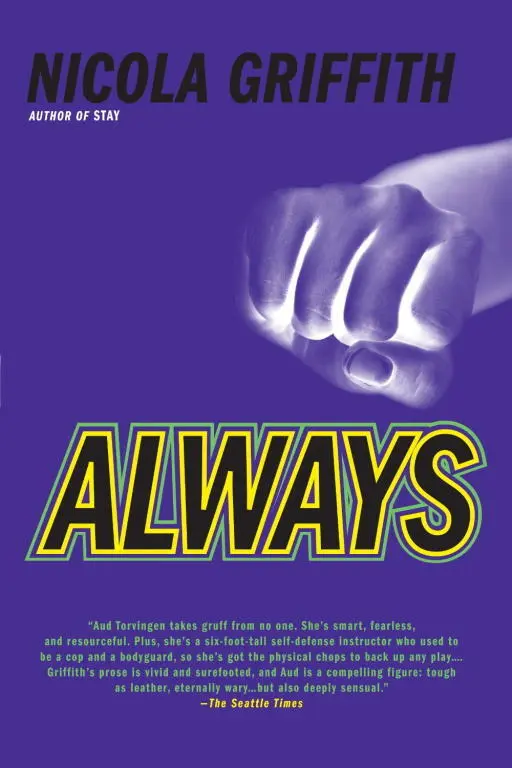
- Название:Always
- Автор:
- Издательство:Riverhead Books
- Жанр:
- Год:2007
- Город:New York
- ISBN:9781594482946
- Рейтинг книги:3 / 5. Голосов: 1
-
Избранное:Добавить в избранное
- Отзывы:
-
Ваша оценка:
Always: краткое содержание, описание и аннотация
Предлагаем к чтению аннотацию, описание, краткое содержание или предисловие (зависит от того, что написал сам автор книги «Always»). Если вы не нашли необходимую информацию о книге — напишите в комментариях, мы постараемся отыскать её.
) returns in an exhilarating new thriller. It doesn’t matter how well trained you are, how big, how fast, how strong; there will always be someone out there bigger or faster or stronger. Always. That’s what Aud Torvingen teaches the students in her self-defense class. But the question is whether Aud really believes this lesson herself-and if not, what it will take for her to learn it.
Aud has trained herself to achieve a fierce, machine-like precision, in hand-to-hand combat as well as life. But in Always she is abruptly confronted with the limits of her own power. Her self-defense classes spin violently out of her grasp and, still reeling from the consequences, she embarks on a seemingly simple investigation of Seattle real estate fraud that pulls her into something far more complicated and dangerous than she had imagined.
Always — читать онлайн бесплатно полную книгу (весь текст) целиком
Ниже представлен текст книги, разбитый по страницам. Система сохранения места последней прочитанной страницы, позволяет с удобством читать онлайн бесплатно книгу «Always», без необходимости каждый раз заново искать на чём Вы остановились. Поставьте закладку, и сможете в любой момент перейти на страницу, на которой закончили чтение.
Интервал:
Закладка:
“I’m not very familiar with them.”
“My son, Jason, used to bring home comics and I’d say, Read a real book! And he’d say, This is a real book, Mom! And he gave me a couple. And, you know what? They were pretty good.”
Everyone looked at her blankly.
Therese stepped into hostess mode. “Isn’t this lovely potato salad? Kim, can I have the recipe?”
“Sure. I’ll e-mail it.”
“We could set up a chat group,” Nina said. “Everyone should give me their e-mail address.”
“What about Sandra?” Katherine said. Then, “Wonder where she is?”
No one said anything. No one was willing to say it.
NINE
WHEN I WOKE, MY JAWS ACHED WITH TENSION. WHAT LITTLE SLEEP I’D HAD WASfilled with dreams of paintings and cold, empty chairs.
According to Gary, Karenna Beauchamps Corning lived in Capitol Hill. The address turned out to be one of those high-priced, high-security condo buildings that went up five years ago and would probably come down in ten: all marble facing on porous concrete and inferior-grade re-bar. Morning sun gilded the polished steel letters (lowercase, Helvetica) that spelled out the name of the building: press. Press what? I rang her buzzer. No response. I got back in the car and phoned. Nothing. I watched for a while.
A man with a very small white dog headed for the main door. I got out of the car, pretending to talk on the phone, feeling in my pockets for a non-existent key.
“—goddamn it, Jack,” I snapped into the phone. “I promised Harris we’d have those projections by tomorrow noon and we’ll goddamn well have them by tomorrow noon. Am I making myself—Hold on one sec.” The man was opening the door. I swapped the phone to my other ear, felt in my trouser pocket. “Yeah,” I said, “yeah. Are you listening, we’ve— Hold on.” I swapped sides again, felt in my other pocket. Spared a harassed glance at the man and his dog. He obligingly held the door open for me. “No, Jack. No. Absolutely not. Tomorrow. Look—” I swapped the phone one more time. “Thanks,” I said in an undertone to the man, waved him ahead when he looked as though he was about to hold the elevator door for me. The dog cocked its head at me. “Tomorrow is the absolute—” The elevator door dinged shut. I put the phone away.
I took the stairs down to the parking basement. The slot marked 809 was empty. The oil spot wasn’t fresh. I walked up to the eighth floor. The air in the stairwell felt thick and unused.
The door was good quality. Pine stained to look like oak, but solid. Heavy brass fittings. One simple mortise lock. I pulled on latex gloves.
I was out of practice. It took three minutes to open. I listened. No beeping: no alarm. Or maybe a very, very expensive alarm. Given the lock, I doubted it.
I checked her bedroom closet, only two hangers empty, and then the bathroom: a gap on the second shelf of the medicine cabinet where three or four things might usually sit. I looked in the fridge: eggs, juice, a wilted head of lettuce. An opened and restoppered bottle of chardonnay. Thai takeaway cartons, limp with grease that had had four or five days to settle. I went back into the bedroom and looked in her dresser. The lingerie drawers seemed more than half-full.
I prowled through the rest of the condo. One lonely paperback in the living room, a Da Vinci Code knockoff. The second bedroom had been converted to an office very recently: it smelled of new carpet and plastic electronic component cases that were still out-gassing. Fake wood-grain filing cabinets, fax, phone, computer, paper shredder. The bin beneath it was empty. I looked in the kitchen. The garbage can was also empty.
I sat on her Italian leather sofa and stared through the picture window at Elliott Bay. A container ship plowed heavily south and west to the docks. One ferry was slicing its way out, one in. Overhead the sky was bright and clear, but bluish grey clouds were slipping over the western horizon.
I reconstructed what had happened. Already shaken from my visit on Thursday, on Friday she had taken any incriminating files from her office. On Saturday morning she had picked up the newspaper and read with mounting panic that someone had drugged half the crew on the Feral set: her minions had overstepped their bounds and someone had nearly died. She had stuffed a few days’ worth of underwear in a bag, with some vague notion of keeping out of the way until things blew over. But keeping out of whose way? Mine? The police? Her political cronies? Someone else? And where had she gone?
I opened her filing cabinet. It was mostly empty; the green cardboard hanging files, the buff folders, the files, the paper, all smelled new. The labels on the hanging folders were unfaded, and there were very few of them. I leafed through what there was, but nothing occurred to me.
I turned on her computer. No password screen. A green Carbonite backup icon at bottom right. I went to her most recent documents, scanned the folders, found one labeled Da Vinci, and smiled. I opened it. A quick look confirmed my guess: it was a list of passwords and user names, including the one for Carbonite. Sometimes people made it too easy. I copied it to the flash drive on my key ring, and found myself humming.
The odds of getting caught on the premises of a break-in increase exponentially once you pass the ten-minute mark. One more minute at the screen, in case something unexpected happened with Carbonite, then two minutes searching her papers.
I found her calendar and pulled it up.
It was all in personal shorthand: 5/14: JB 10:30. Usual. Wtd upd. 5/15 11:45 dtwn lun. push harder. 1:30 upd. Will JB get ETH? 5/18… I wasn’t scheduled, which meant these entries were from before our encounter. I scanned the rest. An entry for the coming Monday caught my eye. 5/22: 11:00—ETH!! Whoever JB was, she or he had come through.
I copied that, too, just in case. Some of it was easy enough to guess at— wanted update, downtown lunch—but I wouldn’t know who was pushing whom harder or about what until I identified JB and ETH.
It took more than two minutes to find her bills because, rather than being filed neatly, they were tossed in a kitchen drawer. I found her cell phone bill, and noted the phone number, her car insurance information—she drove a Lincoln Navigator—and her credit card details.
IN ATLANTAI would have taken the information to Benny or Taeko and had what I needed an hour later. In Seattle, I had to do the grunt work myself. At least I could do it outside.
Gas Works Park. I’d seen it from Kick’s bedroom window. She’d said I’d like it. After mapping it on the MMI, I drove north, detoured past Kick’s house. Her van wasn’t there. Maybe it hadn’t been there all night. I refused to think about that.
Gas Works Park was the southern spit of Wallingford, a green tongue poking into Lake Union. It was the old city gasworks, turned into a park thirty years ago. Kick obviously liked this place, and perhaps Dornan would appreciate the postmodern picture of rusting gasworks surrounded by parkland, but to me it felt wrong. Natural beauty and heavy industry did not belong together.
I carried my laptop case along a broad path. To the east of a big hill, surrounded by grass, two of the old gas towers still stood, covered in graffiti and quietly rusting to themselves. To my left, the exhauster-compressor machinery left from the fifties had been bolted firmly in place and painted thickly with cheerful enamels, an industrial jungle gym for small children. I couldn’t imagine wanting to bring children to play in a place like this. The grass might be green and the engines brightly painted, but the dirt must be drenched in contaminants.
Читать дальшеИнтервал:
Закладка:
Похожие книги на «Always»
Представляем Вашему вниманию похожие книги на «Always» списком для выбора. Мы отобрали схожую по названию и смыслу литературу в надежде предоставить читателям больше вариантов отыскать новые, интересные, ещё непрочитанные произведения.








Обсуждение, отзывы о книге «Always» и просто собственные мнения читателей. Оставьте ваши комментарии, напишите, что Вы думаете о произведении, его смысле или главных героях. Укажите что конкретно понравилось, а что нет, и почему Вы так считаете.