Nicola Griffith - Always
Здесь есть возможность читать онлайн «Nicola Griffith - Always» весь текст электронной книги совершенно бесплатно (целиком полную версию без сокращений). В некоторых случаях можно слушать аудио, скачать через торрент в формате fb2 и присутствует краткое содержание. Город: New York, Год выпуска: 2007, ISBN: 2007, Издательство: Riverhead Books, Жанр: Триллер, на английском языке. Описание произведения, (предисловие) а так же отзывы посетителей доступны на портале библиотеки ЛибКат.
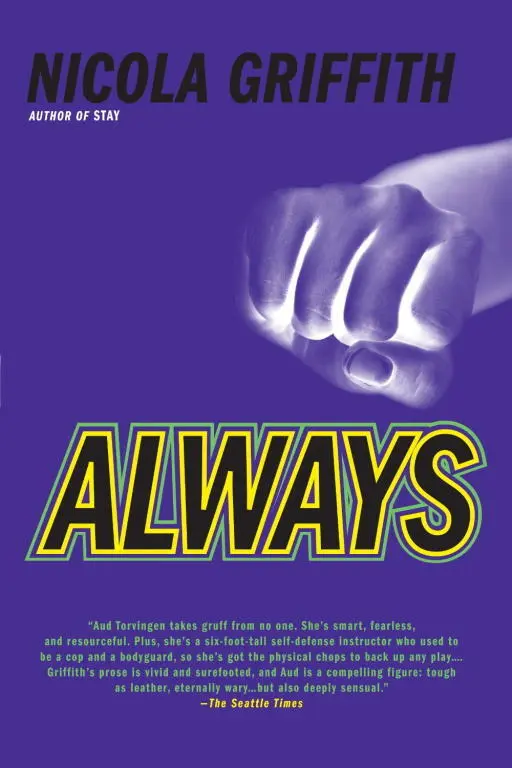
- Название:Always
- Автор:
- Издательство:Riverhead Books
- Жанр:
- Год:2007
- Город:New York
- ISBN:9781594482946
- Рейтинг книги:3 / 5. Голосов: 1
-
Избранное:Добавить в избранное
- Отзывы:
-
Ваша оценка:
Always: краткое содержание, описание и аннотация
Предлагаем к чтению аннотацию, описание, краткое содержание или предисловие (зависит от того, что написал сам автор книги «Always»). Если вы не нашли необходимую информацию о книге — напишите в комментариях, мы постараемся отыскать её.
) returns in an exhilarating new thriller. It doesn’t matter how well trained you are, how big, how fast, how strong; there will always be someone out there bigger or faster or stronger. Always. That’s what Aud Torvingen teaches the students in her self-defense class. But the question is whether Aud really believes this lesson herself-and if not, what it will take for her to learn it.
Aud has trained herself to achieve a fierce, machine-like precision, in hand-to-hand combat as well as life. But in Always she is abruptly confronted with the limits of her own power. Her self-defense classes spin violently out of her grasp and, still reeling from the consequences, she embarks on a seemingly simple investigation of Seattle real estate fraud that pulls her into something far more complicated and dangerous than she had imagined.
Always — читать онлайн бесплатно полную книгу (весь текст) целиком
Ниже представлен текст книги, разбитый по страницам. Система сохранения места последней прочитанной страницы, позволяет с удобством читать онлайн бесплатно книгу «Always», без необходимости каждый раз заново искать на чём Вы остановились. Поставьте закладку, и сможете в любой момент перейти на страницу, на которой закончили чтение.
Интервал:
Закладка:
Ahead of me, framed by sparkling water, a man threw a Frisbee for his red setter. The dog writhed impossibly up and up toward the sun and snapped the yellow plastic from the air and brought it to its owner, who threw it again. Over and over, joyously, tirelessly.
The breeze off the water was steady and strong. I climbed the hill by the water’s edge. At the top was a huge sundial. It took me a minute to work out how to tell the time and date, a task complicated by the fact that the clouds that had been on the horizon only an hour before now kept obscuring the sun. I wondered what kind of faith in the universe the artist must have had to create and build such a thing in Seattle. The city rose in a sheen of glass and chrome beyond the water, the Space Needle off to the right. Small craft plied to and fro. An arrowhead of geese sliced in to land, followed by a tiny seaplane. The sun came back out and the water turned navy blue, the various waves like cream lace. It looked like a sixties fantasy of what a science-fiction city of the future should look like, and I realized that that was the point, that this was a new kind of city for the New World, proud to show its history and heritage and dreams, even if that history was, to European eyes, sadly stunted.
I found a bench that looked down and across the water but was sheltered from the breeze. I took out Corning’s cell phone bill, wrote down the numbers that appeared more than once, and started calling.
“Hey, it’s Janice,” said a recorded voice. “I’m running errands but call me back, ’kay?” Janice: JB? No way of knowing. I tried the next number. “You have reached the law offices of Leith, Bankersen, and Heshowitz, how may I help you?” A male voice. Seattle had the highest number of male receptionists I’d ever come across. “What kind of law do you specialize in?” I asked him. “We are corporate tax specialists.” “Could I have the names of your principals?” “Certainly.” None of them matched the initials. The next number. No reply. The next. Another male voice, but this one an entirely different animal. “Thank you for calling the reelection campaign offices of Edward Thomas Hardy. I appreciate your support. I’m afraid all my lines are busy right now but your call is important to me, so please do leave your name and contact information, and I’ll try get back to you as soon as humanly possible.” Wordy. Like all elected officials. ETH. I circled the number.
I called the others, but got nothing of note.
I opened my laptop, hooked it to my phone, and while the networks sorted themselves out, I downloaded the calendar information from my flash drive, and read it thoroughly. Then I ran a Web search on Edward Thomas Hardy.
It was slow work, using the cell network, but eventually I started getting results.
He was a Seattle city councillor, running for reelection. He had started fifteen years ago as an environmental zealot and was now the current chair of the Urban Development and Planning Committee. He had been instrumental in pushing through several of the zoning changes on the South Lake Union biotech development. An image search turned up pictures of a worried-looking man in his late forties. White. Unexpectedly deep-set hazel eyes. ETH. And someone called JB had “got” him for a meeting with Corning next week.
The Seattle City Council website told me that, in addition to two councillors and two alternates, the zoning committee had three legislative assistants, one of whom was Johnson Bingley. JB.
Bingley turned out to be twenty-eight, recently married, and to have blond hair (and an expensive haircut) and a political science degree from UC Irvine. With a bit of work I turned up the abstract of his dissertation: a piece of nonsense about interstate politics that was all generalities in a blatantly cut-and-paste plagiaristic style. Bingo. Criminals looked for short-cuts. Entry-level politics were full of them.
I did another long, slow search to make sure Bingley was the only staffer with the initials JB. He was it. But ETH was his boss. The question now was, on which side of righteousness did ETH fall?
A cloud scooted away from the sun and I shaded my eyes. I closed the laptop and unhooked my phone, weighed it. I didn’t know whom to call, Kick or Dornan, and I didn’t know what I’d say if they answered.
I plugged it back in and started a deeper search on Edward Thomas Hardy.
I DROVE BACKup Myrtle, past Kick’s house. No van in the driveway. It was only midday, but traffic on 45th was almost stationary. It got hot in the car, but I didn’t want to roll up the windows and turn on the AC.
Traffic crawled over the bridge, and again through downtown. As I got closer to the warehouse my stomach tightened.
Kick’s van wasn’t in the parking lot. Where were they? What were they doing?
The set rang with the clang of hammer and wrench on metal pipe: people putting together a huge scaffold. It was hot. Joel hovered, looking worried, occasionally consulting what looked like a wiring diagram. Everyone—the costumers, Bernard, Peg—was carrying pipes, hauling on command, or standing back to admire the growing edifice.
There was no sign of Kick or Dornan, and the food on the craft-services table was conspicuously packaged sandwiches and a coffee urn with the lid taped down.
“Any idea where they are?” I said to Peg.
She put down her end of a piece of scaffold. “Where who are?”
“Kick. Dornan.”
“Dornan’s her friend?”
No, Dornan’s my friend. “How about Rusen?”
“Editing.”
“Where?”
“On the Avid.”
I said merely, “It’s probably a good idea to wear gloves when you do this kind of work.”
I went back out into the parking lot, to the trailer, and knocked. Traffic roared in the distance. I knocked again. The door opened. Hot, rebreathed air rushed out. Rusen blinked at me. He had that can’t-change-focus look of someone who has spent twelve hours sitting in one place staring at a screen. He hadn’t shaved for at least twenty-four hours. He’d had even less sleep than I had.
“May I come in?”
“May… ? Sure, sure.”
Inside, images were frozen on six screens. He sat on the chair in front of them, seemed momentarily confused when I remained standing.
“Something urgent?”
“Not urgent. But we do need to discuss your problems with OSHA and EPA.”
“Problems? Right. OSHA. EPA.” He focused on the screens, reached for the console, paused, hand above the big hockey-puck frame-by-frame advance control. “Do you mind if I just finish this…”
Scene? Act? Track? I had no idea. As soon as his hand touched the controls, he seemed to lose touch with his verbal centers. I looked around until I found a chair, rolled it over, and watched for a while.
He turned the big dial on the console, and one of the pictures would move forward. He’d dial it back, and forward again. He’d look at one of the other screens, punch a button, dial that back and forth. And another. Sîan Branwell stood and sat, stood and sat, stood and sat, turned and turned back, over and over. He muttered something to himself, chewed the cuticle on his right-hand ring finger, dialed again. Nodded. Punched other buttons. Ran one of the pictures again. The turn of her head was subtly different. Perhaps two frames missing before the screen cut to her beginning to stand, then back. Or—no, he had zoomed in. I didn’t know you could do that. It was like watching someone play God, rearranging time, making the puppets dance differently. It didn’t look as though he were going to stop anytime soon.
“Rusen.”
“Um?” He didn’t look at me.
“Rusen.” I leaned forward, laid a finger on the back of his hand. He blinked, focused on it. Blinked again. Looked at me. Reluctantly withdrew his hands from the console, tucked them under his thighs.
Читать дальшеИнтервал:
Закладка:
Похожие книги на «Always»
Представляем Вашему вниманию похожие книги на «Always» списком для выбора. Мы отобрали схожую по названию и смыслу литературу в надежде предоставить читателям больше вариантов отыскать новые, интересные, ещё непрочитанные произведения.







Обсуждение, отзывы о книге «Always» и просто собственные мнения читателей. Оставьте ваши комментарии, напишите, что Вы думаете о произведении, его смысле или главных героях. Укажите что конкретно понравилось, а что нет, и почему Вы так считаете.