Nicola Griffith - Always
Здесь есть возможность читать онлайн «Nicola Griffith - Always» весь текст электронной книги совершенно бесплатно (целиком полную версию без сокращений). В некоторых случаях можно слушать аудио, скачать через торрент в формате fb2 и присутствует краткое содержание. Город: New York, Год выпуска: 2007, ISBN: 2007, Издательство: Riverhead Books, Жанр: Триллер, на английском языке. Описание произведения, (предисловие) а так же отзывы посетителей доступны на портале библиотеки ЛибКат.
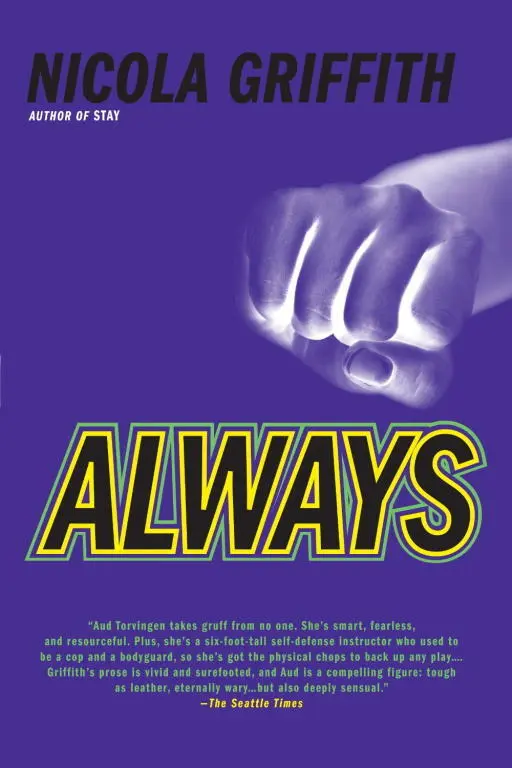
- Название:Always
- Автор:
- Издательство:Riverhead Books
- Жанр:
- Год:2007
- Город:New York
- ISBN:9781594482946
- Рейтинг книги:3 / 5. Голосов: 1
-
Избранное:Добавить в избранное
- Отзывы:
-
Ваша оценка:
Always: краткое содержание, описание и аннотация
Предлагаем к чтению аннотацию, описание, краткое содержание или предисловие (зависит от того, что написал сам автор книги «Always»). Если вы не нашли необходимую информацию о книге — напишите в комментариях, мы постараемся отыскать её.
) returns in an exhilarating new thriller. It doesn’t matter how well trained you are, how big, how fast, how strong; there will always be someone out there bigger or faster or stronger. Always. That’s what Aud Torvingen teaches the students in her self-defense class. But the question is whether Aud really believes this lesson herself-and if not, what it will take for her to learn it.
Aud has trained herself to achieve a fierce, machine-like precision, in hand-to-hand combat as well as life. But in Always she is abruptly confronted with the limits of her own power. Her self-defense classes spin violently out of her grasp and, still reeling from the consequences, she embarks on a seemingly simple investigation of Seattle real estate fraud that pulls her into something far more complicated and dangerous than she had imagined.
Always — читать онлайн бесплатно полную книгу (весь текст) целиком
Ниже представлен текст книги, разбитый по страницам. Система сохранения места последней прочитанной страницы, позволяет с удобством читать онлайн бесплатно книгу «Always», без необходимости каждый раз заново искать на чём Вы остановились. Поставьте закладку, и сможете в любой момент перейти на страницу, на которой закончили чтение.
Интервал:
Закладка:
While she pushed her arms into the sleeves and tugged I watched the sky. The clouds had grown denser, firming from Styrofoam to incised stone, subtly colored, chiseled and layered and polished. “It’s beautiful,” I said.
She buttoned with her left hand, laid her right on my thigh. “Isn’t Atlanta like this?”
I shook my head. “In Atlanta, in May, the sky is always blue. Later in summer there are storms in the afternoons, and for an hour or so there are clouds overlaying a sky the color of pink grapefruit, but this… it’s like intaglio-cut stone.” I pointed. “There. Mica. And amethyst. Rose quartz. Carnelian, and, look, see that grey? That’s what natural, uncut diamond looks like.”
“Kiss me,” she said.
I did, and I wrapped my hands around her tiny waist, then slid them around the swell of her hips, pulled her to me. Her bottom was warm and luscious. I cradled her cheeks, ran my hands back to her waist, dipped my fingers under her waistband. Our mouths were wide. Another tug hooted.
I looked at the grass, decided there were too many goose droppings, and sighed.
She pulled away, grinning, as though she knew what I was thinking. “Oh, well,” she said, “nice park anyway.”
“Glad you like it.”
“I had no idea it was here. Be nice if it was more private, though.” She laughed to herself as she straightened her clothes.
“There’s a woman called Corning who wants to pave all this over with condos.”
“Will you buy one?”
“No.” She shivered again, and I put my arms around her. “Because I’m not going to let her build them.”
She started kissing me again, then stopped. “What time is it?”
“About four o’clock, I think.”
“Shit. I have a—I have to run.” She kissed me again. “Meet you at the house? Around seven?”
AT AIKIDO,the sensei wasn’t there. Mike was leading the class. It was informal and boisterous. I made people fly, and flew in my turn.
Afterwards, as we swept and wiped the dojo, Mike and Petra separately invited me to the Asian Art Museum to see a new display of Chinese art— Mike in a whatever kind of way, and Petra shyly. I declined but suggested they go together, and managed not to smile at their consternation.
THE HOUSEcooled and darkened. We lay under her duvet. My face hurt from smiling. She butted my hand, like a cat; I stroked her head. There were no lights on in the house, and in the long, northern dusk her hair gleamed, dark and light, layered, sometimes pale and silvery like bamboo pith, sometimes heavy and dark, like freshly split pine. “Wood,” I said. “That’s what your hair reminds me of.”
“You think my hair’s like wood?”
“I love wood.” I rolled onto my stomach and stroked her hair, over and over, rounding over the back of her head, feeling the sleekness, like the oak finial of a three-hundred-year-old baluster that has been polished by twelve generations of hands. Figured oak. That was it, exactly.
She rolled onto her stomach, too, so that we were lying next to each other like eight-year-olds looking over the edge of a cliff. “So you know a lot about wood, and about herons and oysters. You didn’t learn that in the police.”
“I wasn’t always in the police.” And I told her of growing up in Yorkshire and on the fjord, in London and in Oslo, while my mother worked her way up the political and diplomatic ladder. Of my travels in the wild parts of the world, working on my cabin in North Carolina: the trees, the birds, the wood.
“It sounds beautiful,” she said. “My parents had a cabin in the North Cascades. It was hot and dusty—dust everywhere. Jesus. It’s basically a desert out there. But that’s where I learnt to ride. Do you ride?”
“I do.”
“English saddle, though, I bet.”
“That’s how I learnt. But I can ride western.”
“I can ride anything. With or without a saddle.”
I can cook anything. I can ride anything. Simple statements of fact. “Even bulls and broncos?” I stroked the small of her back, very gently, running my palms over the tiny hairs there.
“Anything. When I was a kid, I did stunt riding of things like ostriches and goats and llamas. I’ve ridden elephants and alligators and, once, even a very large dog.”
Her backbone was entirely sheathed in smooth muscle. I ran my fingertips down the soft skin. The slanting light threw fillets of muscle into sharp relief. What Kick was saying suddenly registered, and I paused. “When you were a child?”
“It’s a family thing. My mother did stunts. My uncles do stunts. One of my brothers is a stunt rigger. My sister did makeup. My father, in case you’re wondering, is in trucking. How old were you when you learned to ride?”
“Eight. Or maybe nine.”
Downstairs her phone began to ring.
“Pony or horse?” The machine beeped, and someone with a deep voice started leaving a message.
I thought about it. “Pony, I suppose.”
“You suppose? What was his, or her, name?”
“I haven’t a clue.” The voice stopped and the phone machine beeped again.
“You must remember. That moment when… You really don’t remember? ”
“I don’t really remember learning things.” I cast my mind back to being a girl, nine, on a pony on the moors; twelve, my mother and the WAR study; a year or so later in Yorkshire’s West Riding, a horse. “Judy,” I said. “One of my horses was called Judy. When I was twelve or thirteen. She was a hunter. Fifteen hands. Her mane was very pale. A bit like yours.” I ran my hands through her hair. “Yours feels better.” I pushed it away from the back of her neck, which I kissed, then some more, and swung my leg over her so that now I sat in the small of her back, like a soft saddle.
“Um,” she said. I reached around and took a plump breast in each hand. She groaned and began to move.
LATER,she said, “Let’s eat pizza.”
When she went downstairs to find the number, I wrapped myself in a sheet and stood by the window. Eastwards, the radio towers on Queen Anne Hill blinked with red navigation lights. I heard her taped voice in the background, then the beep and deep voice of the replayed message. The sun was setting on the other side of the house, drenching the western slope. The stairs creaked as she came back up.
“You’re doing that noble statue thing again,” she said. She wrapped her arms around me from behind, rested her head between my shoulder blades. “What’s so interesting?”
I nodded at the hill, at the sunset reflecting from the windows on Queen Anne in the growing dusk. “They look like campfires. Like an army camped in the hills above Troy.”
Her arms were tight. We stood there a long time. I wondered who had left the message.
Eventually, she stirred. “Get dressed,” she said. “It turns out I have an early appointment tomorrow, so I’m going to kick you out after we’ve had pizza.” She smiled, but it was brief and distracted. “We’ll do something tomorrow. ”
“Good.”
“But I don’t know my schedule. I’ll call you.”
APRIL. OUTSIDE, NUTHATCHES SANG AND AZALEAS BLAZED ON EVERY LAWN. INSIDE, we all sat on the scratchy blue carpet that smelled less new now, and ten women stared at their copy of the list of general pointers, specific dos and don’ts and miscellaneous hints I’d given them the week before Lake Lanier.
I knew the list. I looked at the women. We’d had a week of solid sunshine since I’d seen them in their bathing suits. A few—Suze, Therese, Nina—were showing the first hint of the gilding common to middle-class Atlanta white women in summer. Many were in short sleeves. Sandra wore short sleeves for the first time, too; things must be going through one of those periodic honeymoon periods at home. She felt me looking at her— she had the sensitivity of a prey animal—and looked back. Her eyes did that brilliant shining thing, trying to share some message that couldn’t be put into words, and I made a mental note to visit Diane at the Domestic Abuse Alliance sometime in the next couple of weeks and chat. From my early days in uniform I knew that simply asking Sandra would send her scuttering back into her burrow, but whatever she was trying to tell me was getting more urgent.
Читать дальшеИнтервал:
Закладка:
Похожие книги на «Always»
Представляем Вашему вниманию похожие книги на «Always» списком для выбора. Мы отобрали схожую по названию и смыслу литературу в надежде предоставить читателям больше вариантов отыскать новые, интересные, ещё непрочитанные произведения.







Обсуждение, отзывы о книге «Always» и просто собственные мнения читателей. Оставьте ваши комментарии, напишите, что Вы думаете о произведении, его смысле или главных героях. Укажите что конкретно понравилось, а что нет, и почему Вы так считаете.