Nicola Griffith - Always
Здесь есть возможность читать онлайн «Nicola Griffith - Always» весь текст электронной книги совершенно бесплатно (целиком полную версию без сокращений). В некоторых случаях можно слушать аудио, скачать через торрент в формате fb2 и присутствует краткое содержание. Город: New York, Год выпуска: 2007, ISBN: 2007, Издательство: Riverhead Books, Жанр: Триллер, на английском языке. Описание произведения, (предисловие) а так же отзывы посетителей доступны на портале библиотеки ЛибКат.
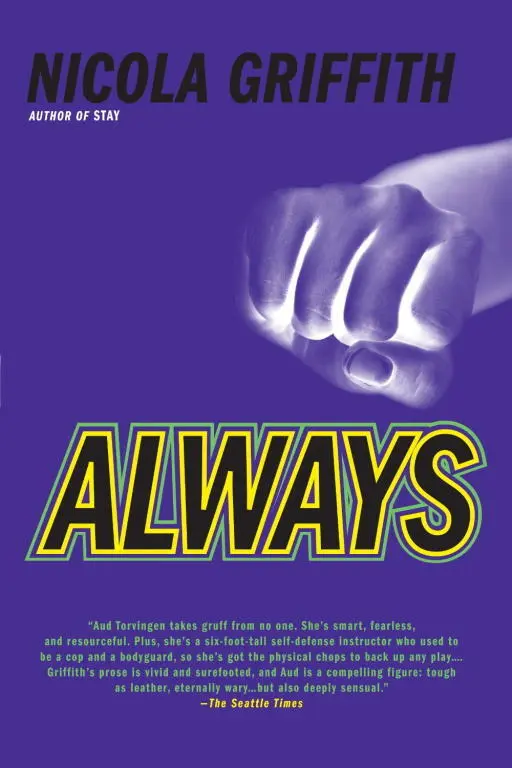
- Название:Always
- Автор:
- Издательство:Riverhead Books
- Жанр:
- Год:2007
- Город:New York
- ISBN:9781594482946
- Рейтинг книги:3 / 5. Голосов: 1
-
Избранное:Добавить в избранное
- Отзывы:
-
Ваша оценка:
Always: краткое содержание, описание и аннотация
Предлагаем к чтению аннотацию, описание, краткое содержание или предисловие (зависит от того, что написал сам автор книги «Always»). Если вы не нашли необходимую информацию о книге — напишите в комментариях, мы постараемся отыскать её.
) returns in an exhilarating new thriller. It doesn’t matter how well trained you are, how big, how fast, how strong; there will always be someone out there bigger or faster or stronger. Always. That’s what Aud Torvingen teaches the students in her self-defense class. But the question is whether Aud really believes this lesson herself-and if not, what it will take for her to learn it.
Aud has trained herself to achieve a fierce, machine-like precision, in hand-to-hand combat as well as life. But in Always she is abruptly confronted with the limits of her own power. Her self-defense classes spin violently out of her grasp and, still reeling from the consequences, she embarks on a seemingly simple investigation of Seattle real estate fraud that pulls her into something far more complicated and dangerous than she had imagined.
Always — читать онлайн бесплатно полную книгу (весь текст) целиком
Ниже представлен текст книги, разбитый по страницам. Система сохранения места последней прочитанной страницы, позволяет с удобством читать онлайн бесплатно книгу «Always», без необходимости каждый раз заново искать на чём Вы остановились. Поставьте закладку, и сможете в любой момент перейти на страницу, на которой закончили чтение.
Интервал:
Закладка:
Funktionslust, the handy German word for enjoying what you do well. “I showed you four ways to deal with a one-handed front strangle, and you’ll have found that one of those techniques feels better to you than any of the others. Jennifer”—she straightened—“liked the little-finger move.
And Christie was good with the arm trap. Therese also liked the little-finger, but Suze preferred hitting the outside elbow. Sandra, on the other hand, liked coming up inside the elbow. The rest of you probably need to practice all four a few more times until you find the one that works best, the one that will spring instantly to mind if someone wraps his or her hand around your neck.”
Tonya and Christie both touched their necks.
“I could show you two dozen variations on how to deal with a strangle-hold—”
“Which is your favorite?” Christie said.
Information is power. But I’d started this.
“The trap, followed by an elbow drive to their nose or throat.”
“How come?”
“Because it works on a front or back strangle, one- or two-handed. It’s flexible, adaptable. But also… because being strangled is personal.” I had a sudden image of Sandra, coming up inside the strangle of a shadowy figure, with that upward strike, putting her face close to her strangler’s. “The pin traps them instantly, so they feel how I just felt.” Me, the imaginary Sandra said. See the face of the one you would hurt. The one who is fighting back. I am real. “The elbow strike is a very strong blow. It says, you can never do that to me again.”
Sandra paled and her pupils expanded briefly. Fear, lust, hatred? I couldn’t tell.
I tried to remember what I was saying. “No one knows everything. You don’t have to. In these weeks I want you to learn one or two things thoroughly, your own things, not mine. Things that you will practice until they are muscle memory, until someone can touch your throat, even by mistake, and your muscles know instantly what to do. No,” I said, as Katherine opened her mouth, “it doesn’t mean you’ll be attacking your hairstylist by mistake if she touches your neck. It means you’ll know how when you need it, that’s all.”
Kim flicked her nails and Suze frowned.
“It’s like mathematics.”
“Oh, that’s just great,” Pauletta said.
“Yeah,” Suze said. “Math sucks the big fat one.”
“No. It’s part of how you think. It’s automatic. You use arithmetic every day. How many are there of us sitting here? It’s second nature. But do you remember how hard it was when you started in…” For a moment my brain stumbled trying to convert to the American educational system “…in kindergarten or first grade? Self-defense is like that. You don’t need to learn astral physics, you don’t need non-Euclidean geometry, you just need arithmetic.”
“Or a calculator,” Nina said.
“How many of you need a calculator when you’re in the supermarket? You look at the prices on the meat counter. You know whether you can afford steak or if you have to get hamburger. You know it without laborious calculation, because arithmetic is second nature. Now, on your feet.”
Moans and groans. But they all stood up.
“Partner with someone different. Try all four strangle breaks. Pick your favorite. Practice that three times, swap roles. Fifteen minutes.”
I walked around the practice circle, reminding them about a tucked chin here, an elbow placement there. They were learning. Some, like Therese, were sucking up every physical technique I could throw at her. Some, like Tonya, were beginning to seriously connect the dots, but even those like Jennifer and Pauletta, who thought they knew nothing, were light-years past the place they had been two months ago.
I walked the circle again. Everyone now had their favorite. Six of them liked the little-finger. It didn’t surprise me. It was a small move, a woman’s move, one for which no judge or police officer or spouse would ever blame or fear them if they had to use it against the bogeyman.
After fifteen minutes, we were all sitting again.
“We’ll finish with an item from the list. The last page. Yell fire, not help or rape. Studies have shown that bystanders, neighbors, are far more willing to call for help if they don’t think there’s malice involved. Fire is a natural disaster. They won’t feel as though they’re ‘interfering’ in a domestic dispute if you yell for them to call nine-one-one. Next: be specific. People in groups default to the lowest common denominator.”
“More math!” Nina said, and they all groaned.
When I was ten, Mrs. Russell, the equivalent of my fourth-grade teacher, had marched to the blackboard and written, in very large letters, The square on the hypotenuse equals the sum of the opposite squares, then put the chalk back on the lip of the blackboard and waited. No one said anything. After about two minutes of silence, an eternity in the world of ten-year-olds, she said, “Does anyone know what that means?” We were used to Mrs. Russell being kindly and approachable, adapting her explanations to the meanest understanding, but that day she was terrifying. Perhaps she’d had a hard day, perhaps she’d been inspired by some new teaching theory to try an experiment. None of us dared say anything. “Your job,” she said, “is to find out what that means.”
I had responded by writing the sentence carefully in my blue-lined notebook, The square on the hypotenuse… and then staring at it, as though by focusing my mind I could get beneath the atoms of the paper surface—I had recently encountered the notion of atoms—and swim lusciously in the flow of understanding beneath. But all that eventuated was a headache.
In retrospect, it was clear that Mrs. Russell had wanted to shock us into a state of inquiry, to lead us to the idea of looking things up: to open a dictionary, look up hypotenuse, ask her what “sum of ” meant, something, anything, but to just begin, to demonstrate that one of us had a particle of scholar in our blood, that her life had not been a total waste.
Mrs. Russell had been disappointed that day.
“Crowds,” I said. “Think of soccer hooligans, religious mobs, people gawping at car accidents. No one does anything. Why?”
Therese folded her arms. She never liked it when I pointed out unpleasant human traits.
“Groups of people need leaders. It’s a human response; most of us immediately want someone else to take responsibility, particularly in a new or frightening situation. So if you ever get knocked to the ground, or are in a car accident, and a crowd gathers and stares at you moon-faced, you’re going to have to direct them. You don’t say, ‘Someone, get help,’ you say, ‘You—yes, you—in the red shirt, call nine-one-one, and you, in the blue shoes—yes, ma’am, you with the barrette—please bring me a blanket.’ You pick specific people and give them specific tasks. You’ll find that once the crowd stirs to help, others will work out what to do on their own initiative. But don’t discount that initial inertia.”
“You’re saying treat them like children?” Kim said. “Jimmie, carry those dishes to the sink; Junie, wipe the table. Like that?”
“Yes.”
“That I can do,” she said.
For the first time this week, nods all round. “Good. What else? Nothing? ” We had five minutes left. “Stand up. We’ll work a bit more with joint locks.” They got up one by one. I realized it was warm. I went to the air-conditioning unit jammed high in the outside wall and thumped the plug. The fan started to turn reluctantly. “Joint locks are most—”
“The thing on the list I don’t understand,” Sandra said, still sitting, “is the one that says, ‘If they abuse you, make them stop.’ ”
Читать дальшеИнтервал:
Закладка:
Похожие книги на «Always»
Представляем Вашему вниманию похожие книги на «Always» списком для выбора. Мы отобрали схожую по названию и смыслу литературу в надежде предоставить читателям больше вариантов отыскать новые, интересные, ещё непрочитанные произведения.











Обсуждение, отзывы о книге «Always» и просто собственные мнения читателей. Оставьте ваши комментарии, напишите, что Вы думаете о произведении, его смысле или главных героях. Укажите что конкретно понравилось, а что нет, и почему Вы так считаете.