Matthew Pearl - The Poe Shadow
Здесь есть возможность читать онлайн «Matthew Pearl - The Poe Shadow» весь текст электронной книги совершенно бесплатно (целиком полную версию без сокращений). В некоторых случаях можно слушать аудио, скачать через торрент в формате fb2 и присутствует краткое содержание. Жанр: Исторический детектив, на английском языке. Описание произведения, (предисловие) а так же отзывы посетителей доступны на портале библиотеки ЛибКат.
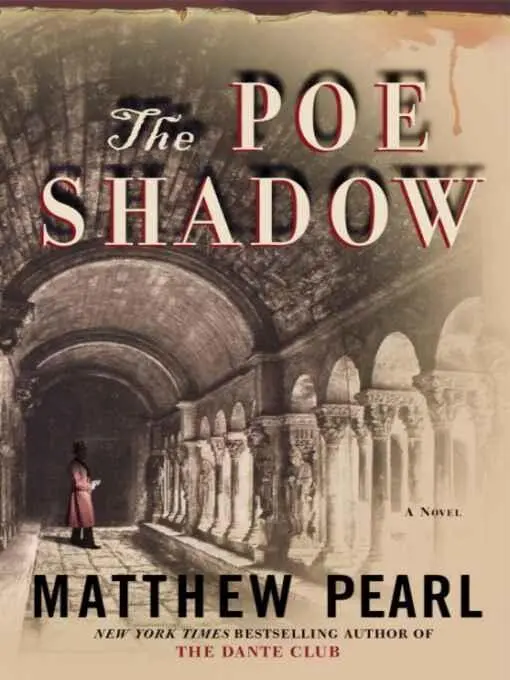
- Название:The Poe Shadow
- Автор:
- Жанр:
- Год:неизвестен
- ISBN:нет данных
- Рейтинг книги:5 / 5. Голосов: 1
-
Избранное:Добавить в избранное
- Отзывы:
-
Ваша оценка:
The Poe Shadow: краткое содержание, описание и аннотация
Предлагаем к чтению аннотацию, описание, краткое содержание или предисловие (зависит от того, что написал сам автор книги «The Poe Shadow»). Если вы не нашли необходимую информацию о книге — напишите в комментариях, мы постараемся отыскать её.
Poe was supposed to be almost anywhere other than Baltimore: he was traveling from Richmond to New York with a planned stop in Philadelphia, not Baltimore. No one knows how he came to be in the city – or, for that matter, how he ended up at the tavern. For some of us, this pretty much describes a really great Saturday night, but when it happens to the master of darkness, just days before his untimely death, it has the makings of a mystery.
Pearl takes us back to those few lost days through the inquiries of Quentin Clark, a Poe-mad young Baltimorean who is dismayed not just by the writer's death but by the press's apathetic reponse to the news. Clark takes it upon himself to look into matters and rectify this slight to his hero. The trouble is, Clark is a stock character from the world of commercial thrillers: a man with a lot to lose, imperiled by his own obsession. Engaged to a beautiful young woman, the son of wealthy and very proper parents and pursuing a career as a lawyer, he may sacrifice them all to his devotion to Poe.
Clark haunts the writer's grave, visits the hospital where he lay dying and tracks down the Poe cousins. But wherever he turns, he's met with indifference or outright obstruction. Finally, in desperation, he turns to another source of information: the pages of a book. Clark has always admired Poe's "Murders in the Rue Morgue" and the other mysteries featuring C. Auguste Dupin, the brilliant Frenchman who solves crimes too baffling for the Paris police. "Dupin's reasoning followed a method Poe called ratiocination," Clark reminds himself, "employing one's imagination to achieve analysis, and one's analysis to climb the heights of imagination."
When Clark stumbles on a newspaper item suggesting that Dupin was based on a real Frenchman, he promptly takes off for the Continent. Of course, there turns out to be more than one candidate for this honor, and soon a couple of testy Frenchmen are racing back to America, eager to snatch whatever glory they might from Poe's death.
Baroquely orchestrated complications ensue, up to and including a threat to the future of the French republic. As he demonstrated in his serial-killers-and-philosophers best seller, "The Dante Club," Pearl is a fine scene-setter and a resolute, if not always inspired, plotter. "The Poe Shadow" is thick with intrigue and thicker still with carefully researched (and ostentatiously displayed) details.
Pearl, who taught literature at Harvard before embarking on his literary career, sometimes displays a wonderfully knowing tone, and enjoys playing with 19th-century lingo. When a Baltimore police officer asks Clark if he has a wife and is told that he has a fiancée, the officer warns: "You should have much to occupy yourself without needing to think of this unhappy affair, then. Or your sweetheart might give you the mitten." Sadly, Pearl's plot is not all sweethearts and mittens.
With its bewildered narrator and its attempt to marry the rational and the spooky, "The Poe Shadow" seems to be modeled on Poe's own writing, but it's missing a crucial element: brevity. Although Pearl has a real affinity for 19th-century America, he overwhelms the strengths of his book with a hurricane of ersatz Victorian prose. He doesn't just disinter Poe's story; he disinters the language of Poe's time. After a while, you feel like you're trapped in a sepia-toned faux-daguerrotype. Pearl has created a museum rather than a world. And no one lives in a museum.
The Poe Shadow — читать онлайн бесплатно полную книгу (весь текст) целиком
Ниже представлен текст книги, разбитый по страницам. Система сохранения места последней прочитанной страницы, позволяет с удобством читать онлайн бесплатно книгу «The Poe Shadow», без необходимости каждый раз заново искать на чём Вы остановились. Поставьте закладку, и сможете в любой момент перейти на страницу, на которой закончили чтение.
Интервал:
Закладка:
"Leave him!" ordered Dupin. Then, to me: "Next time, perhaps, we shall meet somewhere more congenial to our mutual interests, without such flusterations! In the meantime, go and seek glory, Brother Quentin!"
Yes. I am aware it will seem fantastic to readers that these were Dupin's words even while he was presently being fired upon and his chief henchman had just now been killed and he was climbing up this ditch, but I report it only as it happened.
I raised my head to watch. All at once, I felt myself tackled and pulled down hard. My body crumpled to a heap, and I looked up to see that Bonjour had thrown herself over me. She held one of my arms down with her hand. Imagining Hattie watching me, and feeling a pang of guilt and temptation, I tried to wriggle away from under her but could not. I could not help shudder at the lightness but immovability of her body.
"Stay down," she said in English. "Even once I leave. Understand?"
I nodded.
She then pushed herself up and followed the Baron into their carriage without looking at me again. Their horses burst onto the path through the fortifications. After a few minutes, the trampling hoof-falls and rolling wheels of another carriage boomed along the fortifications. There followed more blasts of gunfire in the direction of the Baron's escaping carriage. I covered my head with my arms and did not stir as splinters of rock rained down from all directions.
My deliverance appeared in the form of a hired coach of German visitors who had come to see the fortifications; they kindly permitted me to ride back with them to Paris.
Of course, part of me wanted to run straight to Duponte and tell him all about what had happened. But it would be of no use. If my encounter with Claude Dupin made me realize something, it was that all had become jumbled. The true analyst would not help for any price, and a charlatan like this "Baron" was too willing to pretend to help for a little money. I would do just as well never to see Auguste Duponte again.
It turned out that the guide from Versailles had been correct about the police agents' monitoring my residence in Paris. Shortly after that episode, my supply of cash dwindled and I moved to a less expensive lodging house. Upon arriving, I found two police officers waiting very politely to record my new address.
It was only two days later that my decision to avoid Duponte changed, while I was sitting and having my boots blacked. With that distinct French politeness, the owner of the blacking shop had bowed slightly, alerting me to the fact that my boots were dusty. I had picked up a newspaper. There was a large looking-glass situated right behind the bench so the owner could see the paper as he blacked his customer's shoes. I had heard it said that a certain species of boot-blacker in Paris had over the years learned to read newsprint backward to keep away boredom. I did not believe that anyone could develop such a skill of understanding words so twisted around. Not until that day.
I hurried through the pages quickly but was interrupted by the boot-blacker.
"Turn back a page, kind monsieur? Is it Claude Dupin in Paris again? He is dogged more fiercely in Paris than any animal in the forest. That is what they say."
On this word, I turned the pages back to an astounding item, a paid notice:
Renowned attorney and solicitor Claude Dupin, having never lost a law case in his career, has been enlisted by some of the first citizens of America [ I suppose that meant me ] to solve the mystery surrounding the death of that country's most beloved and brilliant genius of many literary treats-Edgar A. Poe. Claude Dupin was the basis and namesake, furthermore, for the famous character of "Dupin" from the tales of Mr. Poe, including "Les Crimes de la Rue Morgue," a story known widely in both English and French tongues. Obligated to honor this connection, Claude Dupin has left for the United States and in exactly two months from this day in the year 1851, he will have resolved the enigmatic circumstances of Poe's death completely and with all finality. Monsieur Dupin will return to Paris, the city of his birth, after being lavishly heralded and rewarded as a new hero of the New World…
I felt a lump rise in my throat. I had to get back to Duponte immediately.
I could not leave the continent with Duponte believing I had betrayed him by enlisting Claude Dupin, as he would surely think if he read that notice. Indeed, he could not fail to connect the matter with me. Even some of the language in the paper was my own, having been purloined by the Baron directly from my letters. I only hoped he had not seen it. I directed my carriage driver to Duponte's lodgings and rushed through the gates and past the concierge's chamber.
"Hold there! You!" The concierge swiped his hand at me but missed. I took the stairs two at a time. I found Duponte's door open but nobody inside.
The gaslight over his bed smelled as though it had just been lately lighted, and there in the center of his bed was a newspaper. It was La Presse -a different newspaper than the one I had read at the boot-blacker's stand-but it was opened to the very same notice. Other objects, papers and articles, had been pushed to the bottom of the bed. I imagined Duponte had sat down slowly, clearing the always-crowded surface of his quilt with one hand and clenching the article in his other, his eyes filling with-what would it have been to see this? Rage? Bitterness?-as he read about the recruitment of Baron Dupin. He had already convicted me of betrayal.
"Monsieur!" The concierge had appeared at the door.
"You! I will hear nothing from you!" I shouted, prodded by the anger I felt at Baron Dupin. "I am leaving Paris today, but I must and shall find Auguste Duponte first. You will tell me where he has gone at once, or you shall have me to face!"
He shook his head no, and I almost flung my fist into his chin before he explained. "He is not here," he panted. "Inside, I mean! Monsieur Duponte has left, with his baggage."
After further questioning, I learned that the concierge had assisted Duponte only minutes before with bringing his baggage into the courtyard. This after Duponte had studied the poisonous newspaper notice of the devious Baron. The treachery Duponte surely imagined from me had driven him to a melancholy so overwhelming that he could no longer remain in his place. I looked from the apartment's windows for any sign of him before descending.
Driving away from the boardinghouse was a carriage that I could see was loaded above with baggage. I cried out without success for the coach to return but could only throw up my hands limply as it passed into the street. What a surprise when I found no sign of my own coach and driver-whom I had ordered to wait. Stewing over this final insult, I was jarred by seeing that Duponte's coach was driving back-and that it was not Duponte's coach at all; well, he sat inside and his baggage wobbled on top, so now it was his, but it had been my driver and my carriage.
The horses stomped to a halt in front of me.
"Just wanted to turn the horses around to pull away easier, monsieur," the driver said to me, "so we'd not lose time."
He climbed down and opened the door opposite Duponte's, but first I had to see him. I walked to Duponte's side and opened his door. The analyst sat with a fixed gaze. Had the Baron Dupin's deceitful claims on C. Auguste Dupin's character finally affected him in a way none of my enticements or rewards could?
"Monsieur Duponte, does this mean…are you…?"
"You'll be late," shouted the driver, "for the train to your ship, monsieurs. You'll lose your passage. Come in, come in!"
Duponte nodded to me. "Now it is time," he said.
10
Интервал:
Закладка:
Похожие книги на «The Poe Shadow»
Представляем Вашему вниманию похожие книги на «The Poe Shadow» списком для выбора. Мы отобрали схожую по названию и смыслу литературу в надежде предоставить читателям больше вариантов отыскать новые, интересные, ещё непрочитанные произведения.








Обсуждение, отзывы о книге «The Poe Shadow» и просто собственные мнения читателей. Оставьте ваши комментарии, напишите, что Вы думаете о произведении, его смысле или главных героях. Укажите что конкретно понравилось, а что нет, и почему Вы так считаете.