Махи Бинбин - Marrakech Noir
Здесь есть возможность читать онлайн «Махи Бинбин - Marrakech Noir» весь текст электронной книги совершенно бесплатно (целиком полную версию без сокращений). В некоторых случаях можно слушать аудио, скачать через торрент в формате fb2 и присутствует краткое содержание. Город: New York, Год выпуска: 2018, ISBN: 2018, Издательство: Akashic Books, Жанр: Детектив, на английском языке. Описание произведения, (предисловие) а так же отзывы посетителей доступны на портале библиотеки ЛибКат.
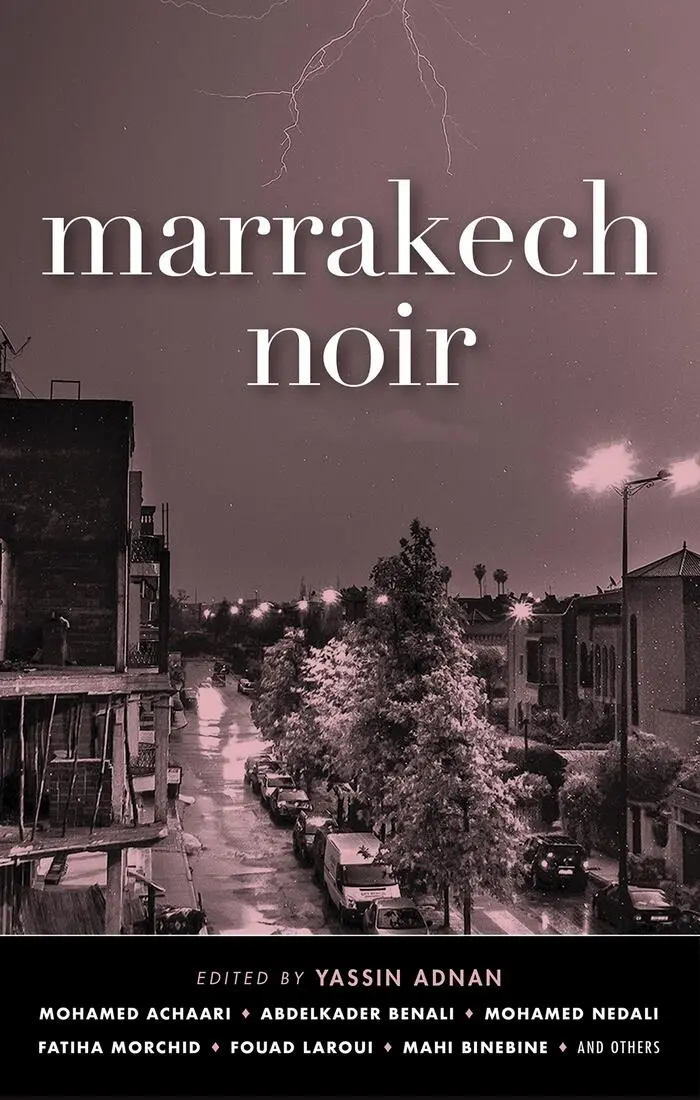
- Название:Marrakech Noir
- Автор:
- Издательство:Akashic Books
- Жанр:
- Год:2018
- Город:New York
- ISBN:978-1-61775-473-9
- Рейтинг книги:5 / 5. Голосов: 1
-
Избранное:Добавить в избранное
- Отзывы:
-
Ваша оценка:
Marrakech Noir: краткое содержание, описание и аннотация
Предлагаем к чтению аннотацию, описание, краткое содержание или предисловие (зависит от того, что написал сам автор книги «Marrakech Noir»). Если вы не нашли необходимую информацию о книге — напишите в комментариях, мы постараемся отыскать её.
Marrakech Noir — читать онлайн бесплатно полную книгу (весь текст) целиком
Ниже представлен текст книги, разбитый по страницам. Система сохранения места последней прочитанной страницы, позволяет с удобством читать онлайн бесплатно книгу «Marrakech Noir», без необходимости каждый раз заново искать на чём Вы остановились. Поставьте закладку, и сможете в любой момент перейти на страницу, на которой закончили чтение.
Интервал:
Закладка:
In the summer we sell jujubes to the tourists visiting the shrine. It’s the same fruit we give to children instead of candy, and we also use it to treat coughs. In almost all our families we make it into a jelly that we store for the winter. Summertime is the season we love the most. There’s the school vacation, and we also earn good money. We pick the fruit in the Bab Ghmat Cemetery and sell it near the sanctuary in the afternoon.
Our mornings aren’t without fun. The cemetery becomes our playground, the ideal setting for our favorite game: hide-and-seek. An endless number of hiding places offer themselves to the connoisseur of this place. There are wild plants and jujube trees sometimes as tall as men, graves exposed by erosion and deep craters of mysterious origin. You would think meteorites had carved them out.
We have a tacit agreement never to let pieces of the dead lie around outside their graves. As soon as we find a shoulder blade, a tibia, a fibula, a phalanx, a rib, a skull, or any bone of the human body, we bring it to a designated hole in the ground that must be either an emptied grave or one of those craters of the necropolis. We have no idea who left the first bone in this place, but we continue to repeat the gesture as if it were our duty, a religious act or a ludicrous rite of passage for frequenters of the cemetery.
Here, in the summer, we become freer than in any other place. We roam the cemetery’s overgrown pathways, doing things we can’t do anywhere else: chasing stray dogs, talking to birds, masturbating in groups. We indulge in secret eccentricities, no longer inhibited by traditions and rules we don’t understand.
This is also the time of the year when we go to el-Hilal cinema. After the mausoleum closes we return home for dinner, bringing a watermelon, a cantaloupe, some peaches, or any other seasonal fruit, or simply a few dirhams to slip into our mothers’ hands. This contribution is obligatory as soon as we start to earn money. What we give to the household is always proportional to what we’ve made. After dinner we’re free to come and go as we please. When you’re a son of Sidi Youssef Ben Ali, you can revel in your freedom day and night. Usually we go in groups to see the double feature — most often kung fu and Bollywood movies — but if we’re short on cash we can resell our ticket to some other penniless filmgoer after the first show, and go out and buy a snack.
Once I went with some friends to the late-night screening and, bizarrely, a different sort of film was showing that night. It was Frankenstein; or, The Modern Prometheus by Stefano Massini, based on the Mary Shelley novel. The story tells of Dr. Frankenstein, who creates a grotesque monster without a name or a family, a being built from the parts of several corpses, one who revolts against his maker and becomes capable of terrible crimes.
We didn’t need much French in order to understand the film; the images were eloquent enough on their own. We watched the events unfold before us, hunching forward in our seats. At the moment when the monster runs straight toward the camera and seems to want to jump through the screen, the electricity cut out. Voices rang out from all around the room — cries of protest at first, but then of fear and panic. We had no idea what was happening. Had the monster in fact come out from behind the screen to spread all this chaos and confusion, or was it the terror the film had awoken in us that made it seem so? We were used to these prolonged blackouts in Sidi Youssef Ben Ali — they often happened at wedding ceremonies and other important occasions, but never had a blackout seemed as strange to me as at that moment. I clung to a friend and tried to follow the line of spectators weaving their way through the crowd to the exit. I jumped at the slightest contact with other people, and could sense that my friend did too.
The next morning, as usual, we started the day by picking jujubes. We were hard at work when a friend came by to tell us that the bones we’d recently collected in the crater had disappeared. We stared at each other in silence. Cinema el-Hilal was directly opposite the Bab Ghmat Cemetery. We of course assumed the film must somehow be connected to the disappearance of the bones. Had they been cobbled together, like Dr. Frankenstein’s body parts, to form a single being? Or was it the monster who had climbed the wall to seek shelter in the necropolis? Did he feed on human bones? A thousand questions flashed through our minds, distracting us from the work we’d begun.
“Look! Look!” a fearful voice cried out. An arm pointed to a large creature, seemingly human, but of exaggerated proportions. He was tall and very thin, with a tuft of hair at the top of his head, and dressed all in rags — mostly old djellabas whose tattered ends flapped behind him like wings. Slowly but surely the heavy footsteps approached us. At this hour, the cemetery was usually empty. Neither gravediggers nor the tolba — the Koranic scholars who come to recite verses to soothe the souls of the dead — ever show any sign of life before nine o’clock. We knew them all, for that matter, and by their first names. And so the creature there among the dead, on that morning, was a stranger. The moment we realized this, we ran out from the shade of the jujube trees like a flock of wild birds chased by a predator. We took off toward the exit, paying no attention to the graves we trampled over, nor to the thorny plants that scratched our ankles. We left our harvest behind us, abandoning the only place where we felt truly at ease.
We described what we’d witnessed to all the children in the neighborhood, connecting it to Frankenstein . A few of them who hadn’t yet seen the film climbed the cemetery wall to get a look for themselves before returning glassy-eyed, pale, barely able to nod to confirm the existence of this bizarre creature who resembled a human yet wasn’t quite one.
Over the next few days, the news quickly spread throughout Sidi Youssef Ben Ali. Our parents were the first to voice their concerns. They were afraid for us, yes, but also worried that they might be deprived of our necessary help. We’d been out of work since the incident: the cemetery, our training ground in the jujube business, was now off-limits. We no longer dared set foot in that earthly paradise, not at any time of day or night. Not one of us was capable of facing the terror that took hold as soon as we thought of it. We kept visiting the saint every day, we prayed for him to set us free from the monster, but we would return home with empty pockets. We weren’t yet old enough to sell candles, or to bring little children down to the cellar near the saint’s tomb; at our age, selling jujubes was the only job we could do.
The adults in the neighborhood were growing increasingly concerned about the monster’s presence. One of the gravediggers claimed to have seen a bizarre creature in the cemetery that spoke to no one and hid there all day long. We wondered what he ate, how he survived, how he spent all those hours in this place of absolute rest.
“We can’t keep our children away from there forever,” the parents agreed. And so they went to the district’s police chief to report the existence of a creature in the neighborhood, an inhuman creature — Frankenstein’s monster . They didn’t dare say the name, even if some were sure of it, for fear of being mocked.
The police chief reassured our parents, promising them to put Inspector Chaloula on the case. Everyone in the neighborhood feared Chaloula. He knew all of us, right down to the ants that circulated in his territory, and even then he could tell the males from the females. When Chaloula was in charge of a case, he refused to sleep until it was solved. Our parents were satisfied, for they knew very well what Chaloula was capable of. The inspector was glad too, as he sensed this case would bring his reputation up another notch. But no one could have predicted what happened next.
Читать дальшеИнтервал:
Закладка:
Похожие книги на «Marrakech Noir»
Представляем Вашему вниманию похожие книги на «Marrakech Noir» списком для выбора. Мы отобрали схожую по названию и смыслу литературу в надежде предоставить читателям больше вариантов отыскать новые, интересные, ещё непрочитанные произведения.


Обсуждение, отзывы о книге «Marrakech Noir» и просто собственные мнения читателей. Оставьте ваши комментарии, напишите, что Вы думаете о произведении, его смысле или главных героях. Укажите что конкретно понравилось, а что нет, и почему Вы так считаете.