Махи Бинбин - Marrakech Noir
Здесь есть возможность читать онлайн «Махи Бинбин - Marrakech Noir» весь текст электронной книги совершенно бесплатно (целиком полную версию без сокращений). В некоторых случаях можно слушать аудио, скачать через торрент в формате fb2 и присутствует краткое содержание. Город: New York, Год выпуска: 2018, ISBN: 2018, Издательство: Akashic Books, Жанр: Детектив, на английском языке. Описание произведения, (предисловие) а так же отзывы посетителей доступны на портале библиотеки ЛибКат.
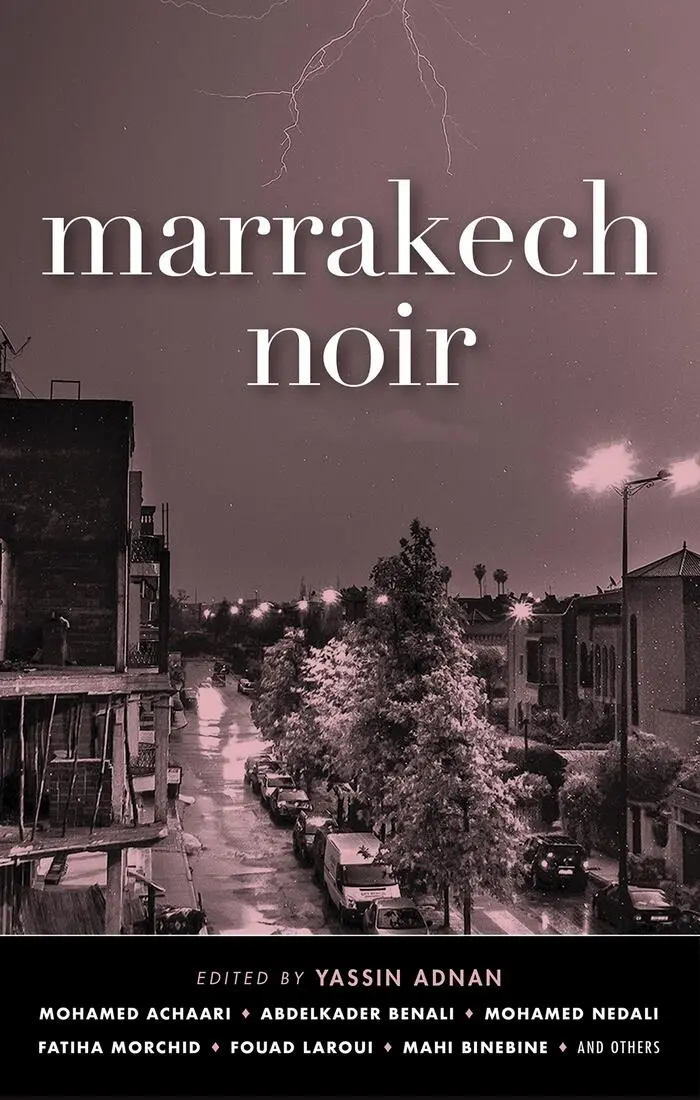
- Название:Marrakech Noir
- Автор:
- Издательство:Akashic Books
- Жанр:
- Год:2018
- Город:New York
- ISBN:978-1-61775-473-9
- Рейтинг книги:5 / 5. Голосов: 1
-
Избранное:Добавить в избранное
- Отзывы:
-
Ваша оценка:
Marrakech Noir: краткое содержание, описание и аннотация
Предлагаем к чтению аннотацию, описание, краткое содержание или предисловие (зависит от того, что написал сам автор книги «Marrakech Noir»). Если вы не нашли необходимую информацию о книге — напишите в комментариях, мы постараемся отыскать её.
Marrakech Noir — читать онлайн бесплатно полную книгу (весь текст) целиком
Ниже представлен текст книги, разбитый по страницам. Система сохранения места последней прочитанной страницы, позволяет с удобством читать онлайн бесплатно книгу «Marrakech Noir», без необходимости каждый раз заново искать на чём Вы остановились. Поставьте закладку, и сможете в любой момент перейти на страницу, на которой закончили чтение.
Интервал:
Закладка:
Once he’d been briefed on his new mission, Chaloula went home to lunch. His plan was to have his squad burst into the cemetery early the next morning; this way, they would surprise the creature in his sleep. But around two o’clock, as he was walking along the cemetery wall on his way back to work, Chaloula doubled over as if he’d been shot. A few people saw and ran to help him, trying to pry his hands from his stomach and wipe away the foam coming out of his mouth as if he were a rabid dog, but their efforts were in vain. His soul had left his body to join the others behind the wall, his bulging eyes fixed on the necropolis.
The mysterious death of Chaloula terrorized the entire neighborhood, not to mention the police chief, who felt his own end approaching. He spent the whole night awake, tossing and turning, horrible images flashing through his mind. He no longer feared for himself but for his children; he was tormented by the thought that some harm would come to them.
The next day, before Chaloula’s burial, the chief brought his entire unit together, including the sentinel, and, like a swarm of bees, they invaded the cemetery. They looked behind every gravestone and up every tree, left no crater unexplored, no bush undisturbed, but it was no use — the monster had vanished.
One by one the chief called us into his office, all of us kids who’d seen the strange creature, and asked us to tell him about it. We all related the same story and described the creature in the same manner. He was able to accept that our monster was more than two meters tall — but that he’d escaped from behind the screen at el-Hilal cinema to go live in the Bab Ghmat Cemetery, or that he was somehow made from the bones we’d collected in the crater, seemed highly improbable to him. And yet, something in him began turning toward a supernatural explanation. He was Moroccan, after all, and he couldn’t shake off what he’d been taught from a young age: that the magical and the rational can and do coexist in our world.
While he was investigating Chaloula’s death, the chief got word that a strange creature had been seen in Bab er-Robb, the cemetery where Imam Abderahim Souhaili, one of the seven saints of the city, is buried. The description of this creature was nearly identical to the one we had given. And so the chief, escorted by two of his most trusted officers, rushed over to Bab er-Robb to arrest Frankenstein’s monster.
This wasn’t an easy affair. The demon resisted, kicking and throwing punches in all directions. He was so agile that, for a moment, the chief thought he might actually have a supernatural being on his hands. But the men were finally able to corner him, get him into the car, and drive him to the Sidi Youssef Ben Ali station.
As it turned out, this so-called monster was only a poor vagabond. A man who’d been so disappointed by the living that he now preferred the company of the dead.
“What’s your name?” the chief asked, his tone forceful.
“I forgot my name and I don’t want to remember it,” the creature replied, staring at an invisible point on the station’s wall.
“Why do you live in cemeteries?”
“No one bothers you in the kingdom of the dead,” the creature said.
The policemen soon learned that the monster survived on plants and the few animals he managed to catch in the necropolis. To him, all animals were good to eat: dogs, cats, birds. When asked why he’d left the Bab Ghmat Cemetery, he replied after a long silence — a silence that clearly irritated his listeners — that the living had come there to disturb the dead, and he didn’t like that. He thought the living should mind their own business.
The chief felt his blood boiling in his veins. He wanted to give this fool a good hard smack for daring to mock them, but managed to restrain himself for fear of losing precious ground in his investigation. “Explain to us what you’ve just said,” he demanded.
A silence fell over the creature again. None of the policemen dared to prod him, for they knew that the man before them was searching for his words, grasping for the power of speech he’d nearly lost after keeping his silence for so long.
Finally he spoke: “A woman and two men came to the cemetery in the middle of the night. Twice. They dug up a dead body and put it back in its rightful place. Then, the next night, they came back to the same grave, and under the full moon they exhumed the body and buried it again.”
His interrogators froze. They were certain that what they’d just heard was true: experience had taught them to read the truth in the faces of witnesses. But they couldn’t see the connection between this story and the death of their colleague.
“Let’s suppose that what you say is true. But what about Inspector Chaloula? You haven’t told us about that yet,” the chief said abruptly, hoping to catch the vagabond by surprise.
“Who’s Inspector Chaloula? I don’t know him, I’ve never even heard of him.”
“Chaloula is the man you killed before you disappeared.”
“I didn’t kill anyone, I’ve never killed anyone, it’s the others who’ve killed me many times over,” the vagabond asserted.
“And the bones that disappeared from the cemetery?”
“I buried them. Those who are in the ground should stay there,” the man added before retreating back into his silence and refusing to answer any more questions.
The chief gave the order to put the poor devil in preventive detention. He called in several other eyewitnesses to the inspector’s death, all of whom claimed that they’d never seen the vagabond, and that Chaloula had been walking alone when he’d suffered his fatal attack.
The results of the autopsy put the chief to a new test; it seemed his colleague had been poisoned.
After he’d briefed the squad, they decided it would be wise to go back and trace Chaloula’s movements on that fateful day. They learned that he’d had breakfast and lunch at home and a black coffee at work. And so they procured some of the coffee beans from his office and sent them to a lab that confirmed they were of good quality and contained no harmful chemicals. Then they called in Chaloula’s wife, who was still in mourning and barely able to respond to the interrogators’ questions. Although they knew her well, they didn’t spare her the discomfort of testifying. She described the meals she’d prepared for her husband that day, which the whole family had eaten. But the chief noticed that each time the word poisoned was spoken, the widow’s face went ashen and her lips trembled uncontrollably. He decided to risk everything and ask his next question with utter conviction.
“Why did you kill your husband?”
Those few words were all it took to make Chaloula’s wife burst into tears. She explained between sobs that an old woman, a charlatan, had sold her a fruit jelly that had spent the night in the mouth of a dead man. It was supposed to make her husband docile, incapable of raising his voice. She could then do with him as she pleased — that was how the old woman had explained it.
They brought in this charlatan who, seeing the widow’s tears, confessed her crime.
It turned out that the dead man in whose mouth the jelly had spent the night was a snake charmer. He’d forgotten to remove the pit viper’s venom gland after capturing it, and as he was putting it into a basket he carried on his back, the serpent took advantage of a moment’s distraction to sink its fangs into the man’s neck.
Translated from French by Katie Shireen Assef
An E-mail from the Sky
by Yassin Adnan
Hay el-Massira
Ashbal al-Atlas Cybercafé: the name is so beautiful — the Atlas Lion Cubs. An extremely successful name. It is true there are no more lions or tigers in the Atlas Mountains near Marrakech, but there are still monkeys. Monkey and boars, as well as some wolves. It’s all right. The name is only a metaphor. A metaphorical name for a virtual space. The café is very spacious, Rahal. Not like the other narrow téléboutiques where you buried dozens of years of your life. Since you obtained your BA in Arabic literature from Cadi Ayyad University in 1994 you have tried, in vain, to join L’Ecole Normale Supérieure for teachers. The results are announced at the beginning of October and your name is never among the successful. And, like a mouse, you retreat to your corner in the téléboutique to eavesdrop on the lives of others from behind your old wooden desk.
Читать дальшеИнтервал:
Закладка:
Похожие книги на «Marrakech Noir»
Представляем Вашему вниманию похожие книги на «Marrakech Noir» списком для выбора. Мы отобрали схожую по названию и смыслу литературу в надежде предоставить читателям больше вариантов отыскать новые, интересные, ещё непрочитанные произведения.





Обсуждение, отзывы о книге «Marrakech Noir» и просто собственные мнения читателей. Оставьте ваши комментарии, напишите, что Вы думаете о произведении, его смысле или главных героях. Укажите что конкретно понравилось, а что нет, и почему Вы так считаете.