Махи Бинбин - Marrakech Noir
Здесь есть возможность читать онлайн «Махи Бинбин - Marrakech Noir» весь текст электронной книги совершенно бесплатно (целиком полную версию без сокращений). В некоторых случаях можно слушать аудио, скачать через торрент в формате fb2 и присутствует краткое содержание. Город: New York, Год выпуска: 2018, ISBN: 2018, Издательство: Akashic Books, Жанр: Детектив, на английском языке. Описание произведения, (предисловие) а так же отзывы посетителей доступны на портале библиотеки ЛибКат.
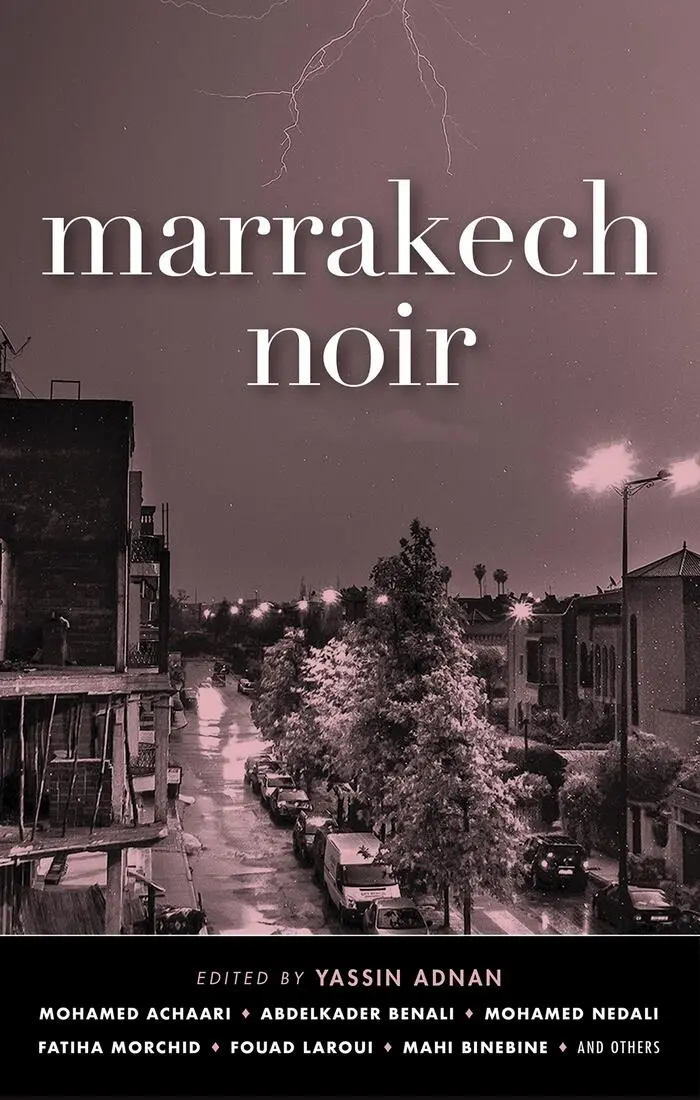
- Название:Marrakech Noir
- Автор:
- Издательство:Akashic Books
- Жанр:
- Год:2018
- Город:New York
- ISBN:978-1-61775-473-9
- Рейтинг книги:5 / 5. Голосов: 1
-
Избранное:Добавить в избранное
- Отзывы:
-
Ваша оценка:
Marrakech Noir: краткое содержание, описание и аннотация
Предлагаем к чтению аннотацию, описание, краткое содержание или предисловие (зависит от того, что написал сам автор книги «Marrakech Noir»). Если вы не нашли необходимую информацию о книге — напишите в комментариях, мы постараемся отыскать её.
Marrakech Noir — читать онлайн бесплатно полную книгу (весь текст) целиком
Ниже представлен текст книги, разбитый по страницам. Система сохранения места последней прочитанной страницы, позволяет с удобством читать онлайн бесплатно книгу «Marrakech Noir», без необходимости каждый раз заново искать на чём Вы остановились. Поставьте закладку, и сможете в любой момент перейти на страницу, на которой закончили чтение.
Интервал:
Закладка:
We would take a detour from el-Rahba el-Kadima alley toward Derb Dabachi in order to cut through Jemaa el-Fnaa. Then we would take Prince Avenue until we reached the Hotel Tazi, then veer left in the direction of Arset el-Maach. We spent our day at the Ibn el-Banna Middle School. When we returned home in the evening, we always paused for a few minutes at the edge of a storytelling circle that had just formed so that we could bring back fresh tales from the square, embellished by our own imaginations, for Mama Aicha. Our accounts of the square made her happy. She listened to us with bright eyes and asked for more. Once we moved from the middle school in Arset el-Maach to the Mohammed V High School in Bab Ghmat, Jemaa el-Fnaa was no longer the only wellspring of stories for us. Other sources erupted between our adolescent feet, their stories drawn from the sufferings of the Moroccan people and from accounts of popular revolutions. Our new stories were only for us and our comrades at the high school, and at the Arset el-Hamd youth center. For this reason, we hid them from our mothers.
Mama Aicha knew nothing of the world around her beyond her husband, Si Mohammed el-Blaighi, her only son, Aziz, my mother, who was her friend and neighbor, and me. Only a single wall separated our two houses, and even if this wall prevented my mother from going over to her friend’s house to drink a cup of tea with her in the shade of the mulberry tree, it did not stop the two young mothers from communicating. As for Mama Aicha, her feet never crossed the threshold of her own front door. She had not left the house since her husband brought her there as a bride from Souss, a girl of only fifteen.
“A graceful posture and a shapely body like none other. God must have been in a state of the highest pleasure with creation when He made it. I’ve never seen such blue eyes and such long eyelashes in all of Marrakech. Her gaze is soft, suited to a world of refinement and happiness. When I looked at her face for the first time, I thought it was the round disk of the sun itself,” my mother had said when she told my grandmother about her.
Si Mohammed was infatuated with her. He feared the least gust of wind might carry her away. When he left the house, he locked the door with an iron key as thick as the arm of a small child. To keep her from suffering from loneliness in his absence, he brought her first a radio and then the seedling of a tree. As he planted it, he told her about the emperor’s wife who discovered a white worm eating the leaves of her mulberry tree, secreting luminous threads in which to wrap itself as it did so. From them, the emperor’s wife wove an enchanted silk fabric fit only for queens: organdy.
The seedling became a tree. She was pregnant, and the movements of the fetus filled her with dreams and love and wonderment. One spring morning she gave birth to Aziz. When they celebrated the aqiqah afterward, joy radiated from Si Mohammed’s eyes as he served food and drink to the well-wishers. He didn’t lock the door when he went back to his shop afterward. He handed over the key to Aicha. She believed that she was finally free. She was happy because her husband had entrusted her with the key to the house.
Despite all of this, she was content with the warm, calm monotony of her small space. Content with hearing our stories about what happened outside. She never thought about going out.
Her days passed happily, her mind filled with thoughts of her son, her husband, and the mulberry tree. There was nothing to trouble her. She watched as Aziz grew up, and her dreams grew with him. He was a diligent student, and his success in school made her heart brim with pleasure.
One winter night there was a windstorm. It snapped branches off the mulberry tree and ripped flowers from their beds. The earth dissolved into muddy pools beneath the downpour of rain. The family members huddled in their beds, trying to sleep.
Aicha heard the rapping of claws on the door and voices like the howling of wolves in the mountains where she’d spent her childhood. She reached out to her husband sleeping beside her and cried out with all her might: “The wolves are coming for us, Sidi Mohammed!”
Si Mohammed slept on and did not hear her strangled cry.
An apparition of her son appeared before her, trembling as he ran. Behind him, a wolf bared its fangs. She awoke terrified and dripping with sweat. Her husband finally opened his eyes and asked: “Who’s knocking on our door in the middle of the night, and in this storm?”
“Don’t answer them!” Aziz shouted, coming into their room dressed in his winter clothes and sneakers.
“Weren’t you sleeping?” his father asked him in surprise.
“The knocking woke me up. Don’t open the door for them, Father, it’s the police.”
“What?”
“It’s the police. They’ve come to take me away,” Aziz moaned.
“But what did you do? What crime did you commit? They don’t show up in the middle of the night like this except to catch the most dangerous criminals. Tell me, son, what crime are you guilty of? When? Where? Answer me, I beg you.” His questions tumbled over one another while his son remained silent. He got out of bed and took him by the hand. “Tell me what happened, child, so I know what I should do.”
“I’ve committed no crime, Father,” Aziz whispered.
“So what did you do?”
“I dreamed, Father. I only dreamed. I dreamed of clean bread, and a new suit of clothes for everyone on Eid, and notebooks and pens for all the children.”
Bewildered, Mama Aicha was blotting at the tears streaming from her eyes with the hem of her nightgown. She tried to speak, but her words were choked. Aziz pressed his palms to her face, brushed away her tears, and kissed her cheek.
The pounding at the door continued, becoming more violent. Aziz loosened her arms from around his neck. “Don’t be afraid, Mother... Don’t be afraid, Father. I won’t let them get me, I’ll run away.”
The door couldn’t hold out long against their powerful fists. It soon gave way. Four men in black suits stomped across the threshold. Their chief led the way. To Mama Aicha, he looked like a wolf baring its fangs.
He bellowed in a voice like thunder: “Where’s Aziz?”
No answer.
He repeated the question.
No answer.
He made a sign to the others behind him. In the blink of an eye, they spread out through the house, throwing wardrobes to the floor. Clothing scattered everywhere. They dug their claws into the furniture, ripping it open and sending the stuffing flying into the air. Aicha’s tears mixed with the rain pouring down into the open courtyard of the house. She asked herself, What can my son Aziz have hidden in the furniture? How could he hide a weapon when a moth’s death makes him cry?
One of the men returned from Aziz’s room. “We found notebooks decorated with a rising sun, and these are the colored pens that were used to draw them.”
His mother returned to asking questions no one heard: “Drawings... since when is this a crime? And colored pens as well?”
The skinny, mean-faced man who seemed to be their leader ordered them to handcuff the father. They would hold him hostage until the fugitive son surrendered himself. They blindfolded him and threw him into a black car that took off like an arrow.
Mama Aicha tried to leave the house, but the agent who had been left behind to watch her blocked her way.
Time passed slowly. A terrible desperation arose in her chest. The seconds seemed like months, and the hands on the clock did not move. Who would hear the sound of her voice? Was there another mother anywhere on this earth afflicted by such a calamity? Who would bring her news of her son? Of her husband?
She sobbed and sobbed. She wandered aimlessly through the house. She pounded on the walls with both hands and shouted. Perhaps her friend Zahra would hear her. She could shout! This was the first positive thing to come from this ordeal. She had discovered that she possessed a mouth that could raise its voice.
Читать дальшеИнтервал:
Закладка:
Похожие книги на «Marrakech Noir»
Представляем Вашему вниманию похожие книги на «Marrakech Noir» списком для выбора. Мы отобрали схожую по названию и смыслу литературу в надежде предоставить читателям больше вариантов отыскать новые, интересные, ещё непрочитанные произведения.










Обсуждение, отзывы о книге «Marrakech Noir» и просто собственные мнения читателей. Оставьте ваши комментарии, напишите, что Вы думаете о произведении, его смысле или главных героях. Укажите что конкретно понравилось, а что нет, и почему Вы так считаете.