Махи Бинбин - Marrakech Noir
Здесь есть возможность читать онлайн «Махи Бинбин - Marrakech Noir» весь текст электронной книги совершенно бесплатно (целиком полную версию без сокращений). В некоторых случаях можно слушать аудио, скачать через торрент в формате fb2 и присутствует краткое содержание. Город: New York, Год выпуска: 2018, ISBN: 2018, Издательство: Akashic Books, Жанр: Детектив, на английском языке. Описание произведения, (предисловие) а так же отзывы посетителей доступны на портале библиотеки ЛибКат.
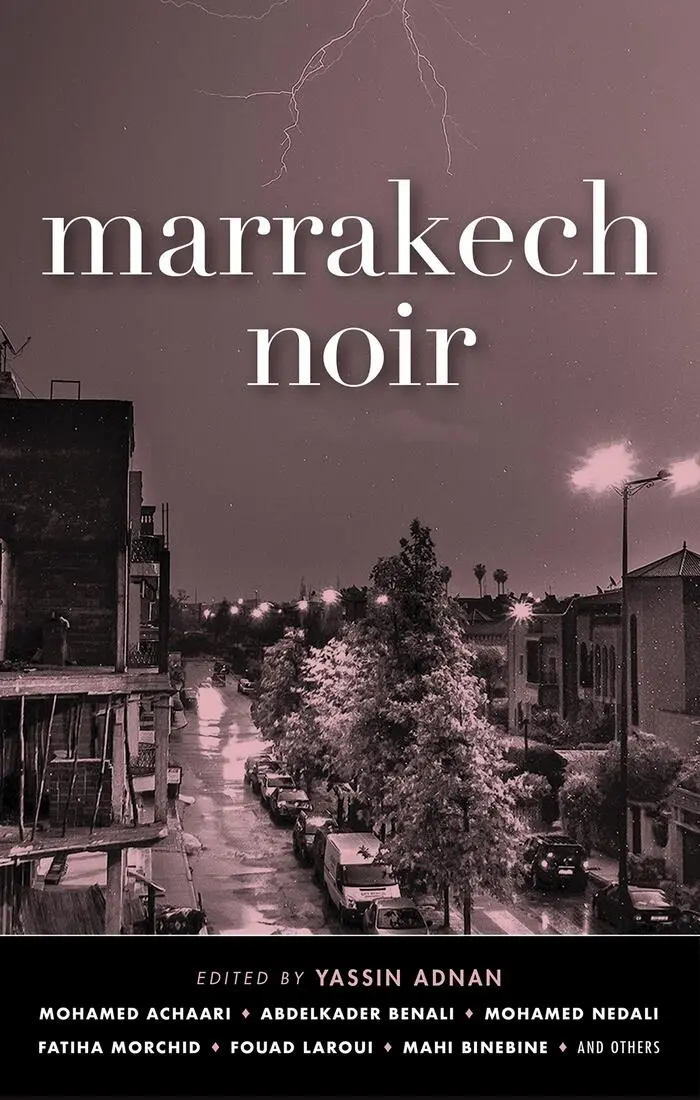
- Название:Marrakech Noir
- Автор:
- Издательство:Akashic Books
- Жанр:
- Год:2018
- Город:New York
- ISBN:978-1-61775-473-9
- Рейтинг книги:5 / 5. Голосов: 1
-
Избранное:Добавить в избранное
- Отзывы:
-
Ваша оценка:
Marrakech Noir: краткое содержание, описание и аннотация
Предлагаем к чтению аннотацию, описание, краткое содержание или предисловие (зависит от того, что написал сам автор книги «Marrakech Noir»). Если вы не нашли необходимую информацию о книге — напишите в комментариях, мы постараемся отыскать её.
Marrakech Noir — читать онлайн бесплатно полную книгу (весь текст) целиком
Ниже представлен текст книги, разбитый по страницам. Система сохранения места последней прочитанной страницы, позволяет с удобством читать онлайн бесплатно книгу «Marrakech Noir», без необходимости каждый раз заново искать на чём Вы остановились. Поставьте закладку, и сможете в любой момент перейти на страницу, на которой закончили чтение.
Интервал:
Закладка:
“But you used to spend school vacations at our house in Marrakech, and the majority of the time you were with her,” I replied.
She looked long and hard at my face, as though trying to find in it remnants of her seventeen-year-old son who had existed once, before he was torn away from the safety of her lap and flung into the dark spaces of a strange country. “That’s right. I couldn’t get used to living here in Casablanca. If the secret police hadn’t made our life miserable after you went abroad, we would never have left our house and relatives and neighbors. Your father wouldn’t have made us move to this noise-infested city.”
The phone continued to ring. I picked it up in one hand while the other kept a grip on the steering wheel. It was Aziz. I pulled over next to the curb. His voice sounded weak but animated, as though he were eager to talk. “Why didn’t you pick up? Were you still asleep? Or is your phone still set to Japanese time?”
“I’m already on the road. I’ll be in Marrakech in three hours,” I told him.
“I’ll be waiting for you at the Argana Café. From there, we’ll go to my mother’s house. We’re having lunch there, as we agreed.”
“I’ll drive as fast as I can so I’m on time for Mama Aicha,” I promised.
“How she cried when you left the country. Your being there by her side during the year before you left lightened the pain of my absence for her.”
How I, too, had cried...
We had promised each other that if either of us were arrested, we would die before we confessed the other’s involvement, so that one of us would remain to take care of our two mothers. Aziz kept his side of the bargain, but I didn’t. He stayed strong and never implicated me, even under torture. I abandoned them both and went abroad.
We were teenagers. My father’s bookshelves had taught me to love literature. Aziz and I would devour the novels that I filched from my father’s library without his permission. Then, at the Arset el-Hamd youth center, we met some other young men our age or a little older who were training themselves to dream — to look ahead to a more just future. They exchanged forbidden Red Books with us. We even joined the leftists in the March 23 movement. It was a secret organization, and we were part of the cell at the high school. There, we began training to dream collectively. This dream had started to grow inside of us when the police raids caught us by surprise.
“You have to leave. You have to give up on your dreams. You have no other choice,” my father had warned me the day he accompanied me to the airport. I’d been aghast. So I would set out alone on a journey into the unknown. A journey without meaning. I endured it as one endures torture. Deep inside me there was a howling, like trapped wolves. I felt like a traitor. I wanted my mother’s hand, wanted her to pass it over my chest, to thaw this cold. I had only this still-bleeding wound to remind me, and the fragrance of a city whose soil I smelled in the color of my own skin. That soil from land reclining upon the foothills of the Atlas Mountains, palm trees held in its embrace. When I was a child, the world as far as I was concerned began and ended there. After I grew up a little, I discovered that Jemaa el-Fnaa Square was the beating heart of the city, and Marrakech was the beating heart of the world. Don’t tourists flock to it from all over the globe, to dance to its songs and sing along under its glittering lights? Don’t they say that Marrakech lavishes a noisy tumult of joy and ecstasy on strangers, while for its sons and daughters it offers only a silent sadness? What is the good humor for which the people of Marrakech are known if not a proud mask concealing the bitterness of their days and the misery of their lives?
Marrakech was slipping away from me. I kept searching in vain for her radiant face in the postcards scattered across my desk and pillow, so that I wouldn’t lose my memory of her, so that I wouldn’t lose the colors of the city, which had begun to fade from my heart and mind. Words flared up inside of me whenever I thought about the organdy, that piece of fine silk cloth I had rushed to buy as a gift for Mama Aicha. The cloth had remained stored away in my cupboard all these years. I’d made a promise to myself and I hadn’t kept it. Marrakech was far away, and the freedom I had dreamed of had gotten tripped up along the way, arriving with its body parts damaged and mutilated.
Aziz and I were born the same year. Mama Aicha had nursed me along with Aziz. We drank the same milk, we studied at the same schools, and we read the same books. Together we dreamed of a cultural revolution that would bring prosperity to our humble families. A revolution that would stay its course until it had granted dignity to all the children of this nation. Mama Aicha’s home was next to ours, at the entrance of el-Rahba el-Kadima alley, only a few steps from Jemaa el-Fnaa. It was a beautiful house, overflowing with life. Pots of chrysanthemums, narcissus, jasmine, and crocus clustered along the walls of its interior courtyard, and basil and lavender spilled from trellises across the tiled floors.
In the middle of the courtyard was a large planter box that held a towering mulberry tree whose branches shaded the entire area. Toward the end of winter, the tree filled with magnificently colored migratory moths whose wings made a rustling sound like the ethereal music of sacred temples. As small children, Aziz and I would watch them for hours on end, and we were tempted to try to catch them so that we could keep listening to the music of their wings in private, while we read or studied our lessons. But Mama Aicha was always there to stop us from getting too close to them.
“These moths are going to lay eggs, and from their eggs hundreds of larvae will come out, and they will make cocoons,” she’d tell us.
Every time she repeated this our jaws would drop in amazement. She would laugh and explain to us each time how the larva was the silkworm and the cocoon was the ball of silk.
We would ask her: “Why won’t you let us play with the balls of silk?”
And every time she would answer: “Because I’m going to turn them into thread, and from this thread I’ll weave a purple cloth called organdy, to make a kaftan so fine that only a princess or a queen would wear one like it.”
“Why?” we’d ask again.
“Because no one in the whole world knows how to make this kind of silk cloth from a worm except a queen in far-off China. Since she’s a queen, she won’t sell her cloth to anyone but other queens, and for a very high price. Though I’m not a queen or a princess, I want to wear it too. I’ve promised myself that one day I’ll have my own kaftan of organdy silk.”
Every year Mama Aicha gathered the cocoons. And every year she told us about the Chinese queen who owned fields of white mulberry trees. In their branches lived millions of moths, and their cocoons became the silk thread used to make the organdy.
The years passed, and Aziz and I were no longer children. Maybe because we ceased to ask her about the organdy kaftan, Mama Aicha whispered to us once with deep sadness: “I have only a single mulberry tree from which a few larvae feed, and it gives me just a little thread each year. How many years will I have to wait? It won’t suit me to wear this kaftan when I’m old.” She was silent for a moment, and then her face brightened again and she went on: “But anyway, I’ll keep taking care of the mulberry tree and my larvae. If I don’t wear the cloth myself, your wife will wear it, Aziz; and yours, Yusuf.”
She continued to sit on the edge of the planter. She drank her midday tea there once she had finished the housework and fed her son and her husband, after the first had gone to school and the other to his shop in Souk Semmarine. She hummed along with whatever was playing on the radio fastened on a hook above the window grate in her bedroom: the songs of Umm Kulthum, Fairuz, Abdelwahab Doukkali, and Naima Samih. She had an angelic voice that poured sweetly from her throat like the breeze in Marrakech at the beginning of spring. Yet no one heard her except the mulberry tree and the birds that came seasonally to hunt the moths or their larvae, and Aziz and I on our days off from school. When the songs on the radio stopped, she would tell us captivating stories about her childhood in her Amazigh village. Stories with which our imaginations would roam to strange and wonderful worlds. When we left her to go study our lessons, she would converse with the mulberry tree instead, talk to it, ask it questions, confess her secrets to it. She told it of her kaftan, which was still not finished. She raised her eyes to the sky, wandering in her thoughts far from the orbit of her domestic space. The sky was closer to her than Jemaa el-Fnaa, which she had never seen. Only its sounds reached her. She listened to them furtively and with a great deal of curiosity, trying to find connections between them and what Aziz and I told her about the square. We were children. We told her about our adventures and our small acts of mischief, about the storytelling circles there, about the singers whose voices were not as fine as Mama Aicha’s, about the fortune-tellers surrounded by sad women, about the famous street performers Bakchich and Tabib el-Hasharat, and the spectacle of the donkey who could read.
Читать дальшеИнтервал:
Закладка:
Похожие книги на «Marrakech Noir»
Представляем Вашему вниманию похожие книги на «Marrakech Noir» списком для выбора. Мы отобрали схожую по названию и смыслу литературу в надежде предоставить читателям больше вариантов отыскать новые, интересные, ещё непрочитанные произведения.






Обсуждение, отзывы о книге «Marrakech Noir» и просто собственные мнения читателей. Оставьте ваши комментарии, напишите, что Вы думаете о произведении, его смысле или главных героях. Укажите что конкретно понравилось, а что нет, и почему Вы так считаете.